

Most couples don’t fight about the big things at night. They fight about nothing, or they barely speak at all, two phones glowing in the dark like a pair of very expensive nightlights. The last hour before sleep has become the most squandered hour in a relationship, a window that genuinely happy couples treat completely differently than the average pair scrolling through whatever algorithm decided they needed to see next.
The research on this is surprisingly clear. A 2026 survey of 2,000 married Americans found that couples who described themselves as “very happy” went to bed together roughly four nights a week, while less-happy couples managed it about once a week. The average couple experiences what researchers called an “80-minute bedtime gap” multiple times per week, one partner disappearing into sleep while the other sits alone in the living room. That gap is not just about sleep. It is a gap in the daily ritual of choosing each other.
What separates genuinely happy couples is not some grand romantic gesture or a subscription to couples therapy. It is a consistent set of small habits they practice in that last hour, habits that are specific, repeatable, and backed by more science than most people expect. Seven of them stand out.
1. They Actually Go to Bed Together

A survey of 2,000 married Americans examined the “bedtime gap” and found that couples go to their shared bed together only about three nights during an average week. Happy couples close that gap deliberately.
58 percent of respondents said they felt closer to their spouse when going to bed at the same time, and a similar 59 percent believed sharing a bedtime was important for increasing intimacy. Those numbers hold even when couples engage in different activities once they’re actually in bed. Research from Secret Life of Mom notes that shared bedtime routines consistently rank among the habits couples associate with greater closeness.
Sleep scientist Wendy Troxel’s research on couples and sleep found that couples who were asleep or awake at the same times were more satisfied in their relationships, while mismatched pairs showed lower relationship satisfaction and more conflict. The practical catch is that many couples have genuinely mismatched sleep rhythms. One person is nodding off at 9:30 p.m. while the other is just getting their second wind. Happy couples find a workaround: the early sleeper heads to bed, the night owl joins them, they talk or touch for twenty minutes, and then the night owl gets up and finishes their evening. The bed becomes the meeting point rather than the finish line. It sounds like a small logistical shift, but it changes the emotional math of the whole evening.
2. They Put Their Phones in Another Room
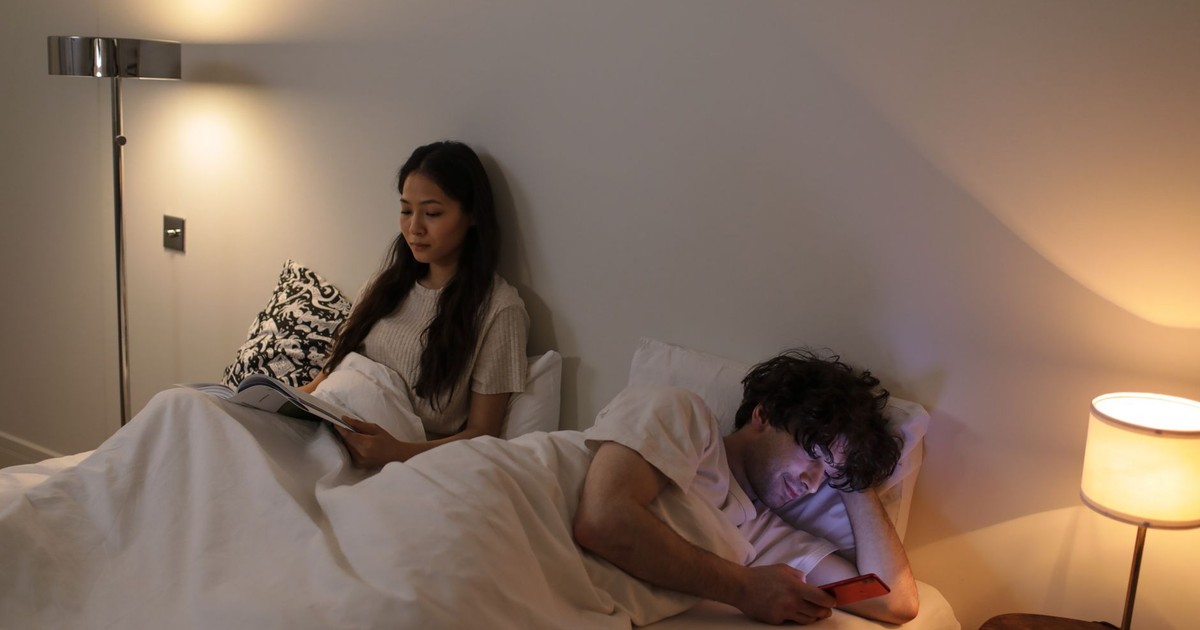
Not on silent. Not face-down on the nightstand. In another room. When couples set aside their devices and focus on quality time together, oxytocin levels rise – and that biochemical shift has real effects on how connected partners feel. The phone is not a neutral object in the bedroom. It is a competing relationship, one that never demands anything difficult and always delivers a small hit of novelty, which makes it a remarkably effective distraction from the person lying six inches away.
Two people scrolling next to each other are physically together and functionally alone. They are not decompressing together, not making each other laugh, not landing on the kind of random conversation that makes a relationship feel alive. They are each being fed an entirely separate stream of content, which means they end the night having shared nothing.
Happy couples treat the bedroom as a phone-free zone not out of some wellness-brand principle but because they have noticed, concretely, that their conversations are better when the phones are gone. The bar is low and the payoff is real.
3. They Have a Decompression Ritual That Belongs to Just Them

Not every couple does the same thing here. For some, it is ten minutes of reading in companionable silence before one of them starts talking. For others it is a specific tea, a particular show they watch together without phones, or a brief walk around the block after dinner that migrates into a longer conversation than either of them expected. The ritual matters less than the fact that it is theirs, repeatable, and signals to both partners that the day is over and this time belongs to the two of them.
These rituals help both people downshift from the high-alert state that most adults operate in for most of the day. Cortisol, the stress hormone that keeps you scanning for problems, does not just switch off because you walked through the front door. A consistent evening ritual gives the nervous system a cue that it can actually stop now. When that ritual is shared with a partner, it becomes a closing ceremony for the day that both people experience together, which creates a sense of synchrony that purely solo wind-down routines never produce.
4. They Express Gratitude Out Loud

Not “thanks for doing the dishes” delivered at speed while someone stares at the fridge. Something more deliberate than that: naming one specific thing the other person did or said that day that they noticed and appreciated. It does not need to be long. It does need to be genuine and specific.
A five-week field experiment with daily data from couples found that a brief behavioral technique to increase everyday expressed gratitude led to couples spending more time co-present in everyday life. The effect was mediated by the change in expressed gratitude itself, not by any other factor.
Research from CommonSpirit Health describes oxytocin as self-perpetuating — the body’s way of rewarding social connection while also making people more capable of forming and sustaining those connections. Physical expressions of appreciation trigger this cycle, and happy couples engage in them consistently enough that it stops feeling like an exercise and becomes just how they close the day.
5. They Touch Each Other

An enormous number of couples go to bed without any meaningful physical contact – a quick peck on autopilot, then each person rolling to their own side. Happy couples treat the last hour as a time for physical closeness that has nothing to do with performance and everything to do with proximity. A hand on a shoulder. Lying close for a few minutes before shifting to comfortable sleeping positions. A longer hold than the situation technically requires.
Research from Dignity Health suggests that being touched can lower your heart rate and blood pressure, lessen depression and anxiety, boost your immune system, and even relieve pain. These effects are not dependent on the intensity of the touch. Gentle, sustained contact produces them just as effectively as anything more dramatic.
The reason this habit matters so specifically at night is that it becomes the last physical impression of the day. The body has a long memory for how it was treated before sleep. Couples who end most nights in some form of physical closeness are telling each other, without words, something important about how they are regarded. That message accumulates across months and years in ways that are hard to reverse once the habit of distance has taken hold. If you want to explore what your sleep positions reveal about your relationship, Secret Life of Mom covers the research in more detail than you might expect.
6. They Talk About Something That Actually Matters

Not logistics. Not tomorrow’s schedule or the thing one of them forgot to do. Happy couples use the last part of the evening for a different category of conversation – something they noticed, something they are thinking about, something they are looking forward to, something small that happened that they want to share with this particular person and no one else.
The difference between a couple who has been together for fifteen years and still enjoys each other’s company versus one who lives in logistical parallel is often this: the first couple maintained the habit of genuine curiosity about each other’s inner life, and the second couple replaced it with task management somewhere along the way. Five or ten minutes of actual conversation, not about the children’s school or the renovation estimate, but about something real to one of them. You cannot feel known if you only ever discuss the schedule.
7. They Go to Sleep Without Unresolved Hostility

This is not the same as “never go to bed angry,” which is advice that mostly produces couples who stay up until 2 a.m. exhausted and saying things they will regret. Happy couples are not necessarily conflict-free. They fight. They have recurring arguments about the same things that couples have been arguing about since people started sharing a bed. What they do differently is arrive at a minimum threshold of repair before sleep: enough acknowledgment that both people feel heard, enough warmth to close the distance, even if the actual issue is not resolved.
The practical move here is specific. It is not a speech and it is not a formal apology when one is not warranted. It is a brief moment of reconnection – a hand offered, a “we’ll figure this out tomorrow,” a return to something genuinely affectionate even in the middle of an ongoing disagreement. Happy couples understand, often intuitively, that going to sleep hostile poisons the morning and makes the next conversation harder to start. They have learned that the relationship is more important than being right tonight, which is not the same as surrendering. It is just accounting for how emotional memory works across a night of sleep.
The habits that keep the spark alive in long-term relationships are rarely dramatic. They are almost always variations on these small, deliberate choices made in the last hour before sleep.
The Last Hour Is the Real One
A relationship can run on pure logistics for a surprisingly long time – two people occupying the same house, sharing the same calendar, splitting the same bills, moving in parallel without ever quite meeting. The last hour before sleep is where you find out whether the actual relationship is still happening underneath all of that.
None of the seven habits listed here require money, a specific personality type, or a relationship that is already working beautifully. They require attention and a small amount of intention directed at the person in your bed rather than at everything else. The couples who do this consistently are not necessarily the ones who started with the most chemistry or the most compatible temperaments. They are the ones who kept choosing the last hour as something worth protecting. Not every night, because that is not how real life works. Enough nights that it became who they are together.
Disclaimer: This information is not intended to be a substitute for professional medical advice, diagnosis, or treatment and is for information only. Always seek the advice of your physician or another qualified health provider with any questions about your medical condition and/or current medication. Do not disregard professional medical advice or delay seeking advice or treatment because of something you have read here.
AI Disclaimer: This article was created with the assistance of AI tools and reviewed by a human editor.