

Optical illusions have fascinated scientists, psychologists, and artists for centuries because they reveal one simple truth about human perception: seeing is not the same as understanding. Your eyes gather information, but your brain decides what it means. This gap between reality and interpretation is where illusions live. They expose the shortcuts and assumptions your brain relies on to make sense of a world filled with constant visual input.
How the Eyes Capture and Send Information
The human eye is not a camera that passively records images. It’s a biological sensor that constantly adapts, filters, and adjusts. Light enters through the cornea, passes through the pupil, and is focused by the lens onto the retina at the back of the eye. The retina is lined with millions of photoreceptor cells known as rods and cones. Rods detect light intensity and motion, while cones handle color and detail.
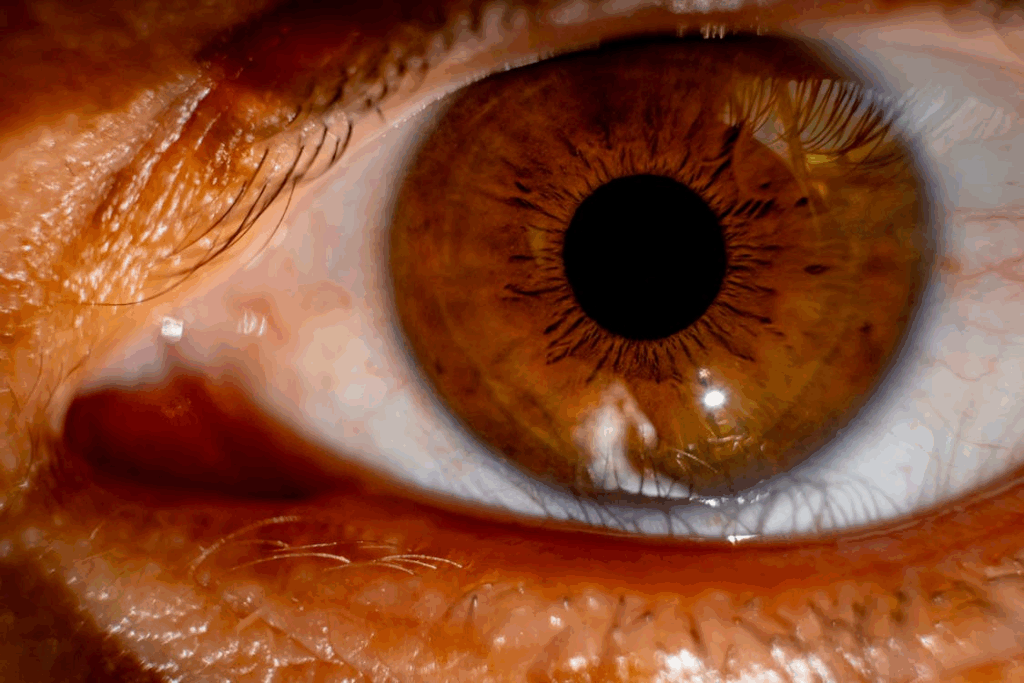
Image credit: Pexels.
These receptors convert light into electrical signals that travel through the optic nerve to the brain’s visual cortex. The brain then reconstructs these signals into what we perceive as an image. However, the brain is not processing every detail. It fills in gaps, corrects inconsistencies, and uses past experiences to predict what you should be seeing. This predictive system works fast and efficiently, but it’s also why illusions can fool you so easily.
How the Brain Processes What You See
The brain doesn’t interpret everything your eyes send at once. It processes visual data through layers of interpretation. The primary visual cortex (V1) handles basic shapes, lines, and edges. From there, information moves through different pathways that specialize in color, motion, and spatial awareness.
The brain relies on context to interpret what’s in front of you. It uses shadows to guess distance, patterns to infer shape, and prior experience to fill in missing information. When something defies expectation, such as an illusion, the brain still tries to create meaning, even if it’s wrong. This process is called perceptual inference. It’s a feature of human cognition that makes perception fast, but not always accurate.
The Science Behind Optical Illusions
Optical illusions exploit how our brain interprets contrast, light, and geometry. Some rely on “lateral inhibition,” a visual process where certain cells in the retina suppress neighboring ones, increasing contrast and creating false boundaries. Others rely on Gestalt principles, a psychological framework that explains how we naturally group objects into patterns and wholes rather than seeing them as separate pieces.

For instance, when you see a dotted outline forming a triangle, your brain fills in the missing lines even though none exist. This is called the Kanizsa triangle illusion. Similarly, color and motion illusions exploit how your brain adapts to constant stimuli, causing stationary images to appear to move. These effects highlight how perception is constructed by the brain rather than simply received from the eyes.
A Brief History of Optical Illusions
The study of optical illusions dates back to ancient Greece, where philosophers noticed that lines and angles could appear distorted depending on their arrangement. Greek architect and sculptor Phidias used such tricks in temples like the Parthenon, adjusting column angles so they appeared perfectly straight to the human eye.
During the 19th century, scientists like Hermann von Helmholtz and Ewald Hering began studying the mechanisms behind these effects. Their research laid the foundation for modern visual psychology. Later, artists such as M.C. Escher took illusions beyond science and into art, exploring impossible geometries and infinite loops that defied logic yet felt strangely believable.

By the 20th century, optical illusions became tools for understanding brain function. Neuroscientists used them to study how perception, memory, and expectation influence what we see. Today, illusions are used in medical imaging, virtual reality, and even robotics, helping engineers understand how to design systems that interpret visual information like humans do.
The Dog Illusion: A Modern Vision Test
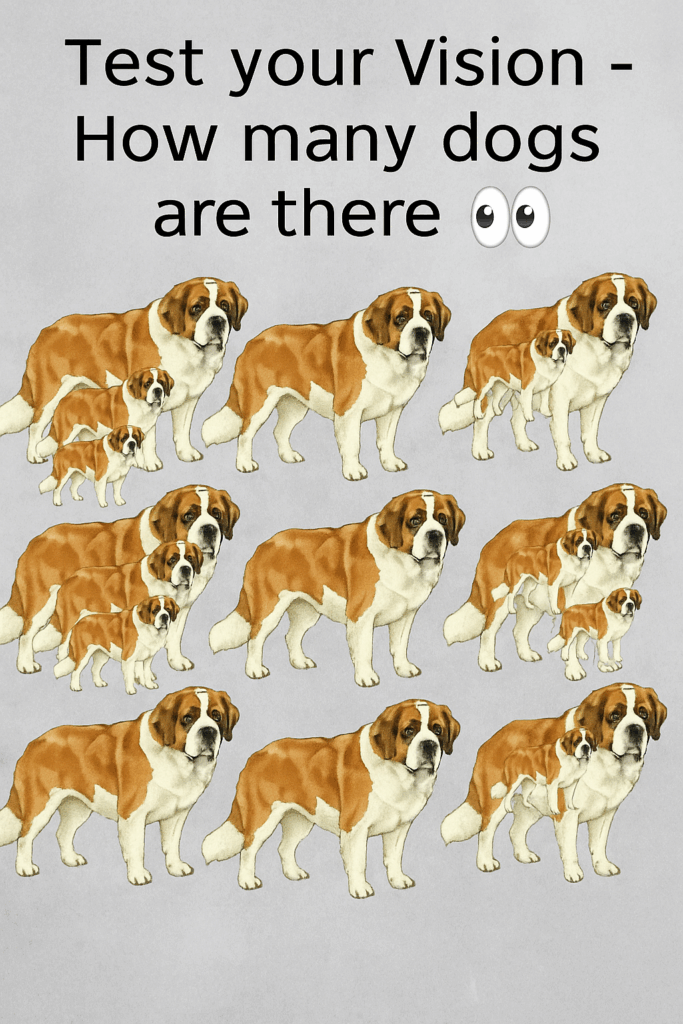
Image credit: Generated.
Take a look at the image of multiple Saint Bernard dogs arranged together. At first glance, you may count eight or nine. But if you slow down and look closely, you’ll realize there are far more than that. This is one of those puzzles that seem simple but quickly becomes tricky once your brain starts grouping similar shapes.
Each large dog overlaps smaller ones that blend into the fur pattern. The eye tends to merge similar colors and lines, making smaller dogs disappear within the contours of larger ones. Your brain’s pattern recognition instinct wants to simplify the image rather than analyze every detail. This shortcut usually helps in daily life, but in this case, it hides information.
To find all the dogs, start by focusing on negative space—the gaps between legs, tails, and faces. Look for smaller outlines nested inside bigger ones. The key is to override your brain’s instinct to treat repeating shapes as duplicates. Instead, treat each outline as unique. When you carefully inspect each overlap, you’ll find 17 dogs in total.
This exercise reveals how strongly the brain depends on efficiency. It prefers the easiest interpretation, even when it’s incomplete. Training yourself to look beyond that automatic assumption is what makes puzzles like this engaging. They give you a small glimpse into how perception can be both brilliant and biased.
Why Your Brain Misses What’s in Front of You
Your visual system evolved to handle speed, not perfection. It processes millions of signals per second, yet it focuses only on what’s most relevant for survival or attention. This means it filters out repetitive or predictable information. When an image contains patterns or repetition, the brain assumes redundancy and tunes it out. That’s why you miss the extra dogs—the brain assumes it already knows what’s there.

This tendency is linked to what psychologists call “change blindness,” the phenomenon where you fail to notice differences between similar images. Even large changes can go unseen when they occur within familiar patterns. The dog illusion uses this exact weakness by repeating shapes that trigger your brain’s predictive filter.
Learning to notice what you normally overlook improves not just visual perception, but critical thinking. The same mental shortcuts that hide dogs in an image also affect how you interpret events, conversations, or even assumptions about people. Optical illusions, in a way, train you to question first impressions.
Why We Enjoy Being Fooled
There’s something strangely satisfying about realizing you were wrong. When an illusion clicks into place, your brain experiences a brief jolt of cognitive conflict. It recognizes a mismatch between what you saw and what’s real, and then quickly reinterprets it. This process activates brain regions related to surprise and curiosity, which release dopamine. That’s why illusions feel rewarding—they trigger the same pleasure system as solving puzzles or discovering patterns.
This reaction also explains why illusions spread so widely online. People enjoy testing their perception against others and comparing interpretations. The mix of competition, curiosity, and discovery creates a social experience around what is, at its core, a neurological phenomenon.
Optical Illusions in Modern Psychology
In research, optical illusions are used to understand how the brain constructs reality. Functional MRI scans show that different illusions activate different parts of the visual cortex, revealing how color, shape, and motion are processed. Some illusions even help doctors diagnose brain disorders by identifying where visual processing breaks down.

For example, patients with damage to the occipital lobe may struggle with illusions that rely on spatial processing. Studying how they perceive these images helps scientists map which brain regions are responsible for different types of interpretation. Illusions have also influenced artificial intelligence research, particularly in training computer vision systems to handle ambiguity the way humans do.
Three Other Classic Optical Illusions
1. The Vase or Faces Illusion

This illusion, known as Rubin’s Vase, plays with figure-ground perception. You can either see a white vase in the center or two black profiles facing each other, but not both at once. The brain can’t process both interpretations simultaneously because it must decide which part of the image is the figure and which is the background.
2. The Checker Shadow Illusion
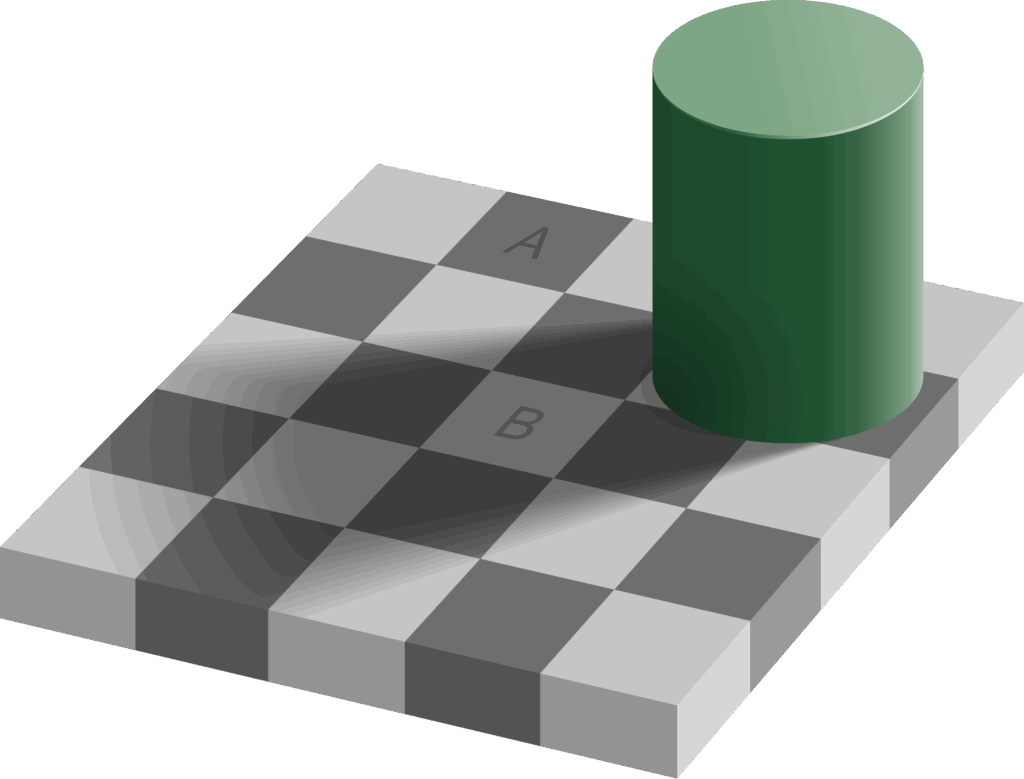
Created by MIT professor Edward Adelson, this illusion shows a checkerboard where two squares appear to be different shades, but they are identical. The surrounding shadow tricks your brain into compensating for lighting. This demonstrates how the brain uses contextual cues to judge brightness, often leading to inaccurate results. In this image, both squares A and B are the same exact color, even though your brain won’t see it that way at first.
3. The Müller-Lyer Illusion
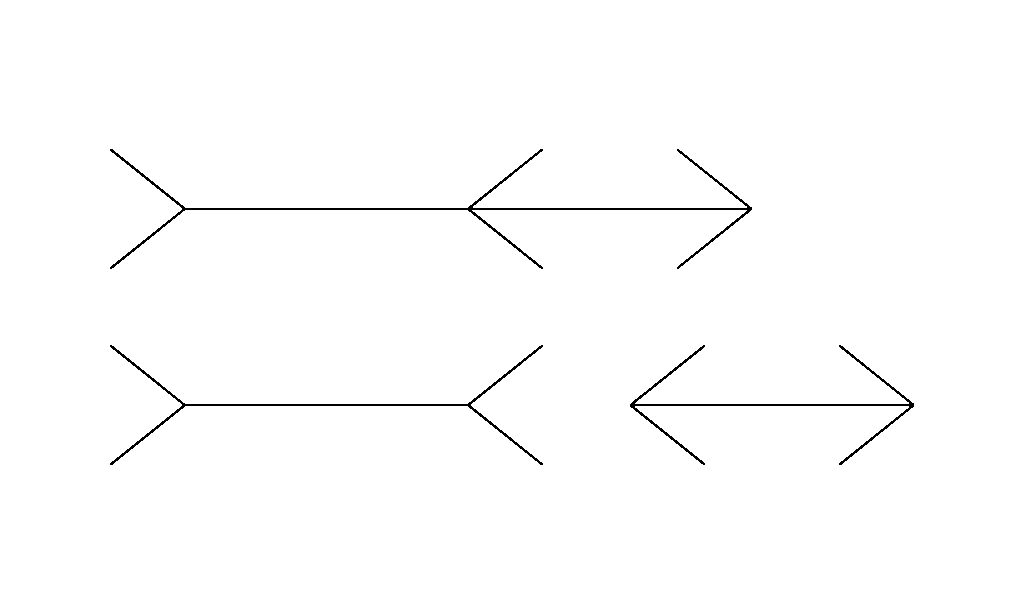
In this illusion, two lines of equal length appear different because of arrow-like fins at their ends. When the arrows point inward, the line looks shorter; when they point outward, it looks longer. This happens because your brain interprets the shapes as cues for depth, as if one line is farther away. Both lines between the arrows are the same exact length.
Why the Brain Can’t Be Tricked Repeatedly by the Same Illusion
Once your brain understands how an illusion works, the effect weakens or disappears. That’s because perception is not a fixed recording—it’s a flexible system built on prediction and learning. When you first encounter an illusion, your brain relies on familiar shortcuts to interpret what it sees. Once those shortcuts are exposed as wrong, your brain adapts, rewires the prediction, and stops being fooled by the same visual trap.
This adaptability explains why illusions work so well the first time, yet lose their power once you know the trick. It’s not that your vision has improved—it’s that your brain has updated its model of reality.
The Brain’s Predictive System
Human perception depends heavily on prediction. Every moment, the brain takes in raw data from the senses, compares it to past experiences, and predicts what’s most likely happening in the world around you. This predictive coding system saves time and energy, letting you respond quickly to threats, movement, or familiar patterns.
When you look at an optical illusion, your brain’s predictions conflict with what your eyes actually see. The brain fills in missing details or adjusts for lighting and depth based on assumptions formed through years of experience. In most situations, these assumptions help you navigate reality efficiently. But in the context of an illusion, they backfire.

Image credit: Shutterstock.
Once the error becomes clear, the brain stores that new information. It adjusts the prediction model so that when you see the same image again, it recognizes the deception and interprets it differently. In essence, your brain learns the illusion’s language and rewrites the code that made it effective in the first place.
The Learning Loop of Perception
Perception is a feedback loop between sensory input and mental expectation. Every visual experience reinforces or revises the brain’s interpretation of the world. When an illusion exposes a flaw in that system, the brain takes it as a learning opportunity. Neural pathways involved in error detection and pattern recognition activate, signaling that the interpretation doesn’t match reality.
Functional MRI studies have shown that after someone understands an illusion, the brain activity in visual processing areas decreases the next time they see it. The response becomes more efficient, and the sense of confusion or surprise fades. This process mirrors how you learn to read a word correctly after mispronouncing it or recognize a song after hearing only a few notes. Familiarity removes ambiguity.
This phenomenon also demonstrates neuroplasticity, the brain’s ability to reorganize and adapt. Even at a subconscious level, the brain is constantly updating how it handles information, ensuring that the same error doesn’t happen again.

Why First Impressions Fool Us
The first time you see an illusion, your brain has no reason to question its assumptions. It applies the same rules it uses in everyday life: light comes from above, objects farther away look smaller, parallel lines converge in the distance. These rules work well for interpreting three-dimensional space, but illusions are designed to exploit them in two-dimensional images.
When the illusion breaks those rules—like making two identical colors appear different or creating false depth—the brain’s first impression wins temporarily. The visual system commits to an interpretation that feels logical, even when it’s wrong. Once you understand the trick, though, that first impression loses credibility. Your brain stops relying on the faulty rule in that context.
This is why seeing the same illusion again doesn’t feel surprising. You already know where the deception lies. Your attention shifts from confusion to analysis. The image becomes something to study rather than something to solve.
The Role of Attention and Expectation
Attention plays a huge role in whether an illusion works. When you focus on an image without knowing what to expect, your attention follows visual cues automatically. These cues—contrast, color, motion—guide your perception without conscious control. But once you know how the illusion operates, your attention changes direction. You no longer follow the visual trap; you look at it strategically.
For example, the checker shadow illusion makes two identical squares look like different shades because of the surrounding shadow. Once you understand the context, your attention focuses on comparing the colors directly rather than interpreting the scene as a three-dimensional space. The illusion collapses, and the squares appear identical.

Expectation influences this process even further. If you expect to be tricked, you become skeptical of the image and pay attention to inconsistencies. That mindset alone reduces the illusion’s power. The brain becomes an investigator instead of a participant, and that shift changes how visual information is processed.
What Optical Illusions Teach About Perception
Optical illusions reveal that perception is not objective. The brain is constantly constructing reality from incomplete information, guided by experience, context, and prediction. Every illusion exposes a gap between sensory input and interpretation, reminding us how much of “seeing” is actually thinking.
In the dog illusion, your brain’s habit of pattern simplification hides details that are literally in front of your eyes. By learning to slow down and question what you assume, you strengthen observational accuracy—a skill useful far beyond visual puzzles.
Illusions make us humble about perception. They remind us that confidence in what we see doesn’t equal correctness. Every image that fools us is proof of how the brain trades accuracy for speed, efficiency, and familiarity. In that tradeoff lies both the beauty and the limit of human vision.
Read More:
Disclaimer: This article was written by the author with the assistance of AI and reviewed by an editor for accuracy and clarity.