
What seemed like an image of a family enjoying a day at the beach quickly riled up internet users as a mysterious, odd shape was caught in frame. The hidden detail in the family photo, taken on a Melbourne beach, shows what could be a shark fin gliding on shallow water. The picture, which was taken and shared on Facebook, divided social media users as to what the hidden detail could be. The image shows a man and his young child standing, pointing towards the camera, and in between them, a dark protrusion can be seen emerging from the water.
On the left of the mysterious fin-like protrusion stand two men, a boy, and a dog, demonstrating that the fin could originate from a small marine creature. However, local authorities struggled to identify the mysterious creature and turned to experts and social media for any clues as to what the mysterious shape could be.
Father Captures Unexpected Detail in Background
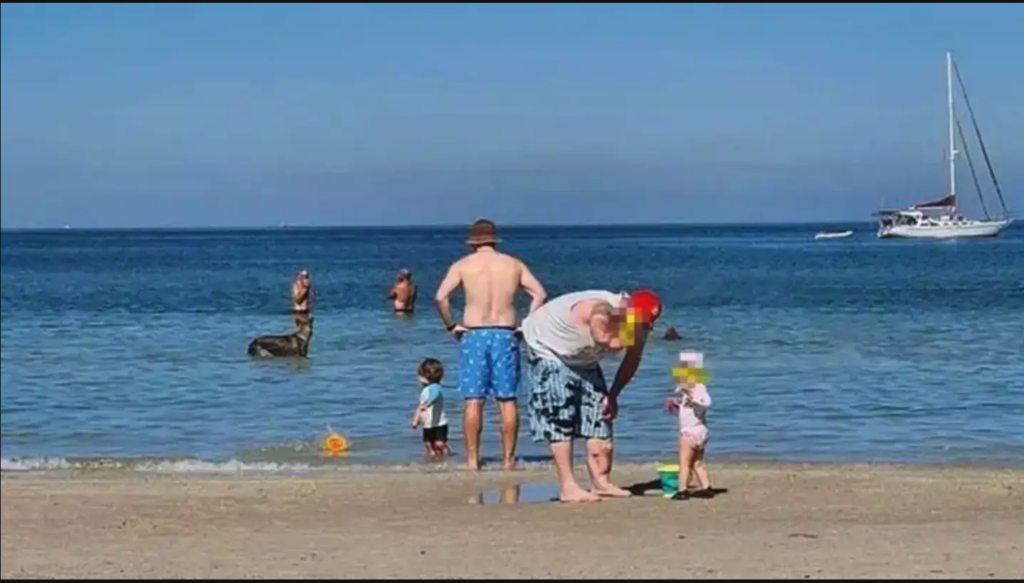
A family set out on a trip to Carrum Beach, taking their toddler for their first beach visit. Wanting to document the toddler’s first beach experience, the family snapped several photos throughout their visit. Nobody noticed anything unusual at the time and the family left the beach after their day was over.
Later that evening, upon reviewing the images, the father noticed something alarming in one of the photographs. He discovered a dark fin-shaped object in the background of an image he had captured. The shocking discovery motivated the family to post it on Facebook where it went viral, with users debating on what the shape could be.
Chelsea SES Reports Unconfirmed Shark Sighting
The Chelsea State Emergency Service posted about a shark sighting on the same day as the family took the picture. The report came from Chelsea Beach, located near Carrum Beach who advised community members to stay vigilant for sharks. “We posted about a shark sighting, just off the beach, between Bonbeach and Chelsea. Well later, we received a message from a family, who follow our page, who were at Carrum Beach earlier in the morning,” they explained.
The family had been following the Chelsea SES Facebook page regularly and recalled the shark warning announced earlier that day. The timing seemed too coincidental to ignore so the father decided to contact the Chelsea SES about their photograph. “Now I have to admit, when I saw the pictures, I wasn’t sure what they were, so I have contacted a number of places to ask their opinions, and they all agree that although they can’t confirm it’s a shark, they can’t say that it’s not,” the Chelsea SES posted on their Facebook.
Chelsea SES received the messages and images from the family and examined them closely with officials contacting multiple experts to identify the mysterious shape. Unfortunately, nobody could identify the shape in the image.
Experts Cannot Confirm Species from Photo Quality
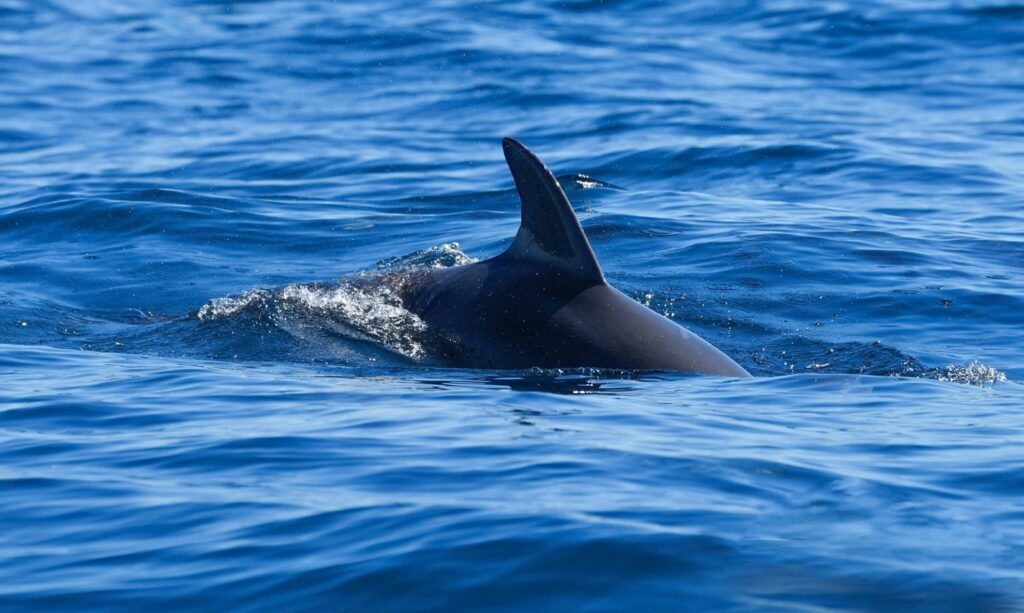
After reviewing the images and sending it to experts, the Chelsea SES shared the photo on their Facebook in hopes the public would have some answers. The post quickly gained attention, and local residents began commenting and sharing their theories. Professor Charlie Huveneers leads the Southern Shark Ecology Group’s research team. He examined the photograph at the request of the authorities. He stated, “The quality of the photo does not allow me to confirm the species, but based on the shape, it does not seem like a shark dorsal fin and is more likely to be the wing of a Southern Eagle Ray, which are often found in shallow areas and along beaches.” Southern Eagle Rays frequently visit shallow coastal waters around Melbourne beaches. The wing of a Southern Eagle Ray can resemble a shark fin.
Southern Eagle Rays are common in Port Phillip Bay
Southern Eagle Rays inhabit temperate waters across southern Australia and New Zealand. The species ranges from Moreton Bay in Queensland to Jurien Bay in Western Australia. These large rays prefer rocky reefs, sandflats, and shallow seagrass embayments. They often feed in estuaries and harbors at depths above 50 meters.
The rays can grow quite large, reaching a total length of 3 meters. Adults weigh more than 50 kilograms when fully mature. They display brownish, grey, olive-green, or yellowish coloring on their upper surface. Grey-blue spots and bars create variable patterns across their bodies.
Southern Eagle Rays feed on bivalve molluscs, polychaete worms, and crustaceans. They prefer shallow water near beaches and shoals for hunting. The species can cover itself with sand for camouflage. This bottom-dwelling behavior helps them avoid predators and ambush prey.
Community Divides Over Shark Versus Ray Identification
Nearly 100 local residents commented on the Chelsea SES Facebook post with diverse comments as to what the shape could be. Some insisted the shape appeared too shallow for a shark while others argued the fin looked exactly like a shark. One commenter on Facebook questioned whether dolphins or stingrays might explain the sighting, adding, “It’s not a dolphin or a sting ray? They come fairly close to the shore. Jesus though… not keen to take the whippet for a swim now.”
Both species regularly approach Melbourne’s southeastern beaches quite closely. Chelsea Beach and the surrounding areas host dolphins, especially during cooler months. The Burrunan dolphin population calls Port Phillip Bay home year-round.
However, some commenters stated on Facebook that it“looks like a small shark, so maybe that’s why no one was attacked,” with another commenter agreeing, stating it “couldn’t be a very big one, given the size of the dog and the depth of the water.” Sharks cruising in shallow water typically remain visible to beachgoers. This behavior suggested the creature posed no immediate threat.
Victorian Fisheries Authority Reviews Photographic Evidence
The Victorian Fisheries Authority serves as the lead agency for shark hazard management, working closely with the Victorian Police and Life Saving Victoria. They coordinate responses to shark sightings across the state’s beaches. Life Saving Victoria also examined the image and agreedthat the photograph lacked sufficient clarity for definitive identification.
The VFA emphasized that the summer seasons usually have an increase in shark sightings naturally. During the summer seasons, more people will visit the beach, leading to heightened beach activity. This subsequently leads to more reported shark sightings overall. However, many reports turn out to be dolphins, rays, or even floating debris.
Shark Attacks Remain Extremely Rare in Victorian Waters
Victoria has recorded only 13 fatal shark attacks since 1849. The state has experienced no shark-related fatalities for over 35 years. Port Phillip Bay specifically maintains an excellent safety record. Shark attacks in Victorian waters remain uncommon compared to other Australian states.
New South Wales recorded the highest number of shark attacks between 1990 and 1999. That state experienced 73 attacks during the decade. Queensland saw 43 total attacks during the same period. Victoria recorded only 12 attacks throughout those 10 years.
Bronze Whaler sharks inhabit Port Phillip Bay throughout the year. These sharks use the bay’s warm waters as a birthing ground. The species grows up to 3.5 meters long and weighs 300 kilograms. Bronze Whalers feed on schooling fish like salmon and squid.
The sharks are not considered aggressive toward humans. They rarely feature in attack incidents across Australia. Spearfishers carrying fresh catches face the highest risk from Bronze Whalers. Surfers should also exercise reasonable caution when these sharks appear near shore.
Read More: Spotting a Purple Flag on the Beach? Here’s What You Need to Know
Safety Protocols for Melbourne Beach Visitors
Life Saving Victoria recommends several safety measures for beachgoers. Swimmers should always enter the water at patrolled beaches. The red and yellow flags indicate supervised swimming areas. Lifeguards monitor these zones throughout their patrol hours.
Beachgoers should never swim alone at any Victorian beach. Swimming with a friend provides assistance during emergencies. Children under 5 years old require constant supervision within arm’s reach. Children aged ten and younger should remain in direct line of sight.
Anyone spotting a shark should exit the water immediately and calmly. Swimmers at patrolled beaches should notify lifesavers about the sighting. People at unpatrolled locations should call triple-zero without delay. Authorities can coordinate appropriate responses to protect other beachgoers.
The Chelsea SES thanked the family for reporting their photographic discovery. The organization acknowledged the genuine concern behind the family’s message. They encouraged other beachgoers to remain watchful but not fearful. Marine life sharing coastal waters represents a natural part of beach environments.
Read More: Seaside Town Enraged After Nudists Flood Their Beaches