

Scroll past this photo quickly, and you might assume someone posted it last week. The swimwear looks current. The high-cut bikini bottoms rise above the hip in a silhouette that fills Instagram feeds every summer, and the man wears dark swim briefs like the kind you see on European beaches today. Even the warm, faded tones feel familiar, like a vintage filter applied to a modern snapshot.
But the photo is from Odessa in 1989. That’s Ukraine when it was still part of the Soviet Union, two years before the whole system collapsed. The people in this image had no idea they were standing in shallow water at the edge of history. They were just enjoying summer, wearing exactly what everyone else wore to the beach that year.
You can’t immediately tell, which is why the photo goes viral every time it resurfaces. People share it with captions like “this could be today” and “fashion really does repeat itself.” And it raises the obvious question: How did we end up right back where we started?
When the Bikini Was Still Scandalous
The modern swimsuit emerged from scandal and a bit of showmanship. Louis Réard was an automotive engineer who had taken over his mother’s lingerie business in Paris, and he’d noticed something on the beaches of Saint-Tropez. Women kept rolling up the edges of their swimsuits to get better tans. He decided to give them what they clearly wanted.
On July 5, 1946, Réard debuted his design at Piscine Molitor, a popular public pool in Paris. He named it the bikini after Bikini Atoll, where the United States had tested a nuclear weapon just days before. The connection was intentional because Réard expected an explosion of his own.
He got one. The Vatican declared the swimsuit sinful. Italy, Spain, Portugal, Belgium, and Australia banned it from public beaches. The design was so scandalous that Réard couldn’t find a professional model willing to wear it. So he hired Micheline Bernardini, a nude dancer from the Casino de Paris who had no qualms about appearing nearly bare in public. She received 50,000 fan letters.
When Brigitte Bardot showed up at the 1953 Cannes Film Festival and let photographers capture her in a bikini on every beach in the south of France. She turned what had been indecent into aspirational. European women followed her lead, and by the mid-1950s, the bikini had become acceptable across much of the continent. American women, meanwhile, still reached for one-pieces that covered everything from shoulder to thigh.
American One-Pieces Were Engineering Projects
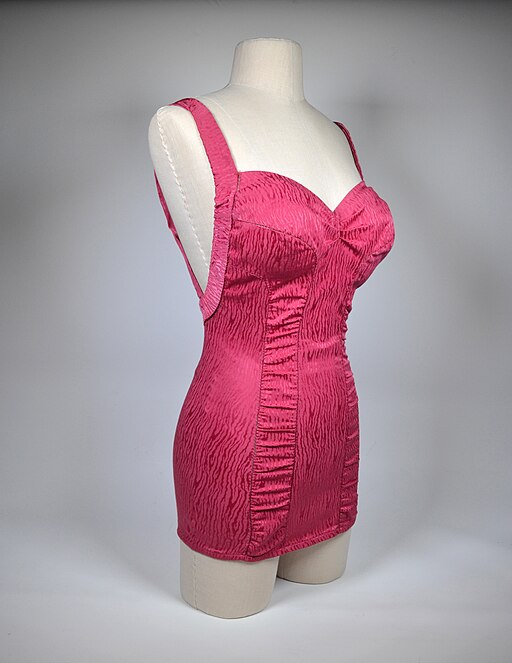
Those American one-pieces weren’t simple garments. Designers like Rose Marie Reid built swimsuits the way foundation garments were built, with boning, underwire, tummy-control panels, and structured cups meant to mold the body into an idealized silhouette.
Reid’s “Magic Length” line featured an inner bra, elasticized back, and stay-down leg, and she designed variations for different body types so every woman could achieve the hourglass shape the decade demanded. The point was to shape as much as cover.
Men’s swimsuits were changing too, though less dramatically. Elastic waistbands replaced belts in the 1950s, and the options came down to briefs or boxers, depending on preference and where you lived. Cabana sets paired printed shorts with matching shirts for a resort look that worked off the sand. Nylon arrived in swimwear mid-decade, and suddenly suits dried faster and held their shape better.
These advances in fabric and construction set the stage for everything that came after.
America Covered Up While Europe Stripped Down
The divide between American and European beaches started early and never fully closed. American beachside rules enforced modesty standards well into the mid-20th century, and these restrictions applied to men as much as women. Brief-style wear was standard across Europe, Hawaii, and the Caribbean. But American beaches pushed for longer, looser trunks that covered more of the thigh.
Some of this came down to cultural attitudes about the body itself. European beach culture treated swimsuits as functional, something minimal that let you swim and tan without fuss. American culture is layered in more anxiety about display and what a body in public is supposed to look like.
The result was a split that shaped swimsuits for decades. European men kept wearing briefs while American men shifted toward board shorts and trunks, and European women adopted bikinis as default summer wear while American women moved more slowly. Choosing modest one-pieces and skirted bottoms long after their French and Italian counterparts had let them go.
The same suit that felt normal on the Riviera could get you asked to leave an American public pool.
The 1970s Loosened Everything
String bikinis arrived on beaches around the world, and thongs appeared for the first time outside Brazil. The women’s liberation movement was reshaping attitudes about what women could wear and where, and swimwear followed.
The 1980s pushed the silhouette further. Leg cuts rose high, creating the V-hip line that would define the decade. Bottoms that once sat at the upper thigh now extended toward the waist, elongating the leg and changing the entire proportion of the suit. This was borrowed directly from aerobics culture and the high-cut leotards Jane Fonda made famous in her workout videos.
The gym and the beach merged into a single aesthetic. Fabric technology shifted too. As nylon blended with elastane produced suits that stretched, hugged the body, and held their shape through sun and salt water in ways earlier materials never could.
Why High-Cut Swimwear Actually Works
The style flatters because of basic optical principles that designers have understood for decades. A higher leg opening creates a longer unbroken line from hip to foot. Making legs appear longer regardless of actual height. The cut draws the eye upward, and the angled line across the hip creates the appearance of a more defined waist. These are the same visual tricks tailors use when cutting trousers, applied to swimsuits with equally effective results.
The 1980s understood this and ran with it. Colors went bold as the culture embraced excess, with neon pinks, electric blues, and geometric prints covering beaches and pool decks from Miami to the Mediterranean. The aesthetic was athletic, confident, and unapologetically visible. Speedo briefs became synonymous with competition swimming while Baywatch premiered in 1989 and cemented the high-cut one-piece as the image of beach culture that a generation would carry into adulthood.
A Summer in Odessa
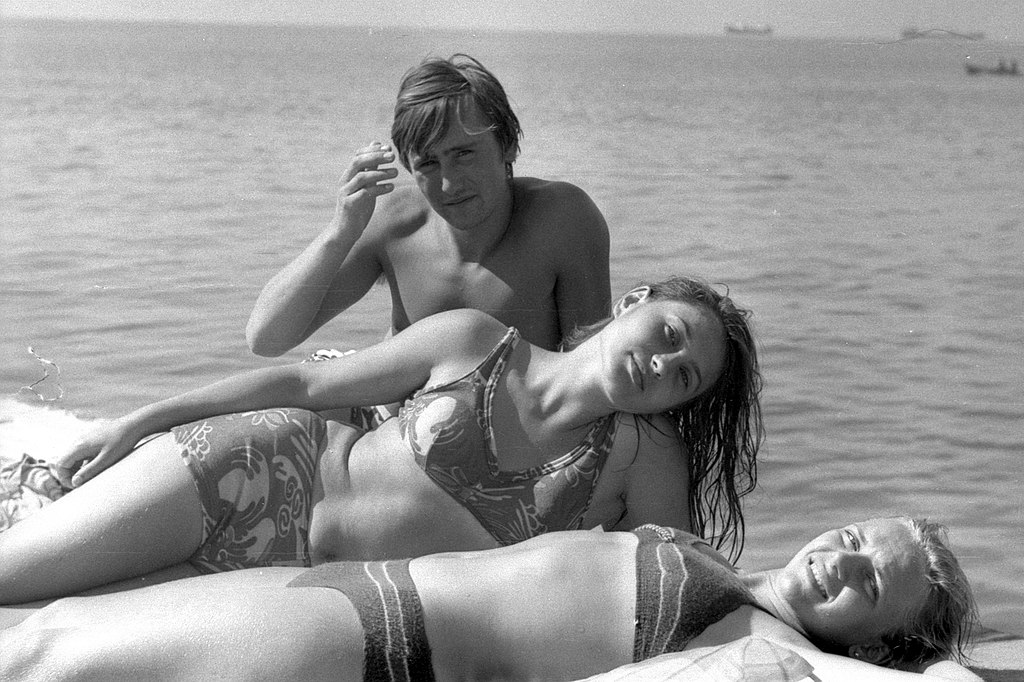
The Black Sea coast drew millions of Soviet citizens every summer. Odessa, Sochi, Crimea. These were the destinations, the places people spent their annual leave soaking up sun and salt water along coastlines that felt worlds away from the factories and offices of daily life.
Some came through official channels. Using vouchers distributed by trade unions that covered accommodations and meals at state-run sanatoriums. While others arranged trips independently and spent their days however they wanted. Soviet ideology framed rest as something that belonged to the collective.
Your body needed recuperation so it could return to productive work. That was the official line. But the photos from those beaches tell a different story. People played chess on the sand, posed with friends, smiled at cameras, and enjoyed the brief freedom that summer provided. The state may have organized the vacation, but the joy was personal.
What the Odessa Photo Actually Shows
When someone scrolling through their phone in 2026 sees that photo, they register the swimwear first. The high-cut bikinis and dark briefs look like something from a current lookbook, maybe styled to feel retro but completely wearable today. That recognition stops most viewers from looking any deeper.
What they miss is everything else in the frame. No logos on anyone, no brand names visible anywhere, no advertisements in the background. The vehicles are older models, the buildings have a specific, subdued architecture, and the whole scene carries visual markers of a society that didn’t run on consumer capitalism. These details don’t register for viewers who have never known anything else.
For someone who was there in 1989, the image means something entirely different. This was the Glasnost era. When Soviet citizens were finally able to access Western-style clothing and enjoy a public freedom that earlier decades had restricted. The relaxed body language, the playful posing, and the sense of ease on a crowded public beach all represented a loosening that people had been waiting for.
For people from that region looking at this photo now, the reaction is more layered. There’s nostalgia for youth and summer and the way things felt before everything changed. But there’s also the weight of knowing what came next. The economic collapse of the 1990s, the chaos of transition, and the long road to whatever stability exists today.
Modern beaches in Odesa look indistinguishable from anywhere else in Europe now, so the swimwear seems dated rather than daring. The real difference isn’t what people are wearing but the entire world that surrounds them when the shutter clicks.
How the Soviets Obtained Fashionable Swimwear
By the late 1980s, Soviet citizens had found multiple ways around limited consumer options. The German sewing magazine Burda Moden began publishing a Russian-language edition in 1987 and became an instant phenomenon because it included detailed patterns that let anyone with a sewing machine recreate the styles on its glossy pages.
Nearly every skilled private tailor in the Soviet Union owned copies. And women who couldn’t sew themselves found dressmakers who could.
For those who didn’t want to make their own clothes, there was fartsovka, the illegal resale of imported goods that flourished despite official prohibition. Neon colors, geometric prints, colorful leggings, and branded sportswear all circulated through informal channels operating just beneath the surface of official commerce. State-owned factories couldn’t keep up with demand for fashionable clothing, but the black market could. People wanted to look current, and they figured out how.
Beaches as Cultural Crossroads
The beach functioned as a strange kind of social space in Soviet society. One that operated by different rules than the rest of daily life. Black Sea resorts were places where Western trends spread despite official ideology because people from across the vast country mixed together on the same stretch of sand.
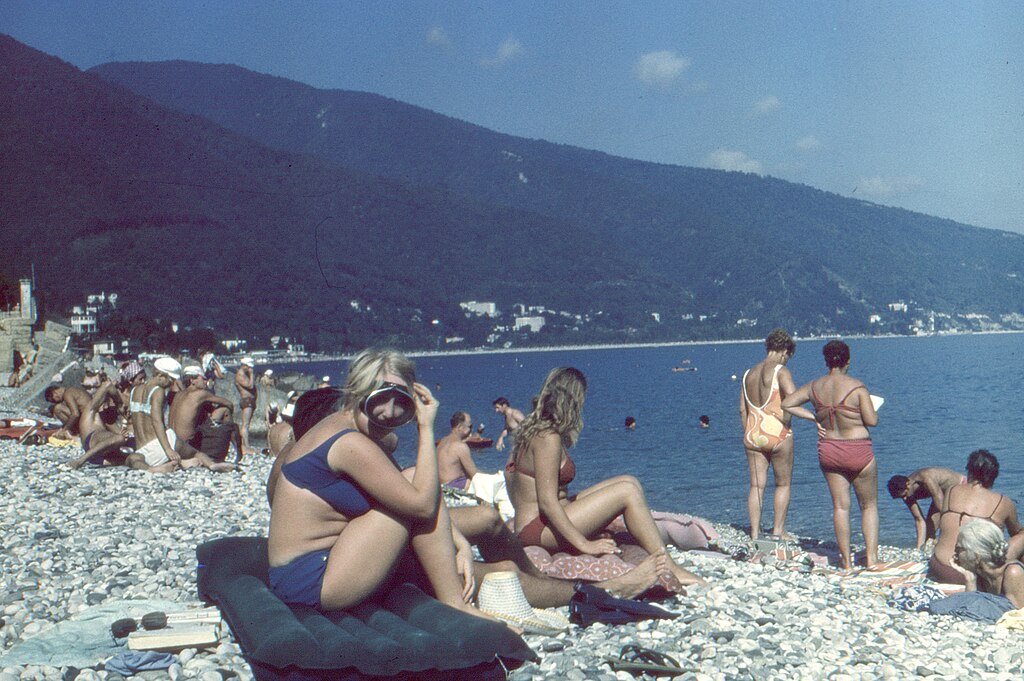
They learned the latest dances, picked up new fashions from other vacationers and from the occasional foreign tourist, and carried those ideas back home. The same system that controlled movement and access had inadvertently created spaces where new ideas circulated freely.
By 1989, young Soviets were absorbing Western fashion and music even while living in a society that officially frowned on such influences. The swimsuits in the Odessa photo matches global trends of that moment perfectly. Two years later, the Soviet Union would collapse entirely. But the people in this photo had no way of knowing they were standing at the edge of that change.
Read More: Spotting a Purple Flag on the Beach? Here’s What You Need to Know
The Revival Begins
High-cut bikini bottoms started reappearing in the mid-2010s, and by the end of the decade, they were everywhere. Body Glove launched explicit 80s throwback collections with neon colors, scoop backs, and leg lines rising above the hip. Marketing nostalgia to women who remembered the original era and to younger buyers discovering the silhouette for the first time. The numbers confirmed what anyone scrolling through Instagram could already see. Stylight, a fashion analytics platform tracking 12 million monthly users, found that clicks on high-leg styles in 2020 had grown 380 times higher than the year before.
Social media turned what might have been a slow revival into something that moved in weeks. When Dua Lipa posted herself in a crochet bikini in mid-2020, searches for similar styles spiked almost immediately. And when the Kardashians followed with throwback photos featuring vintage micro bikinis from the 1990s, designers who had spent years producing lower-cut bottoms scrambled to meet demand they hadn’t anticipated.
By Miami Swim Week 2021, the runways made the shift official. Designers showed what the industry started calling floss bikinis, with extra strings and cuts that sat higher than anything mainstream brands had offered in decades. The trend also defied assumptions about who was buying. Because industry data showed the boom was being driven largely by women over 45, a demographic embracing styles they might have skipped a decade earlier.
Why the Silhouette Came Back
Some of this traces directly to nostalgia and the cyclical nature of fashion itself. The Zoe Report, a fashion and lifestyle publication, has written about how Princess Diana’s vacation swimwear from the late 1980s and early 1990s still circulates constantly online, held up as style inspiration decades after the photos were taken.
But nostalgia alone doesn’t explain the return because plenty of old trends stay buried. These cuts came back because they’re genuinely flattering in ways that transcend their era. Designers knew this 40 years ago, and new designers rediscovered it when they started looking backward for inspiration.
Men’s swimwear is following the same trajectory, though, again, more slowly. FRNKOW, a menswear publication, notes that boardshorts dominated American beaches for years. While European men never abandoned the brief, and that cultural gap still exists. But something is shifting.
American men are growing more comfortable with their bodies and less interested in hiding behind oversized shorts, and swim briefs are gaining ground outside the competitive swimming and fashion-forward crowds that kept them alive. Social media accelerates all of this by putting old images in front of new audiences every day, so trends that took years to spread now feel current again within a single season.

A World That Only Looks Like Ours
The snapshot from Odessa in 1989 works like an optical illusion, a visual trick where your eyes and brain perceive something that differs from reality. When the photo lands on a feed today, viewers scroll past assuming it’s recent because the styles literally are recent again. None of it signals “decades ago” to a brain trained on current fashion, so the image passes as contemporary until someone reads the caption and realizes they’re looking at a world that no longer exists.
Fashion looped back so completely that 37 years disappeared into a single glance. These people dressed for their moment and accidentally dressed for ours, which is why the photo keeps going viral every time it resurfaces.
They didn’t know they were being timeless. These were just people at the beach, enjoying the water, standing in the sun with friends on a summer day that happened to fall two years before everything they knew came apart.
The Soviet Union would collapse, the economy would crater, and the world in this photo would vanish so completely that only the swimwear would survive. We look at this image now and see ourselves reflected back, but when they looked at the camera, they had no idea what was coming.
Read More: This Photo of People on a Beach is Turning Heads. Can You See Why?