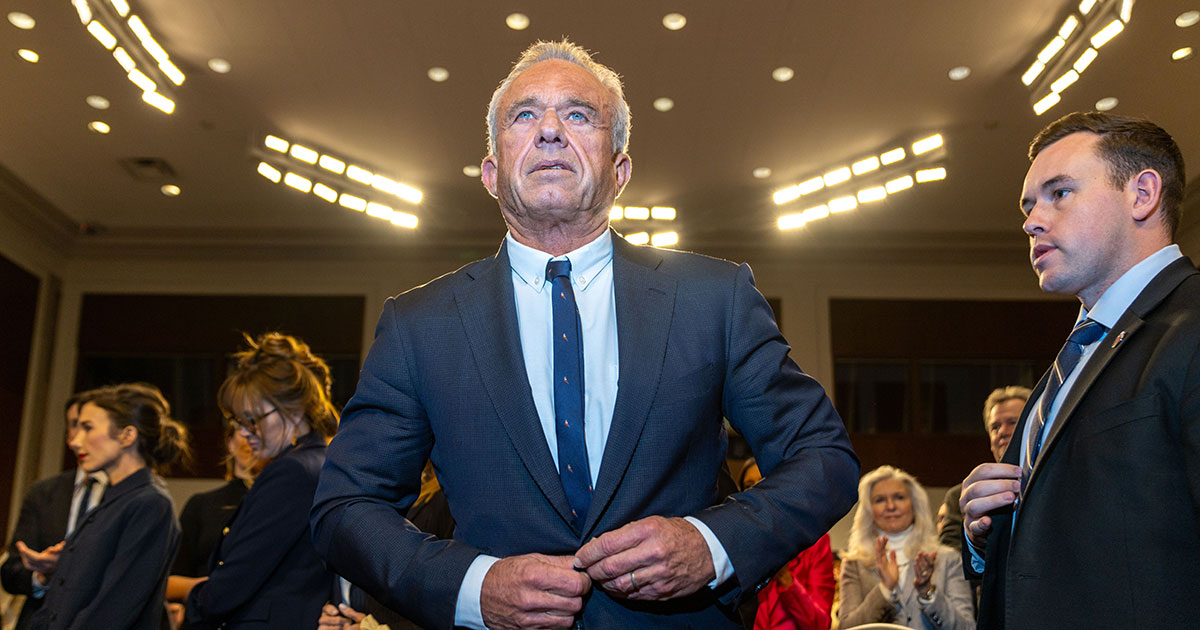

The May 2026 episode of The Joe Rogan Experience featuring US Secretary of Health and Human Services Robert F. Kennedy Jr. should have been, at minimum, an interesting hour of radio. Kennedy has strong opinions about institutional medicine. Rogan is genuinely curious about things when the topic suits him. The UK, as it happens, has a live and loud debate happening inside its own parliament about online speech law. None of that potential made it into the clip that went viral.
What happened instead was Kennedy calling the United Kingdom a “dictatorship” over its social media laws, Rogan agreeing with enthusiasm, and approximately five seconds of analysis between the two of them. The British press responded the way you respond to a relative explaining geopolitics at Christmas dinner: patient smile, very long exhale, and then a detailed rebuttal nobody in the original conversation will read.
What actually happened in that conversation, and what’s actually happening in the UK, are two different stories. One of them is genuinely worth talking about. The other involves two very famous American men confidently explaining a foreign country’s legal system with the air of people who have definitely Googled it.
What Kennedy and Rogan Actually Said
Speaking on the podcast, Kennedy said, “You look what is happening in England right now. A lot of people are going to jail for Twitter posts.” Rogan replied, “Twelve thousand people in the last year,” to which Kennedy declared, “It’s just a dictatorship.” For Kennedy, that was apparently enough to settle the matter – the country that gave the world the Magna Carta, parliamentary democracy, and the National Health Service is, in fact, a dictatorship. Case closed.
Kennedy compared Britain to the Soviet Union and suggested it was “Kafkaesque” for its crackdown on online hate. The Kafka reference is interesting, given that the central horror of Kafka’s The Trial is that the protagonist has no idea what he’s accused of or how to defend himself – a fairly specific legal nightmare that does not describe a country with a published Crown Prosecution Service guidance document, active parliamentary debate, and a Lords Library research briefing available to anyone with a wifi connection.
Rogan then made what one outlet described as “a completely misinformed attack on the government’s recent justice reforms.” He said, “Well they got rid of trial by jury. Now it’s just a judge. There’s no reasonable judge by jury for your peers.” This is not accurate, and the actual situation is both more complicated and, frankly, more interesting than a sweeping abolition of jury trials.
The 12,000 Number: What It Actually Means
The 12,000 figure is real. It is not made up. What Kennedy and Rogan did with it, however, was strip away every piece of context that would make it meaningful.
According to a 2025 Freedom of Information report filed by The Times, over 12,000 people were arrested – including for social media posts – in 2023 under Section 127 of the Communications Act 2003 and Section 1 of the Malicious Communications Act 1988. Those are the laws. They have been on the books for decades. Section 127 of the Communications Act 2003 and Section 1 of the Malicious Communications Act 1988 contain communications offences which criminalise the sending of indecent or grossly offensive messages.
Here is the part of the conversation that did not happen on the podcast: what those arrests actually led to. In 2023, police made 12,183 arrests under those two acts. Of those arrested, fewer than 10% – some 1,119 – were convicted and sentenced. That is not the profile of a country jailing people for tweeting opinions. That is the profile of a country with broad arrest powers, inconsistent enforcement, and a significant evidential problem at prosecution stage – a concern that UK civil liberties groups, Lords, and MPs have raised loudly and on the record.
Arrests made under these sections had increased since the pandemic, while convictions under them had decreased over the past decade. So arrests went up, convictions went down – the trajectory Kennedy described as a dictatorship is, in practice, a system where more people are being picked up and fewer are actually being found guilty of anything. You may find that troubling for entirely different reasons – the chilling effect of an arrest, even without a conviction, is real and worth discussing. But “people are going to jail for Twitter posts” is not what the data says.
The laws themselves sweep broadly and have drawn genuine, sustained criticism. The House of Lords Library published a detailed 2025 briefing noting that commentators have argued the arrest numbers raise serious questions about freedom of expression. Civil liberties groups have called for an independent review. These are legitimate debates happening loudly in the actual UK, by actual British people, in actual parliamentary chambers. They are not suppressed. They are Hansard-recorded.
The Jury Trial Question
The jury trial claim deserves its own moment, because it’s where the conversation slipped from imprecise into simply wrong.
Justice Secretary David Lammy announced plans to scrap jury trials for offences that carry a likely prison term of less than three years. That is a significant reform and it has been enormously controversial – barristers, opposition MPs, legal scholars, and members of Lammy’s own Labour Party have pushed back hard. The reforms, Lammy told Parliament, would help cut the backlog of cases waiting for trial in England and Wales, which currently stands at 78,000. Defendants are currently being offered court hearing dates for 2029.
This is a genuine civil liberties debate with real stakes. It is not, however, the abolition of jury trials that Rogan described. Cases of sexual assault, murder, and manslaughter, in addition to people trafficking, grievous bodily harm, and prosecutions that fall under the category of “public interest,” will still be given a jury trial. Murder is still tried by a jury. Rape is still tried by a jury. The reform targets the middle tier of offences where the likely sentence is under three years – think burglary, lower-level fraud, and, yes, communications offences.
In practical terms, jury trials already form only a small part of the system, accounting for around 2% of all criminal cases. The other 98% – the vast majority of British criminal justice – has long been handled by magistrates’ courts where there are no juries. This is not new. This is not Soviet. This is how the English legal system has functioned since long before anyone was posting anything on Twitter.
Why This Matters Beyond the Clip
It would be easy to wave this off as two Americans being confidently wrong on the internet, which is its own well-established tradition and not exactly scarce. But the conversation is worth taking seriously because the underlying questions are not trivial.
The reality of social media policing in the UK – and, frankly, in most Western democracies – raises hard questions about where the line sits between protecting people from harassment and incitement, and chilling legitimate expression. Freedom House found that internet freedom declined in the United Kingdom during the coverage period due to a reported increase in criminal charges for online speech. That is a real finding from a credible human rights organization, not a podcast claim. Civil liberties groups warn the laws are dangerously vague, sweeping up lawful but unpopular speech and creating a chilling effect online.
There are people in the UK – lawyers, academics, Lords, MPs across party lines – making exactly this argument, with evidence. When Kennedy and Rogan swoop in with “it’s a dictatorship,” they don’t amplify that conversation. They replace it with something easier to share and much harder to learn anything from. The clip goes viral. The Lords Library briefing does not.
A separate report from The Telegraph found that 292 people had been charged for spreading false information and “threatening communications” under the Online Safety Act between when it came into effect in 2023 and February 2025. That number – 292 charges in roughly 18 months – is the actual scale of prosecution for the newer, more expansive speech offences. It is worth scrutinizing. It is not 12,000.
The Podcast as Geopolitical Authority
There is something particular about this genre of podcast conversation – the two-men-in-chairs, four-hour, stream-of-consciousness format – that gives everything said in it the texture of settled fact. No fact-checkers, no editors, no one in the room to say “actually, let me stop you there.” Just two people, agreeing with each other, with increasing certainty, in front of millions of listeners.
Rogan’s reach is genuinely enormous. Kennedy is a sitting Cabinet secretary, a position that comes with access to actual information and actual analysts. When those two combine to describe a democratic country with a functioning parliament, active press, and robust legal system as equivalent to the Soviet Union, they are not speaking to a small audience. They are mainstreaming a framing that makes the real, legitimate concerns about UK speech law harder to discuss clearly – because once you’ve said “dictatorship,” there is nowhere to go from there except agreement or argument, and neither leads anywhere useful.
The irony is that Kennedy, in particular, has positioned himself as someone who cuts through institutional distortion to give people the real picture. On this one, at least, he didn’t. He took a complicated, genuinely contested legal situation and turned it into a punchline about authoritarianism. The real picture – 12,000 arrests, fewer than 10% resulting in convictions, a communications law that civil liberties groups and House of Lords peers are actively challenging, a jury reform that is far narrower than described – is actually more interesting than the punchline. It just requires more than a three-sentence exchange to explain.
The Bit and the Weight Behind It
Kennedy and Rogan aren’t entirely wrong that something worth watching is happening in the UK. The arrest figures are genuinely high. The laws are genuinely broad. The free speech questions are genuinely live. Jake Hurfurt, head of research and investigations at Big Brother Watch, warned against “heavy-handed use of vague communications offences,” saying it represented a threat to freedom of expression – and called the statistics “seriously concerning.” That is a serious person, making a serious argument, using actual data. It deserves to be heard.
What it doesn’t deserve is to be squashed into a viral moment where an American Cabinet official calls Britain a Soviet dictatorship based on a statistic he didn’t read closely enough to know referred to arrests, not imprisonments. The UK has problems worth discussing. It also has a parliament, a free press, an independent judiciary, and a House of Lords that dedicated a debate in July 2025 to whether its own communications laws go too far. Countries that are actually dictatorships tend not to do that last one.
What You’re Left With
You can hold both things at once: the concern about where UK speech law is heading, and the recognition that describing a messy democratic argument as Kafkaesque authoritarianism tells you more about the speaker than the country. Those are not contradictory positions. One requires reading past the first number. The other requires stopping there.
The frustrating thing is that the legitimate version of this conversation – the one about broad arrest powers, declining convictions, vague statutory language, and what it means to police speech in a democracy – is a genuinely interesting one. British civil liberties groups are having it. Lords are having it. MPs are having it in chambers that are on public record. The conversation exists. It just doesn’t fit in a forty-second clip, and it doesn’t end with “it’s a dictatorship,” which means it won’t go viral, which means most people will never hear it. That gap – between what’s actually being debated and what gets amplified – is the real story. Not the one Kennedy told, but the one behind it.
AI Disclaimer: This article was created with the assistance of AI tools and reviewed by a human editor.