
The internet has always had a soft spot for animals. Cats knocking things off shelves, dogs failing to catch frisbees with a particular kind of dignity – the whole ecosystem of online animal content operates on one reliable premise: creatures living their lives with zero awareness of how funny they are. It’s the purity of it that gets us every time. The animal isn’t performing for anyone. The animal is just being itself, magnificently and completely unaware that thousands of strangers are screenshot-ing its face.
And then, occasionally, an animal comes along that feels like more than just a funny moment. It feels like commentary.
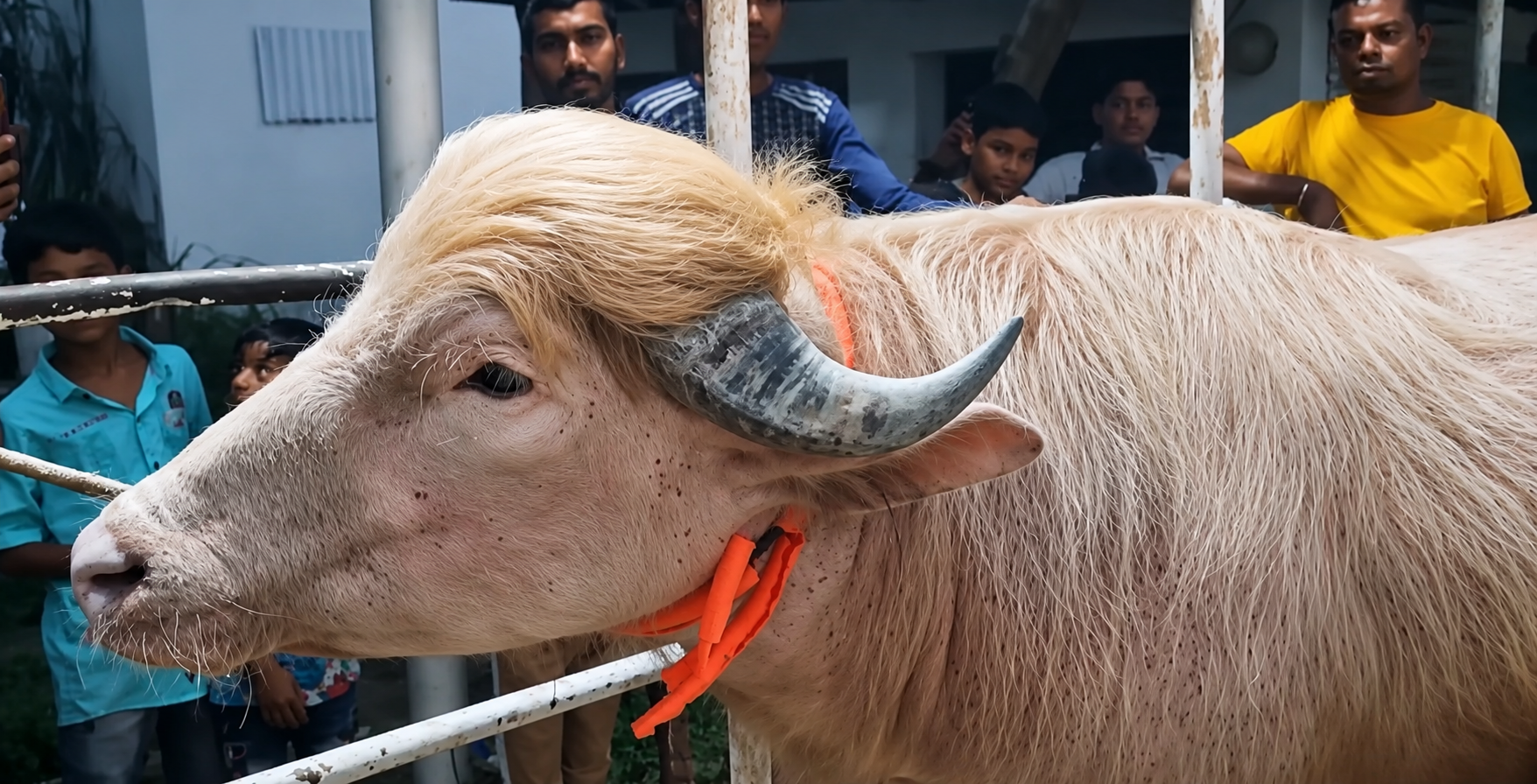
That is the only way to describe what happened at a farm in Narayanganj, just outside Dhaka, Bangladesh, in the weeks leading up to Eid al-Adha. A 700-kilogram albino buffalo became an unlikely social media sensation after being nicknamed “Donald Trump” for its golden-colored head hair and pale pink coloring. The story traveled faster than the animal could trot. And once you’ve seen the photos, you understand why. The resemblance is – and there is no diplomatic way to say this – genuinely uncanny.
The Buffalo Everybody Wanted to See
According to the Bangkok Post, visitors have been flocking to the Rabeya Agro Farm in the Paikpara area of Narayanganj, just southeast of Dhaka, to photograph and touch what farm staff describe as a calm and gentle creature. Farm owner Ziauddin Mridha purchased the buffalo from a cattle market in Rajshahi about ten months ago. He didn’t set out to acquire a global celebrity. He was looking for livestock. The celebrity part came later, courtesy of his younger brother.
“My younger brother jokingly named it Donald Trump after seeing the hair on its head,” Mridha explained. That’s it. That’s the origin story. A man looked at a buffalo, looked at the head of state of the most powerful country on earth, looked back at the buffalo, and made the only logical call. Nobody could argue with him. The farm staff reportedly did not try.
The animal features a prominent mane of blonde hair remarkably similar to the U.S. leader’s signature style, and has gone viral across social media platforms thanks to its distinctive combination of pinkish skin and golden locks. Visitors confirmed what the internet had already decided. One local resident who visited after watching videos on Facebook said simply: “It really does look like Trump. Its face and hair resemble him closely.”
The farm owner also noted the animal’s temperament with what can only be read as a completely straight face: “It is very calm in nature. Albino buffaloes are generally peaceful and do not become aggressive unless provoked.” A man described his buffalo’s personality. He was not making a political joke. The political joke was right there anyway.
The Science Behind the Hair (Yes, Really)
An albino buffalo is not simply a buffalo that got bleached in the sun. A 2012 study in PMC/NIH on oculocutaneous albinism – a hereditary pigmentation disorder affecting both skin and eyes – found that the condition is genuinely rare in buffalo herds and traced it to a recessive genetic mutation. The main clinical findings in affected animals are photophobia (sensitivity to light) and a complete lack of pigmentation in the hair, skin, horns, hooves, and eyes. Segregation analysis confirmed the condition passes through recessive inheritance – meaning both parents have to carry the relevant gene for the calf to be born this way. You can go your whole career in buffalo farming and never see one. This animal’s existence, before anyone named it anything, was already remarkable.
The golden hair specifically comes from the same genetic quirk. The usual dark coat pigmentation is simply absent, leaving behind whatever faint coloring the tissue carries naturally – which, in the case of this particular animal and in the particular light of a Bangladeshi afternoon, looks, to the casual observer, disturbingly presidential.
The Holiday Context That Makes This Even Better
Eid al-Adha, the Festival of Sacrifice, falls on the 10th day of Dhul Hijjah in the Islamic calendar – in 2026 that lands on May 27 – and in Bangladesh it is taken seriously in a way that involves the entire country. Bangladesh sacrifices an estimated 13 million animals each year during the observance, a number that requires months of preparation, thousands of cattle markets, and an enormous amount of careful livestock selection by families who want the best animal they can find.
Starting from the first day of Dhul-Hijjah, temporary cattle markets known as haat begin to appear across Bangladesh, and the animals are traditionally decorated with garlands. It is, in other words, a season of genuine pageantry around livestock. The cattle markets fill with buyers appraising animals with real expertise, looking for size, health, temperament. Into this setting walked a pink-skinned buffalo with a golden mane, and the entire country paused.
Mridha confirmed the animal had already been sold at 550 taka per kilogram and would be delivered to its new owner the following week. Rabeya Agro Farm prepared around 200 cattle for Eid al-Adha this year, with nearly all of them booked. So the star has already left the building, so to speak. The hair did not save it from the market.
But Wait – There’s Also a Netanyahu
Any story this good requires a supporting character, and this one delivered. While another buffalo has been dubbed Benjamin Netanyahu for its likeness to the Israeli leader, “Donald Trump” has emerged as the undisputed star attraction at the farm in Narayanganj.
The contrast between the two animals is, in a word, on the nose. According to Sunday Guardian Live, the Netanyahu buffalo weighs more than 750 kilograms, remains unpredictable, and has earned a reputation for being aggressive – notorious for snorting and charging at handlers without warning.
The two buffaloes’ contrasting personalities – one placid, the other a hazard to anyone holding a feeding bucket – sparked humorous debates across social media platforms, with users flooding timelines with memes, jokes, and comparisons. The internet, which is rarely at a loss for opinions, had many opinions about this particular data point. The comments on every article covering the story constitute a level of political analysis that, respectfully, no one had asked for and everyone provided anyway.
You can hold the joke and the weight of it at the same time. Two animals, two names, a cattle farm in Bangladesh, and somehow a near-perfect encapsulation of a particular cultural moment. The internet didn’t manufacture this. It just found it.
The Memes Were Inevitable
The story reached beyond Bangladesh within hours. People across Asia and around the world have a well-documented appetite for the moment when an animal becomes an accidental mirror – and this buffalo obliged on a scale that most internet animals never manage. The photos circulated on Facebook first, which is how one local visitor described first hearing about it: he saw videos in his feed and drove to see the animal himself. This is the modern pilgrimage, apparently. You see something improbable online, and you go verify it in person.
What made the story stick beyond a single news cycle is the specificity of the resemblance. It was not a vague likeness that required imagination. People kept arriving at the same conclusion independently. The hair – that particular golden sweep across the top of an otherwise pale pink face – reads, from the right angle, as unmistakably deliberate. The universe, or genetics, or both, appears to have a sense of humor about things. If you enjoy the internet’s habit of finding faces and figures where none were intended, you might also appreciate the optical illusion hidden dog that left social media equally divided not long ago.
What This Is Really About
The story of a buffalo in Bangladesh named after a sitting U.S. president is, on its surface, a very funny story. And it is. A genuinely funny story with a genuinely uncanny photo and a supporting character with a contrasting personality, all wrapped up in the context of a major religious holiday. It has every element a viral story needs: an unexpected protagonist, a recognizable reference, a clean visual payoff, and a detail or two that makes you feel like you couldn’t have invented it.
But there is something underneath it worth pausing on. The people at Rabeya Agro Farm didn’t engineer this. They bought a buffalo at a cattle market in Rajshahi, looked at it for a few months, and noticed something. A younger brother cracked a joke. And because the joke was accurate enough to be immediately legible to people on the other side of the planet – because it required zero cultural translation, zero explanation, zero footnote – it traveled everywhere. That is not a small thing. The world is full of contexts that feel impossibly far apart, and occasionally a buffalo stands in a field with the right kind of hair and briefly, absurdly, connects them.
The buffalo has since been sold. Whatever comes next for it, it had a moment. And the farm owner, who described his albino buffalo as “very calm” and “generally peaceful,” delivered the best line of the whole story without trying to. He was just describing the animal. He was not writing a caption. He didn’t need to.
AI Disclaimer: This article was created with the assistance of AI tools and reviewed by a human editor.