
Most parents don’t know whether there’s a gun in the house their child is about to walk into. Not because they’re careless, but because that question doesn’t come up the way it probably should. You know the address. You know which parent drives the fastest on the school pickup loop. You know the Wi-Fi password because your kid texted it to you. And somewhere in all that ordinary knowledge, there’s a gap most families have never thought to close.
That gap is sitting at the center of a real legislative fight playing out at the Arizona statehouse right now. A bill has passed the Arizona Senate and is working its way toward a full House vote, and if it becomes law, it would require every kindergartener through 12th grader in Arizona’s public and charter schools to receive annual gun safety instruction. No firearms in the classroom, no ammunition, no handling demonstrations. Just age-appropriate lessons about what to do if a child encounters a gun: stop, don’t touch it, leave the area, tell a trusted adult.
Simple, in theory. But nothing involving guns in America stays simple for long.
What the Bill Actually Does
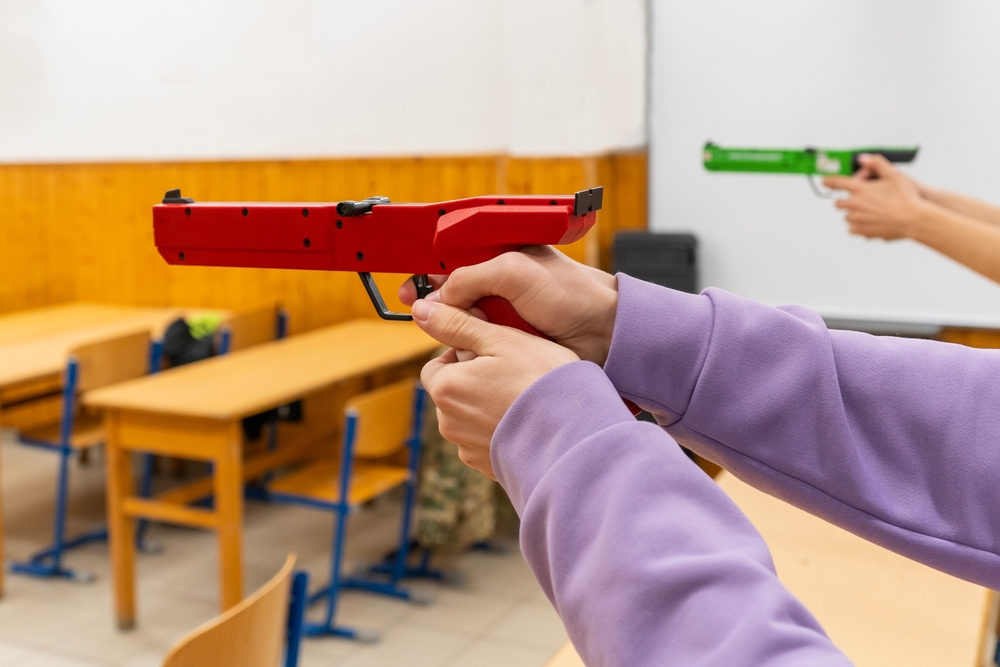
Senate Bill 1424 was introduced by two Republican state lawmakers who want to require all K-12 students to take a firearm safety class every year. The bill would require public and charter schools to provide annual firearm safety and accident prevention lessons for students in every grade, from kindergarten through 12th grade. The instruction would cover safe gun storage, what a student should do if they find a gun, and the risks of handling firearms. Schools would not be allowed to use live guns or ammunition during the lessons.
If enacted, the bill would mandate that instruction begin in the 2027-28 school year. The Arizona Department of Education would work with the Department of Public Safety and the Arizona Game and Fish Department to develop the curriculum. Schools would have some flexibility in how they deliver it. Districts and charter schools could satisfy the requirement with classroom instruction, an assembly presentation, video or digital instruction approved by the state education department, or by incorporating the material into existing health or safety curricula.
The framing from supporters has been consistent: this is not firearms training. It’s closer to fire safety – the same principle as teaching a five-year-old what to do when they smell smoke. Don’t investigate, don’t touch, get out, tell a grown-up. Supporters argue that firearms, like fires and pools, exist in the world children actually inhabit, and that preparing children to respond safely to something they might encounter is just practical.
The Number That Stops You
The reason this bill exists at all comes down to a fact that doesn’t get easier to absorb no matter how many times you read it. According to the CDC, firearm injuries were the leading cause of death among children and teens ages one to nineteen in the United States. That statistic carries the full weight of everything parents quietly carry when they wave goodbye at a friend’s front door.
And here’s where the bill’s logic gets specific. According to Nationwide Children’s Hospital, nearly 40 percent of all unintentional shooting deaths among children ages 11 to 14 occur in the home of a friend. Not at a range, not at home, but at a sleepover. At a playdate. At the kind of ordinary afternoon that a parent packs the snack bag for and doesn’t think twice about.
The risk isn’t only inside your own house. Parents who are genuinely careful about their own storage still send their children into other homes, where the same diligence may or may not exist. Many guns are kept loaded, unlocked, and potentially accessible to children, which means the question of where a gun is stored at a neighbor’s house is not a paranoid one – it’s the right one.
Research from the same source also finds that 75 percent of children who live in homes with guns know where they are stored – which puts a tidy hole in the “I hid it” logic that a surprising number of parents still rely on. Kids find things. That’s practically their primary function.
The Pushback, Which Is Also Legitimate
The opposition to SB 1424 isn’t coming from people who don’t care about children’s safety. It’s coming from people who believe the bill doesn’t do enough, or that it does the wrong thing entirely.
The core argument from critics is this: if guns were stored properly, the conversation wouldn’t need to happen in classrooms at all. The child at a sleepover in 2021 whose unsecured gun became a tragedy didn’t need a better school curriculum. He needed an adult in that house who kept his firearm locked. Passing responsibility onto children – even with kind intentions – lets the adults who own the guns off the hook.
There’s also a research problem that supporters of classroom gun safety programs have had to reckon with for years. The question of whether teaching children to avoid guns actually changes their behavior in the moment is not settled, and the evidence is not encouraging. Studies have repeatedly found that children who can correctly recite what they should do when they encounter a gun will often still pick it up when they find one. Multiple investigations have demonstrated that children may be able to verbalize that they shouldn’t pick up a gun, but when they encounter one in an unsupervised setting, they will still play with it. Researchers have also shown that even children who learn gun safety during a formal program are not always able to transfer that knowledge to their natural environment.
Knowing the rule and following it under pressure, when you’re a curious ten-year-old alone in a room, are not the same thing. For parents who have spent years teaching kids about rules and limits, that gap is probably not surprising. Children’s impulse control is still developing, and that development doesn’t pause for a school assembly.
The Unfunded Mandate Problem
There’s a third criticism of SB 1424 that has nothing to do with ideology and everything to do with how schools actually function. The bill does not include any funding for the training. A spokesperson for the Arizona Education Association called SB 1424 an unfunded mandate, and educators rallied at the Capitol calling on lawmakers to stop passing bills that add requirements without extra resources. “We’ve seen wave after wave of political attacks and unfunded mandates, including bills that expand educators’ liability or impose new requirements without providing the resources to implement them,” said one representative from the Phoenix Union Classified Employees Association.
This is the part of the debate that tends to get lost in the back-and-forth about guns. Teachers are already absorbing a significant number of additional responsibilities without corresponding support, and the bill as written asks schools to build and deliver an entirely new annual curriculum without telling them where the money to do that will come from. The bill is, by design, content-light – it deliberately avoids specifying exactly how long the instruction needs to be, which means different schools in different districts could end up with wildly uneven results.
The instruction is required to be objective, not promoting firearms ownership or any political position, and it must be limited to accident prevention and personal safety awareness. That’s a careful mandate. Whether a five-minute video and a poster count as satisfying it is a separate question.
What Comes Next
The bill still needs to clear a full House vote before it reaches Governor Katie Hobbs’ desk. The bill has passed the Arizona legislature, which is narrowly controlled by Republicans, with a 17-13 advantage in the Senate and a 33-27 advantage in the House. Whether the governor signs it is genuinely uncertain.
Arizona isn’t the first state to move in this direction. Arkansas made firearms safety classes mandatory for students in 2025. The trend is real, and it reflects a broader reckoning with a problem that hasn’t improved with time: children keep dying from encounters with guns they weren’t supposed to be able to reach, in homes they were supposed to be safe in.
What to Hold Onto
The argument about SB 1424 is, underneath its policy surface, an argument about where responsibility lives. Supporters say children deserve every layer of protection available, including the knowledge to recognize and avoid a dangerous object. Critics say that layer of protection belongs with the adults who own the guns, not the children who might find them, and that the classroom is being asked to fix something that storage laws and enforcement could address more directly.
Both things can be true at the same time. A five-year-old who knows to stop, not touch, and tell a grown-up has something she didn’t have before. She also still lives in a world where the grown-up who owns the gun down the street may not have locked it. The lesson and the locked case are not in competition with each other. The gap between them is just where the real risk tends to fall.
As a parent, you probably already understand this tension without having to be told. The combination of things you can control and things you can’t has been the background hum of raising children since the first day you sent yours somewhere without you. This bill may or may not become law. The underlying question it’s trying to answer isn’t going anywhere.
AI Disclaimer: This article was created with the assistance of AI tools and reviewed by a human editor.