

Tattoos have been a part of human culture since ancient times. Ancient peoples in many cultures used tattoos to tell stories, to mark a coming-of-age, and to denote triumphs and to which tribe they belonged. For a long time in the Western world, however, tattoos were seen as something negative that only gangsters and “unsuccessful” people got. In the last couple of decades, however, tattoos have moved into the mainstream. Now, even the most surprising of people have tattoos, from the skater kid down the street to your boss and even an unassuming elementary school teacher.
This also means that, for a very, very long time, people have been getting tattoos that they came to regret. Recently, a woman’s confusing tattoo has gone viral on social media, and not for a good reason. What was intended to be a sentimental symbol of resilience and a “broken heart” left thousands of commenters scratching their heads. Her story has sparked a massive debate over design, execution, and the importance of a second opinion.
The Confusing Tattoo That Broke the Internet
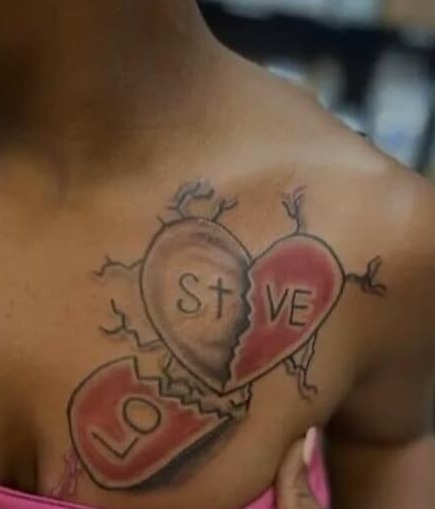
The controversy began when a woman proudly shared her new tattoo on social media, expecting a wave of support for its deeper meaning. Instead, people were confused and certainly weren’t expressing admiration for her new ink. The design features a red broken heart, with the left side of the heart lying below on its side. The left side of the tattoo has “LO” written on it, while the upright, right side of the broken heart has the letters “VE”. What is confusing people, however, is the grey-colored left half of the heart that sits where the red left half used to sit. It has the letters “ST” written on it.
Commenters on social media were completely baffled by it. Yes, people could figure out that before the heart broke, the word “LOVE” was whole. What no one seems to understand is the ST part. What is it supposed to mean – Stove? Steve? Did someone named Steve break this woman’s heart? Or was her heart broken, and someone named Steve came along and helped her?
The answer, however, is none of these things. It has nothing to do with a guy named Steve (or a stove, as some people read it). It is supposed to say LOST LOVE. The way it is designed, however, not a single person understood it. One user did a social media deep-dive to find somewhere where the original poster had explained what the tattoo meant.
When “Deep Meaning” Meets Poor Design
This viral reaction highlights a common pitfall in the tattoo world: the “meaning-to-readability” ratio. While a tattoo should ultimately satisfy the person wearing it, tattoos are a visual medium. If a design is too cluttered, the lines are too close together, or, in this case, the design ultimately doesn’t read the way it was meant to, the meaning can quickly turn into a rather regrettable situation.
Now, you could say simply that tattoos are a “to each their own” situation. It doesn’t matter if the rest of the world gets it, as long as she does. That being said, her tattoo is rather large and, depending on what she chooses to wear, fairly visible. This means that she’ll have to explain it to people over and over and over again for the rest of her life.
Tips for Choosing the Right Tattoo Design
Image credit: Shutterstock
If you’re thinking about getting a tattoo, stories like this one likely spook you a little bit. After all, she probably thought her tattoo idea and design was brilliant, understanding the meaning behind it and therefore not seeing how it could be confusing to the outward eye. To avoid becoming the next viral sensation for a “what the heck is that” tattoo, the planning phase is crucial. Here is how to ensure your vision translates perfectly:
- Prioritize Readability: A good tattoo should be recognizable from a few feet away. If you have to explain what it is every time someone looks at it, the design might be too complex for the scale.
- Avoid “Over-Telling”: Many people try to pack too many symbols and meanings into one small piece. Sometimes, simplicity is more impactful (and clearer).
- The Sleep-On-It Rule: If you find a design that you love, wait a little while before getting it. Give it perhaps a month or even six if you’d like; if you still love it then, it’s likely not a fleeting whim.
- Consider the Aging Process: Fine lines and tiny details blur over time. A design that looks delicate and intricate today might look like a bruise in ten years if not executed with proper spacing.
Finding the Perfect Artist

Image credit: Shutterstock
Your artist is 90% of the reason your tattoo will come out looking even better than you wanted it, or you wish that you could go back in time and undo it. You need to ensure that the artist isn’t just good, but also does the style you like. Don’t just go to the shop closest to your house; do your homework.
- Check their specialization: If you want a portrait, don’t go to an “American Traditional” artist. Look for portfolios that feature the exact style that you are looking for.
- Look for healed photos: Fresh tattoos always look vibrant and sharp. A truly skilled artist will show photos of their work six months or a year later to prove their technique holds up. Of course, this is also skin-dependent, not entirely artist-dependent.
- The consultation is key: A professional artist will tell you if your idea won’t work. If an artist agrees to do a tiny, highly detailed piece in an area they know will blur, they’re likely more interested in your money than your long-term satisfaction.
- Hygiene is non-negotiable: The shop should be spotless, and the artist should be happy to show you their sterilization process.
The Reality of Tattoo Regret and Removal

Despite the best intentions, tattoo regret happens. Whether it’s due to a poor design, a change in lifestyle, or a “shattered heart” that people can’t figure out the meaning of what’s written on it, you aren’t stuck forever. However, the “undo” button is much more painful and expensive than the original ink.
Laser tattoo removal is currently the gold standard. Modern lasers, like Q-switched or Picosecond lasers) work by sending high-intensity light pulses into the skin to shatter the ink particles into tiny fragments. Your body’s immune system then slowly flushes these particles out. This is not a one-and-done procedure, however. It takes multiple sessions, often 6 to 12, spaced weeks apart. It is also significantly more painful than getting the tattoo and can cost thousands of dollars.
Read More: Gen Z Brings Back ‘Trashy’ Tattoos Millennials Left Behind
Other Options
Surgical Excision and dermabrasion are alternative options for very small tattoos. A surgeon can sometimes cut the skin away and stitch it back together. Dermabrasion, which involves “sanding” the skin down, is less common today because it is highly invasive and often leads to significant scarring.
If you still like tattoos but just hate that tattoo, simply getting a cover-up might be your best route. A skilled artist can use dark ink and clever composition to hide an old mistake. Keep in mind that a cover-up will always be significantly larger and darker than the original piece.
The Bottom Line
Tattoos are a beautiful way to wear your heart, broken or otherwise, on your sleeve. But as the internet’s reaction to this viral confusing heart proves, the bridge between an idea and a permanent image is a narrow one. By taking your time, researching your artist, and listening to professional advice regarding design and placement, you can ensure that your ink remains a source of pride rather than a source of online debate. Remember: a tattoo is a permanent addition to your body; it’s worth the extra time to make sure everyone can see the beauty you intended.
Read More: Dad Gets Tattoo to Match Son’s Scars After Heart Surgery