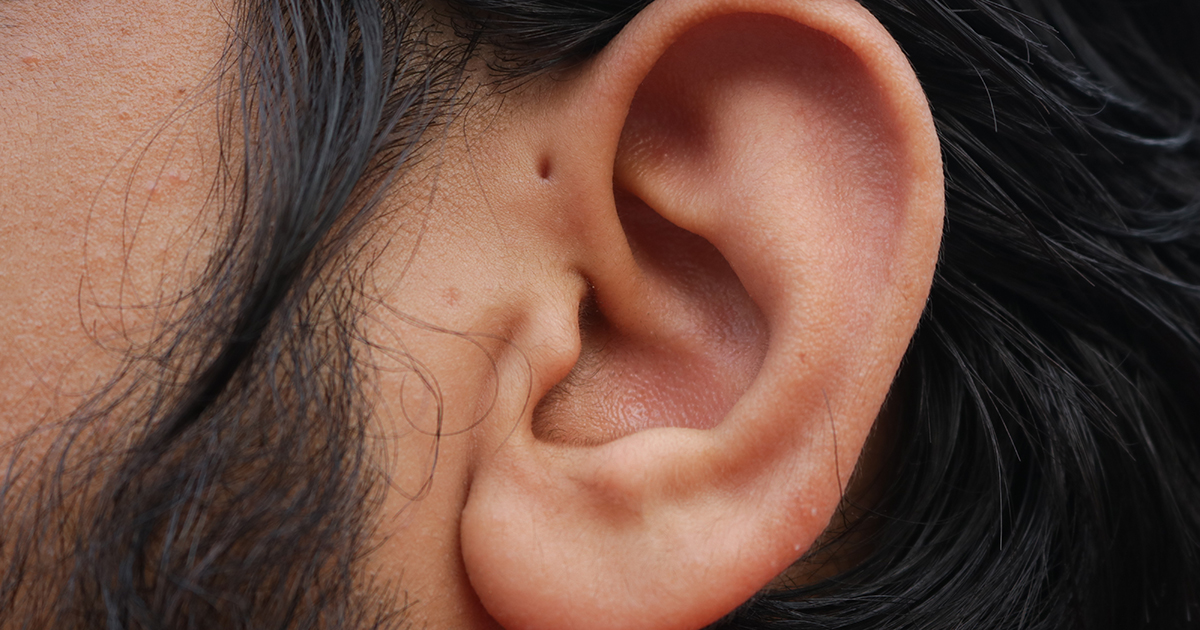

That small pinhole sitting just above your ear, right at the crease where your face meets the cartilage, has been confusing people for generations. Some assume it’s an old piercing. Others assume it’s a dimple that landed in an odd spot. A quick look in the mirror won’t tell you much, because from the outside it’s barely there, just a tiny opening in the skin that looks like it leads nowhere.
It does lead somewhere, though. That little mark is called a preauricular pit, or ear pit hole, and it has its own biological backstory, its own documented history in medicine, and a surprisingly specific set of facts that most people who carry one have never heard. Doctors have been writing about it in medical literature since 1864. That’s not a minor footnote; it means generations of physicians have examined, categorized, and debated this small feature, and the picture they’ve built up over that time is more interesting than it first appears.
The origin of the pit has nothing to do with injury, pressure, or anything that happened after birth. It was already there, fully formed, before you arrived.
What an Ear Pit Hole Actually Is
A preauricular pit is a congenital malformation in which a sinus tract, essentially a narrow tunnel, runs under the skin in front of the ear and above the ear canal. It goes by a few names, including preauricular cyst, preauricular fissure, or preauricular sinus. The visible pinhole on the skin’s surface is simply the entrance to that underground tract.
The tracts beneath the skin can vary considerably in size. Some people have a short, simple one, while others have a longer tract with multiple branches running in different directions. Think of it like the difference between a single hallway and a maze with offshoots. You’d never know which one you had from looking at the outside.
There’s usually only one pit, and it most commonly appears on the right side. In cases where only one ear is affected, the left side is actually more often involved, which makes bilateral (both-sided) cases a separate consideration entirely. The openings usually form on one ear, though preauricular pits have been known to show up on both. In uncommon cases, a pit may also appear below the ear canal, closer to the earlobe.
Preauricular pits are congenital, meaning children are born with the malformation when ear development goes off-course early in gestation. The malformation is not associated with hearing impairments and is only rarely associated with a genetic syndrome involving other problems.
How It Forms in the Womb
The ear pit hole has its origins in a very specific window of fetal development. The visible part of your ear is called the auricle, and a baby typically grows it during the sixth week of pregnancy. A preauricular pit forms when the auricle doesn’t fuse all the way.
More precisely, the leading theory on how the pit forms is an incomplete or defective fusion of the six hillocks of His, which are small tissue mounds that merge together during fetal ear development. This defect can either be inherited or occur spontaneously. The hillocks of His are essentially the building blocks of the outer ear, and when the fusion between two of them is incomplete, the tiny opening left behind becomes the ear pit hole you can see from the outside.
The malformation is also thought to occur due to abnormalities in the formation of the branchial ridges during fetal development. Normally, these ridges develop into various structures including the ears. In the case of a preauricular sinus, the branchial ridges may remain separate and form the sinus instead. By the time any of this could be detected, it had already happened. The fusion failure is complete within the first trimester, long before most parents know much about the pregnancy at all.
How Common Is It, and Who Gets One?
The answer to “how common” depends heavily on where in the world you’re asking the question.
The frequency of preauricular sinus differs significantly depending on the population: between 0.1% and 0.9% in the US, around 0.9% in the UK, and between 4% and 10% in parts of Asia and Africa. So in an American context, fewer than 1 in 100 people have one. But in certain parts of sub-Saharan Africa or East Asia, it’s common enough that a doctor might see several cases in a single day.
A 2014 study published in the International Journal of Pediatric Otorhinolaryngology, drawing on data from 23,533 individuals in the Korea National Health and Nutrition Examination Survey, found that the rate of unilateral preauricular sinus was 1.3% and bilateral was 0.3%. Female gender was statistically associated with preauricular sinus. The same study also documented a strong hereditary link specifically for bilateral cases: children of a parent with bilateral preauricular sinus had a substantially higher likelihood of developing them too, with the father-to-child association being particularly pronounced. No such hereditary association was found for unilateral cases.
The American Academy of Family Physicians reports that preauricular skin lesions including pits and tags affect between five and ten babies in every 1,000 live births. That’s a reasonably consistent rate, but it’s still low enough that most people will go their entire lives never noticing one on themselves or anyone close to them.
The Genetics Behind the Ear Pit Hole
If you have one, your kids might too, though the picture is more complicated than a simple “you pass it on, they get it” calculation. Preauricular sinuses are inherited in an incomplete autosomal dominant pattern, with reduced penetrance and variable expression. They can also arise spontaneously. The sinus may be bilateral in 25 to 50% of cases, and bilateral sinuses are more likely to be hereditary.
Autosomal dominant with reduced penetrance means: you only need one copy of the relevant gene variant to potentially develop the trait, but having the gene doesn’t guarantee you’ll actually show it. The “variable expression” part means that even within the same family, one person might have a barely-there pit while another has a longer, more complex sinus tract. Genetics rarely comes with a neat rulebook.
Researchers have identified that the genetics may involve chromosome 8, with one study published on PMC noting that a locus for congenital preauricular fistula maps to chromosome 8q11.1-q13.3. The molecular story is still being pieced together, but what’s clear is that the trait has both a spontaneous and an inherited form, and that the inherited version tends to run more strongly through families where both ears are involved rather than just one.
What Happens If It Gets Infected
For most people, an ear pit hole is a permanent, unremarkable feature that never causes a day of trouble. Occasionally a preauricular sinus or cyst can become infected. Most preauricular sinuses are asymptomatic and remain untreated unless they become infected too often.
The infection risk comes from the structure of the sinus tract itself. The ear pit opens into a thin tunnel under the skin. Bacteria can get into the tract, causing swelling, soreness, and redness around the pit. Some people may also develop a cyst, a bump under the skin near the ear pit, which can also get infected.
The Children’s Hospital of Philadelphia describes a clear escalating approach to treatment: performing needle aspiration on a difficult infection known as an abscess if it fails to respond to antibiotics; draining it with incision if needle aspiration fails; and surgically removing the entire tract if the pit is prone to recurrent infections. The surgical procedure is done under general anesthesia and may take up to an hour, though it can be done in an outpatient facility.
One thing doctors consistently emphasize: don’t squeeze it, pick at it, or try to clear it out yourself. The infection is very close to the brain and must receive prompt medical treatment to prevent complications. That’s not said to alarm anyone, but to reinforce that redness, swelling, or discharge around the pit is a reason to see a doctor promptly, not something to wait out.
The good news is that surgery, when it’s needed, has a strong track record. A literature review found that the recurrence rate following preauricular sinus excision is significantly lower with a supra-auricular approach, at around 1.2% recurrence, compared to other tract approaches at 8.1% recurrence. And for the majority of people who never develop an infection at all, treatment is simply never needed.
When It Might Signal Something More
The ear pit hole is almost always just the ear pit hole, nothing more. But in a small number of cases, it can be one part of a broader condition. Preauricular sinuses can be associated with other defects that are not visible, one example being branchio-oto-renal syndrome.
Branchio-oto-renal syndrome can cause hearing loss, pits in the side of the neck, ear tags, preauricular pits, and kidney problems. If a preauricular pit appears alongside other ear abnormalities, or if a child also has hearing concerns, doctors will typically want to investigate further, including imaging and hearing tests. An ultrasound of the kidneys is recommended when pits are present alongside a branchial cleft cyst to rule out branchio-oto-renal syndrome. Pits by themselves don’t usually require a hearing test.
In everyday clinical practice, healthcare professionals tend to notice preauricular pits during routine examinations of newborns. People with one or more preauricular pits will likely be referred to an otolaryngologist, also known as an ear, nose, and throat doctor. In most cases, the appointment is brief and the news is reassuring.
If you’ve had a pit your whole life, have never had an infection, and have no other symptoms, you almost certainly don’t need to do anything. The pit is just part of how you were built.
You might also find it useful to read about other surprising congenital traits that science is only beginning to map properly.
What to Do With This Information
That small hole above your ear formed during week six of your fetal development, when your outer ear was being assembled from a cluster of tissue mounds, and one of those mounds left a tiny gap behind. By the time you were born, fully formed and ready for the world, that gap had already been there for more than seven months. It didn’t cause any trouble. Most likely, nobody even mentioned it.
The ear pit hole is not a defect in the dramatic sense. It’s not a warning sign, not something that needs to be fixed unless it repeatedly becomes infected. It’s a feature in the most literal sense of the word, an anatomical detail that a small fraction of people carry through their entire lives without it ever becoming a problem. In large parts of East Africa and Southeast Asia, it’s common enough that it barely gets remarked upon. In the US, fewer than one in a hundred people have one.
Whether you just discovered yours or have known about it for years, the medical picture is straightforward: you’re fine. You have a minor congenital variation that medical science has documented since 1864, that likely came to you through your genes or arose on its own in the earliest weeks of your formation, and that has no bearing on your hearing, your health, or anything else about you. Keep an eye on it the same way you’d monitor any skin feature. See a doctor if it gets red or swollen. Otherwise, consider it one of the more interesting small things that makes you exactly who you are.
AI Disclaimer: This article was created with the assistance of AI tools and reviewed by a human editor.