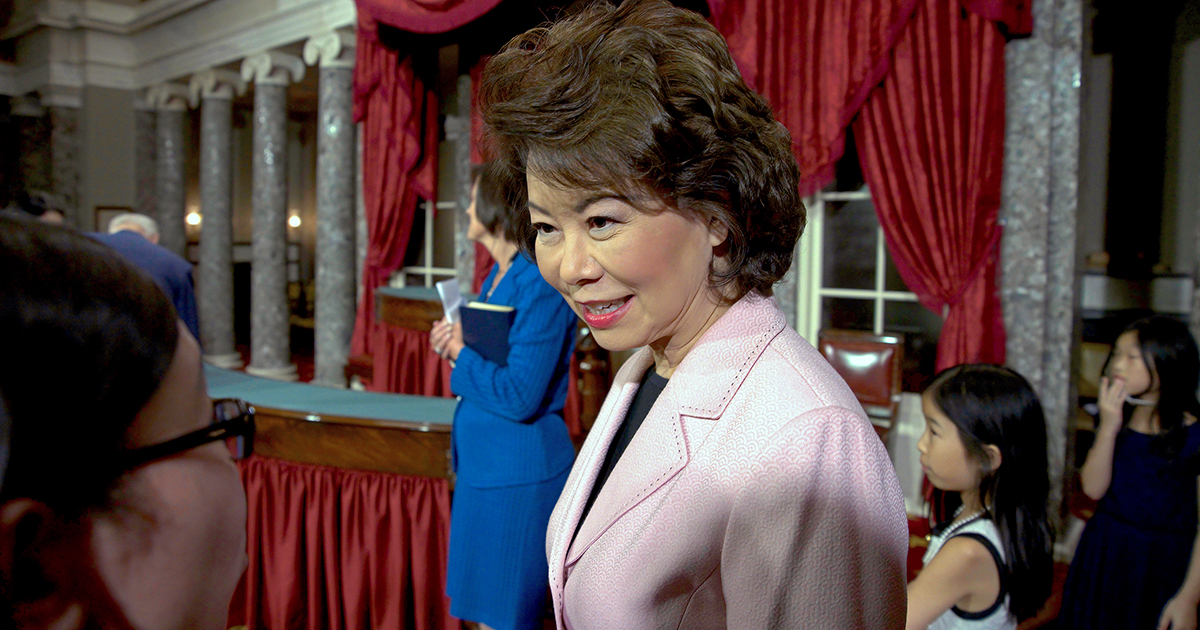

Elaine Chao arrived in the United States at age eight, came knowing no English, and spent the next several decades accumulating a record in public service that almost no one in American political history can match. She is often introduced, especially in recent years, as the wife of former Senate Majority Leader Mitch McConnell. That introduction is accurate and also incomplete by several decades. Elaine Chao is the first Asian American woman ever appointed to a presidential cabinet, and she holds the record for the longest combined cabinet tenure since World War II. The marriage to McConnell is part of the story. It is not the whole story.
Here are five things worth knowing about her.
1. She Was the First Asian American Woman Ever Appointed to a Presidential Cabinet

Elaine Chao is the first Asian American woman ever appointed to a president’s cabinet in American history. That happened in 2001, when President George W. Bush nominated her as Secretary of Labor. The confirmation was unanimous.
According to the University of Louisville McConnell Center, when she was confirmed to her first cabinet post as Secretary of Labor, she became the first woman of Asian American and Pacific Islander heritage to serve in a president’s cabinet in history. For context: this was not a country that had made a habit of confirming cabinet secretaries unanimously.
She arrived in the United States in third grade, not knowing how to speak English, and received her citizenship at the age of 19. Between that arrival and that Senate floor vote lay nearly four decades of professional accumulation: banking at Citicorp and Bank of America, a White House Fellowship, a series of increasingly senior government transportation roles, the directorship of the Peace Corps under President George H.W. Bush, and a stint as CEO of United Way of America.
2. She Holds a Record for Cabinet Service That Has Stood Since World War II
Elaine Chao served eight years as Secretary of Labor under George W. Bush, then returned to the cabinet under Donald Trump as Secretary of Transportation. According to the Harvard Business School Library, she served two terms as Secretary of Labor and, later, as Secretary of Transportation – a record-breaking 12 years, making her the longest-serving cabinet secretary since World War II.
A tenure spanning four presidential terms, three Senate Majority Leaders, and an almost complete generational turnover in both chambers of Congress. She was confirmed to her Labor post in 2001, served through 2009, spent years in the private sector and at the Hudson Institute, then came back confirmed as Transportation Secretary in 2017.
During her tenure as Secretary of Transportation, the department prioritized safety while increasing its investments in infrastructure by more than $300 billion, with hallmark initiatives focused on developing future transportation systems including self-driving cars, drones, high-speed rail, and commercial space. Her time at Labor was defined by a focus on workforce preparedness and workplace safety.
3. She Resigned From Trump’s Cabinet the Day After January 6
Transportation Secretary Elaine Chao was the first cabinet-level Trump official to resign in protest of President Trump’s role in inciting the mob that attacked the Capitol Building on January 6. According to CNBC, Chao was the first Trump cabinet member to quit in connection with Wednesday’s chaos, having served in the administration for four years. She resigned with nine days left.
Her statement was direct. She said, “Yesterday, our country experienced a traumatic and entirely avoidable event as supporters of the President stormed the Capitol building following a rally he addressed,” adding that “it has deeply troubled me in a way that I simply cannot set aside.” In her later testimony before the January 6 House select committee, she elaborated, describing the events as “shocking” and saying her personal values and philosophy made it impossible to continue.
Born in Taiwan, Chao immigrated to the U.S. in the third grade without any knowledge of English, became a U.S. citizen at the age of 19, and went on to earn her master’s degree from Harvard Business School. She said, in her testimony: “I came as an immigrant to this country. I believe in this country. I believe in a peaceful transfer of power.” Coming from someone who had served two presidents across two decades, that statement carried a different weight than it would have from a political newcomer.
4. Her Time at Transportation Was Shadowed by an Inspector General Investigation
After she left the Department of Transportation, the department’s own inspector general released findings that had been building for years. According to a report by Fox News, the Transportation Department’s inspector general said it had twice asked the Justice Department under President Trump to investigate then-Secretary Chao, and the DOJ declined both times – first from the U.S. Attorney’s Office for the District of Columbia on December 16, 2020, and then from the DOJ’s Public Integrity Section the following day.
The inspector general alleged that Chao used her position to benefit her family’s shipping company and used her taxpayer-funded staff for personal tasks. Her father, James S.C. Chao, founded Foremost Group, a U.S.-based shipping company with substantial operations in Asia. The company became a focal point of questions about whether Elaine Chao’s policy decisions, or access to government resources, could have benefited the family business.
The inspector general’s office also looked into allegations that Chao improperly steered federal funds to her home state of Kentucky, and she was cleared of conflict of interest allegations regarding stock in a stone and asphalt producer. The investigation produced a complicated picture: some allegations supported, others not. The Justice Department declined to pursue criminal charges on two separate referrals.
5. She and McConnell Are One of Washington’s Most Enduring Political Partnerships
They met through mutual friends in the early 1990s. McConnell had befriended Stuart Bloch, a liberal public-interest lobbyist, back in the 1960s, and in the early 1990s, Bloch invited McConnell to a dinner with his wife, Julia Chang, and Chang’s protégée, Chao. They married in a ceremony at the U.S. Capitol on February 6, 1993, choosing that date for three reasons: it was Ronald Reagan’s birthday, it was just before Chao’s 40th birthday, and it landed right before a one-week Senate recess.
The couple has an 11-year age difference, and while their marriage has been described as strong and enduring, they never had children together. McConnell has three daughters from his first marriage to Sherrill Redmon, who later became a feminist scholar. McConnell cooked occasionally and did the laundry; Chao was responsible for fixing things around the house, according to an interview the couple gave The Washington Post in 1998.
McConnell had polio as a child and finds backslapping painful, so Chao stepped in to hug constituents in his stead – a detail so specific it became part of their campaign mythology. She was known on the trail as the “campaign hugger.” The partnership survived Trump’s racist attacks on both of them, including when he publicly used a mocking ethnic slur to refer to Chao by name after McConnell refused to challenge Biden’s election results.
What Her Story Actually Adds Up To
Elaine Chao’s biography does not fit cleanly into any single narrative. She is a historic figure by several objective measures: first Asian American woman in a presidential cabinet, longest-serving cabinet member since World War II, one of the few people to have held two separate cabinet positions. She is also someone whose tenure in government generated genuine ethical scrutiny that was never fully resolved. Both of those things are true.
Eight-year-old Chao started her journey to America on an overnight train in Taiwan with her mother and two sisters in 1961, then boarded a cargo ship to cross the Pacific Ocean to California before finally reaching New York. The gap between that cargo ship and the secretary’s desk at the Department of Transportation is genuinely vast. Her story captures what the American immigrant experience can look like when it intersects with ambition and access in exactly the right combination, and it does not resolve the questions about what she did with that power once she had it.
AI Disclaimer: This article was created with the assistance of AI tools and reviewed by a human editor.