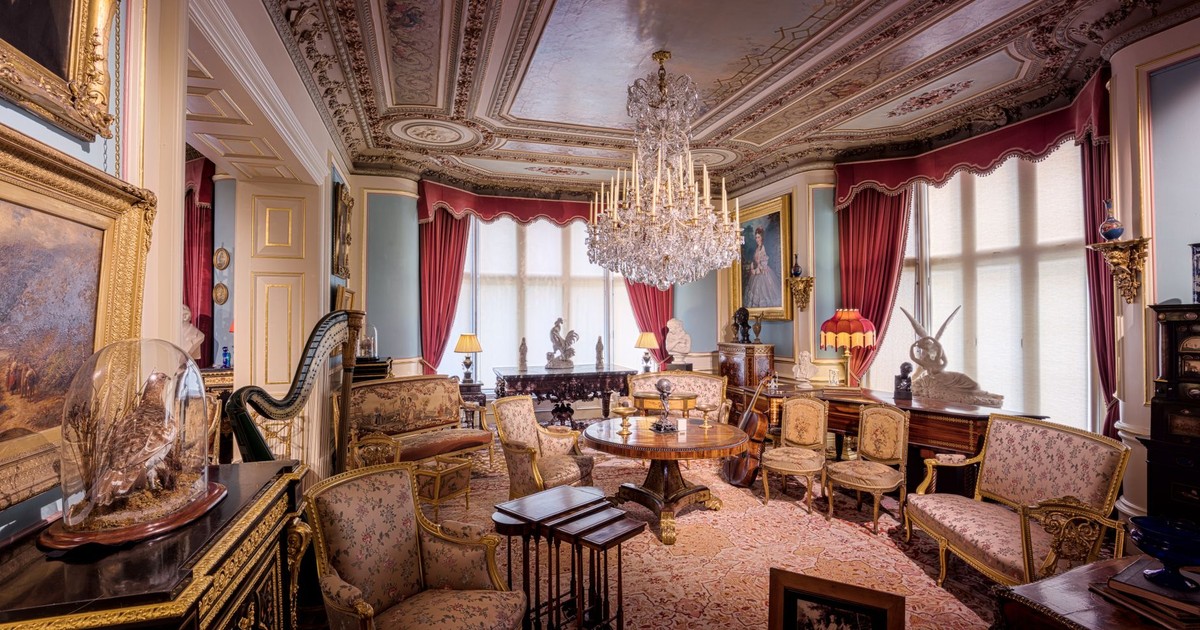

Every room in a Gilded Age mansion told a story, and every object in it was a carefully chosen line in that story. The parlor wasn’t just a parlor. The tea service wasn’t just something you drank from. Even the fern in the corner was doing work, announcing to every visitor exactly who lived there and, more pointedly, who did not. The Gilded Age, roughly 1870 to 1900, was the era that gave America its first crop of self-made industrial billionaires, the Vanderbilts and the Carnegies and the Rockefellers, and the domestic interiors of that period reflected a singular, almost theatrical obsession with demonstrating that wealth was not just possessed but inhabited.
Mark Twain and Charles Dudley Warner coined the term “gilded age” in their 1873 satirical novel to describe a society that was shiny on the surface and rotten underneath, a culture so fixated on accumulating and displaying riches that it mistook glitter for gold. The objects wealthy families filled their homes with were not incidental to that project. They were the project. Each one communicated something specific: taste, education, technological access, connection to the natural world, or simply the brute fact of having more money than the family three streets over.
The logic hasn’t disappeared, it has just migrated into different things. But there is something particularly clarifying about looking at Gilded Age household items, because the performance was so unambiguous. These families weren’t pretending not to show off. Showing off was the point.
1. Ferns and Indoor Plants
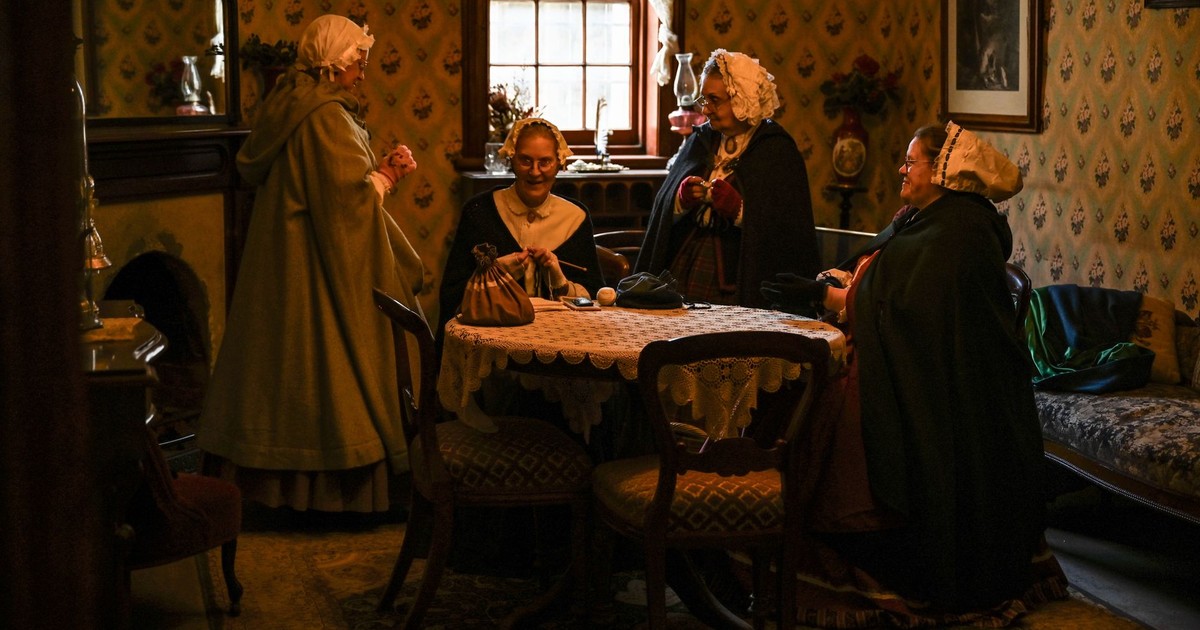
Of all the things a wealthy family could fill a room with in the late nineteenth century, a fern was among the most socially loaded. The rarer or more difficult a plant was to grow, the greater its value as a status symbol, and rare tropical houseplants were the most coveted expressions of that hierarchy.
The craze had a name: pteridomania, or “fern fever.” It swept Britain between the 1840s and 1890s. The term “pteridomania” was coined in 1855 by Charles Kingsley in his book Glaucus, or the Wonders of the Shore. The obsession crossed the Atlantic, taking hold among the American wealthy as well. Among the wealthy, this wasn’t casual gardening. The particularly passionate and prosperous would display their collections in carefully constructed outdoor ferneries, and if that were out of reach, a book of collected, pressed, and dried ferns might do.
To collect ferns, the more exotic the better, you needed a fernery, often a glasshouse where the ferns could be cultivated and displayed, though outdoor ferneries also existed in the form of gothic grottos. For those without grounds for an outdoor fernery, the Wardian case (a sealed glass enclosure, essentially the first terrarium) became a fashionable alternative that sat in the parlor like a jewel box. The case originated around 1829 when physician and amateur naturalist Nathaniel Bagshaw Ward accidentally discovered that plants could thrive inside a sealed glass container, and subsequently developed a specific case for growing plants indoors. Ferns and fern motifs spread far beyond the plants themselves, adorning rugs, tea sets, chamber pots, and garden benches.
2. Grand Pianos
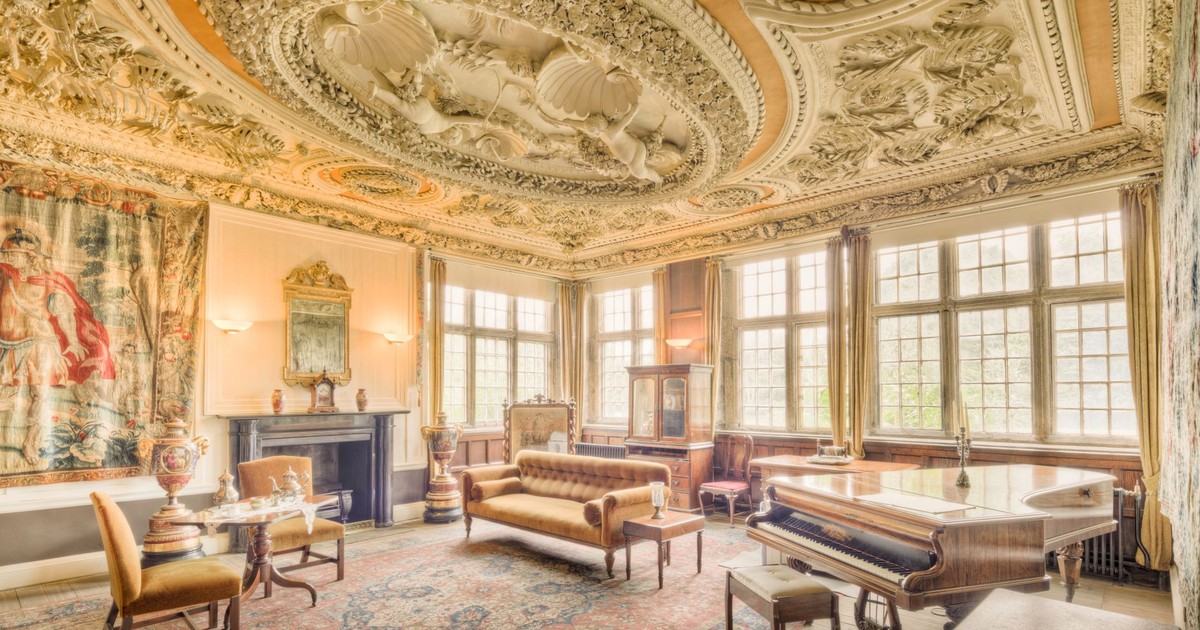
A grand piano is a large object. It takes up a significant portion of a room, requires regular tuning, demands a certain kind of floor, and is essentially useless if no one in the household can play it. For the Gilded Age elite, all of that was precisely the point.
The ultimate musical instrument for Gilded Age households was the pipe organ: very large, very expensive, and often requiring design during the house construction itself. But the grand piano was the more common aspiration. One wealthy Fifth Avenue household of the era boasted a piano on all three floors. The piano didn’t just announce musical interest. It announced space, expenditure, and a willingness to make an entire room subordinate to a single object.
For wealthy households at the end of the 19th century, the piano was a centerpiece, often commissioned with bespoke cases to harmonize with the broader decorative scheme of the interior. The instrument itself was frequently designed as a work of art. Neoclassical references, symmetry, columns, and palmettes remained fashionable in more conservative homes, while a grand piano with Empire-style gilt mounts or Art Nouveau marquetry served as both a musical instrument and a declaration of cultural alignment with the decorative trends of the day. A Steinway grand piano with an ornate case designed by the painter Lawrence Alma-Tadema — commissioned for the Manhattan mansion of financier Henry Marquand — was acquired by the Clark Art Institute in 1997 and remains one of the grandest instruments of the Gilded Age.
3. Tea Sets
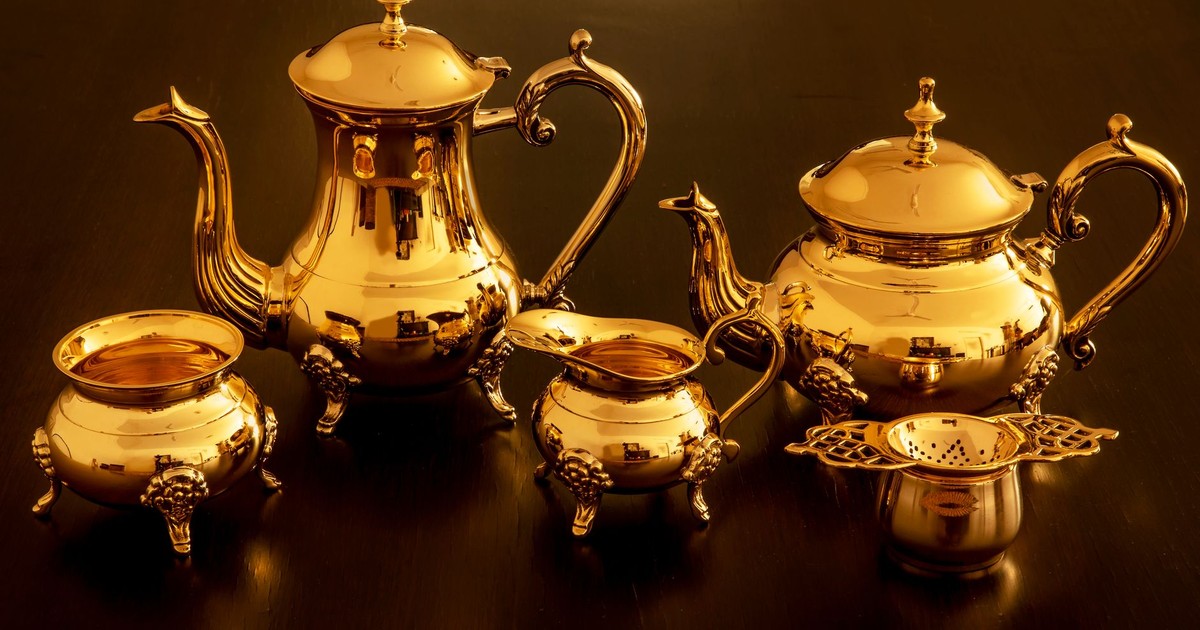
Tea, in the Gilded Age, was not a beverage. Or rather, it was a beverage, but that was almost incidental. What it actually was, was a social ritual that gave wealthy women a structure around which to organize their afternoons, display their possessions, and receive guests in a setting they controlled entirely.
The tea set was the centerpiece of that ritual, and it could be extraordinary. A complete service typically included cups, saucers, a teapot, a milk or cream jug, a sugar bowl, tongs for the sugar cubes, and often a tray and a kettle stand. For the wealthiest families, these were made of sterling silver, or elaborate enameled materials in jewel-like colors that reflected the owner’s taste and purchasing power. Fern motifs, consistent with the era’s broader obsession, frequently appeared on the china. The visual statement of an elaborate tea service laid out for guests was unmistakable: someone here has money, someone here has taste, and someone here has enough household staff to keep all of this polished.
Silver collections in this era were about more than impressing guests with needlessly large place settings. Many of these objects required the money and the servants necessary to maintain them, meaning having the staff required to keep the silver polished and tarnish-free. The tea set, in this sense, was not one object but an entire ecosystem. You needed the set, the room to display it in, the guests worth displaying it to, and the domestic workers who would ensure that nothing was tarnished when those guests arrived. Owning it was only the beginning of what it communicated.
4. Telephones
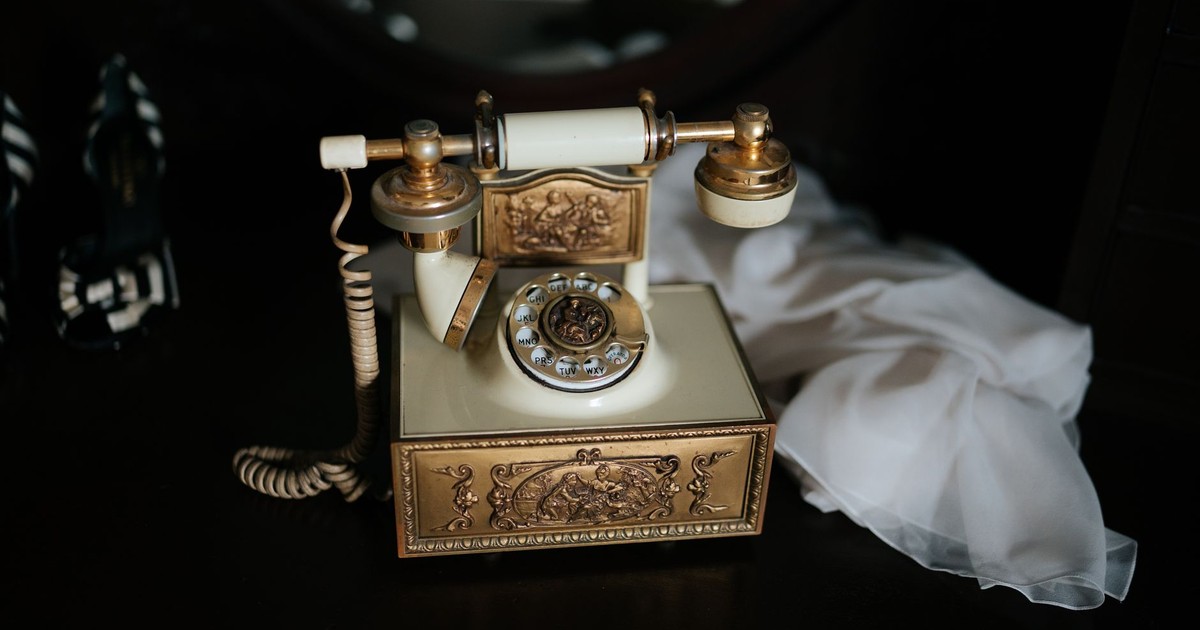
In the Gilded Age, a home telephone was as rarefied as a private jet, and it communicated something very similar: that you operated at a level of urgency and importance that ordinary communication infrastructure could not accommodate.
Telephones, which were patented in the U.S. in 1876, quickly became a mainstay in the homes of the Gilded Age elite. The access was extremely uneven. By 1880, almost 50,000 telephones were in use across the entire country, a number that sounds large until you consider what the population was. For the very wealthiest families, having a single telephone room was the entry point. Most houses had a small telephone room, but those who were even wealthier had telephones in more rooms, mostly bedroom suites, and to have a phone in the bathroom would have been very upscale.
The telephone also conferred something beyond status in the purely social sense: it gave its owner a practical advantage over everyone who didn’t have one. Business could be conducted faster, invitations sent and received more efficiently, and the social machinery of the Gilded Age kept running at a pace that was simply unavailable to anyone operating without one. The telephone wasn’t just a symbol of wealth; it was a tool that actively helped maintain it.
If you’re curious which household objects from this era have held their financial and historical value into the present day, it’s worth a look at antiques that will only grow in value, where Gilded Age pieces appear consistently for reasons that track directly back to this kind of original status.
5. Silver Collections
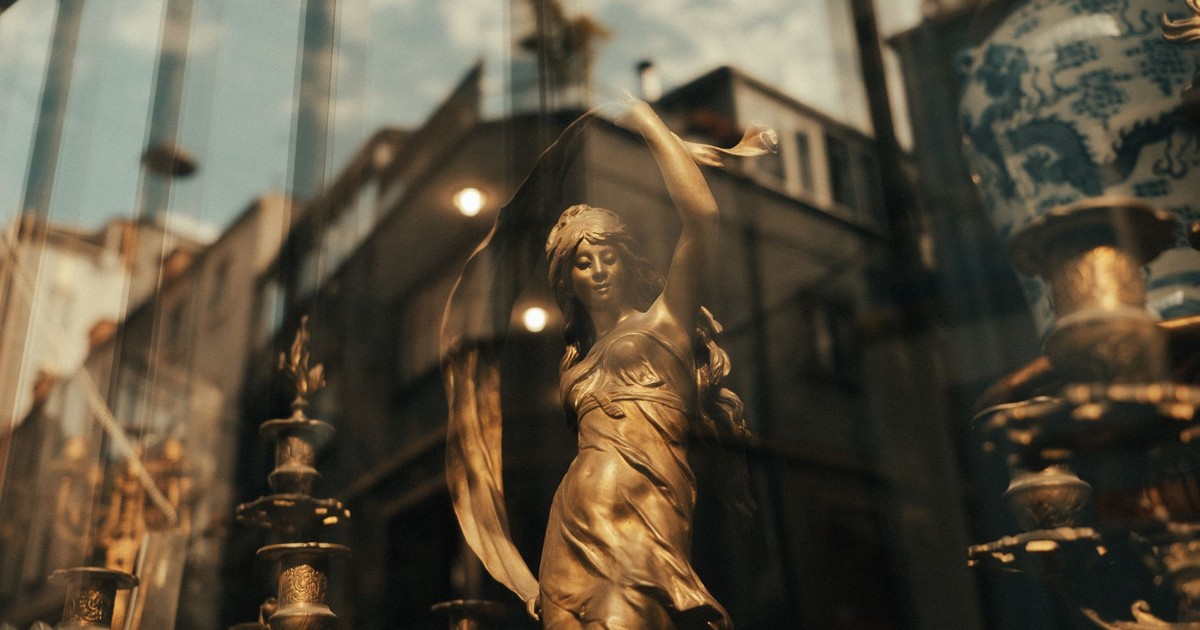
A piece of silverware has a function, yes, but the Gilded Age silver collection was almost always purchased and maintained far beyond any functional justification. An elaborate silver epergne (a large branching centerpiece used for holding fruit or flowers at the dining table), or a monogrammed silver tea service with matching serving pieces and a silver-mounted carving set, was never just about eating. It was about declaring, in gleaming, high-maintenance, tarnish-prone metal, that your household was of a particular order.
Art and literature flourished during the Gilded Age, and the rich filled their lavish homes with expensive works of art and elaborate décor. Silver sat at the center of that decorative program in a particularly pointed way, because it required ongoing labor to maintain. A silver collection that was not polished was an embarrassment. A silver collection that was polished was proof that you had enough staff to keep it that way. The object and its maintenance together told the story. This is why silver was understood not merely as a material possession but as an emblem of the entire domestic operation behind it.
Silver also traveled well into dining room theater. Elaborate Gilded Age dinner parties, hosted in the grand Fifth Avenue mansions of the era, with guests dancing until dawn and listening to concerts performed by visiting European musicians, were the social equivalent of a standing ovation you threw for yourself. The silverware on those tables was part of the performance. Guests noticed. They were meant to.
What the Objects Were Really Saying

The Gilded Age ended, more or less, with the introduction of the federal income tax in 1913 and the social disruptions of the First World War. The dynastic wealth it produced didn’t vanish, but the culture of unabashed, room-filling, staff-requiring display did soften. Grand pianos got replaced by record players. Ferneries became impractical. Telephones became ordinary. Silver got locked in velvet-lined boxes and brought out less often.
The underlying logic didn’t change. Every era has its version of these five objects, things that look like household items but are actually arguments about who you are and where you belong. The Gilded Age version is simply unusually legible, because the people involved were not particularly interested in pretending otherwise. They wanted you to see the piano. They wanted you to notice the fern. They had no interest in minimalism, no anxiety about looking like they were trying too hard. These weren’t possessions that happened to carry meaning. They were meaning, first and last, with a practical use almost as an afterthought.
Disclaimer: This information is not intended to be a substitute for professional medical advice, diagnosis, or treatment and is for information only. Always seek the advice of your physician or another qualified health provider with any questions about your medical condition and/or current medication. Do not disregard professional medical advice or delay seeking advice or treatment because of something you have read here.
AI Disclaimer: This article was created with the assistance of AI tools and reviewed by a human editor.