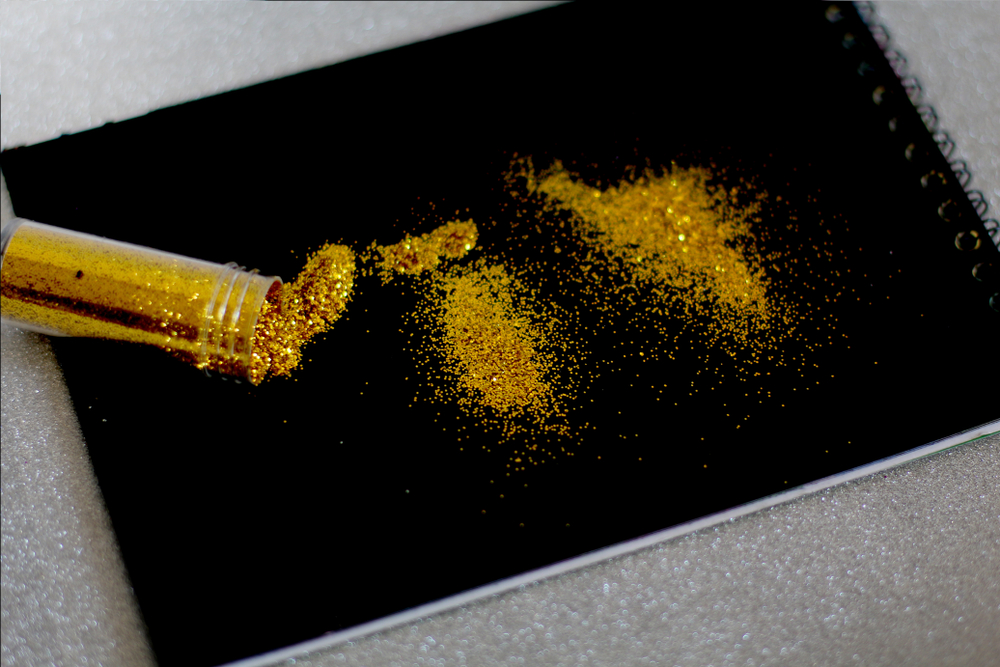

Every serious baker’s kitchen has a drawer, or a shelf, or a little cluster of vials somewhere near the workspace, and to anyone glancing at it, the contents look more or less interchangeable. Small containers of powder in metallic golds and silvers and bronzes, some labeled “edible,” some labeled “for decorative use only,” some with ingredient lists and some without. They sit beside the piping bags and the food coloring and the sprinkles, and they look like they belong in the same category because, visually, they do. The distinction between edible and non-edible decorating powders is a text difference on a label, and not always a clear one at that.
This is how a danger stays invisible: not because anyone was reckless, but because the system that produces these products has not kept pace with the responsibility of how they’re sold and stored. Metallic lustre dusts are a growing feature of baking culture, popularized on television, in instructional videos, and across social media. They create the kind of gleaming, editorial-quality finish that makes a birthday cake look like it belongs in a magazine. And the vast majority of people using them have no reason to suspect that some of them contain copper, zinc, lead, or barium. Because nothing on the label says so.
In May 2025, a professional baker in Queensland, Australia named Katie Robinson learned what happens when a 14-month-old gets hold of one of those vials. Her son Dustin, known as Dusty, bit the top off a canister of metallic decorating powder, inhaled and ingested the contents, and ended up in intensive care. What followed is the kind of story that changes how you look at your own kitchen.
What the Powder Actually Did
Dustin inhaled a vial of metallic decorating powder while his mother was making a Bluey-themed birthday cake on May 1. Once mixed with the moisture in his airways, the powder didn’t stay powder. It became something closer to paste, a dense, blocking material that filled the pathways through which his lungs needed to move air. Surgeons had to go in and remove it. The physics of what happened inside his body in that span of minutes is what drove the severity of everything that followed.
Doctors diagnosed Dusty with chemical pneumonitis, a serious condition caused by inhaling toxic substances. Chemical pneumonitis is lung inflammation triggered by an irritant rather than a virus or bacteria; without prompt treatment, it can cause irreversible lung damage. He underwent emergency surgery to remove the powder from his lungs and was placed in an induced coma.
Doctors sent the decorative powder away for testing and discovered it contained copper and zinc compounds. Copper does not dissolve in blood. It does not pass through. It gathers. When inhaled or swallowed, copper can cause breathing difficulties, serious lung injury, and potentially permanent chronic complications. Katie Robinson, by her own account, was horrified when she learned what was in the powder she had been keeping in a kitchen drawer alongside her edible supplies.
A Labeling Problem That Has Been There for Years
Here is the part of this story that is hardest to sit with: this was not unknowable. The danger of non-edible decorating dusts was not a mystery lurking in a laboratory waiting to be discovered in 2026. Several types of glitters and dusts, broadly known as lustre dust, can be purchased online and in craft and bakery supply stores, and decorating foods with these products has been a growing trend popularized on television programs, instructional videos, and in magazine articles.
Lustre dusts that are safe for consumption are typically marked “edible” on the label. Some lustre dusts used as cake decorations are not edible or food grade – labeled as “nontoxic” or “for decorative purposes only,” these products are intended to be removed before consumption. That word, “nontoxic,” is doing a lot of misleading work. Nontoxic, in this context, means roughly: not immediately harmful if a small amount contacts skin. It does not mean safe to eat. It certainly does not mean safe to inhale.
Robinson noted that the packaging on the product Dustin inhaled was quite vague – it said nothing about the product being non-edible, toxic, or anything to that effect. Her partner said there was no ingredient list on the product at all. As a professional baker surrounded by similar-looking vials every day – some edible, some not – she had no reason to treat this one differently from the others.
The National Capital Poison Center has warned that if a cake decorating product is labeled “for decorative purposes only” or simply “nontoxic,” it should not be eaten – and specifically, that it should be removed from a cake before serving. That’s important guidance for adults making deliberate choices about what goes on a cake they’re about to serve. It does almost nothing to protect a 14-month-old who has found a vial in a kitchen drawer.
The CDC investigated heavy metal poisonings associated with lustre dust as far back as 2018 and 2019, finding that non-edible lustre dusts used in cake frosting contained elevated levels of copper, lead, aluminum, barium, and other metals. Investigators at the time found widespread use of non-edible lustre dust on food items and called for clearer labeling. The labeling, clearly, has not caught up.
If you have baking supplies at home and you’re not completely certain which products in your collection are food-safe and which are decorative-only, this is the moment to check. It’s also worth a look at hidden hazards that can live in a kitchen – because some of them look far more innocent than they are.
Where Dusty Is Now
In an update posted in mid-May, Robinson shared an encouraging development: “Our beautiful boy is awake and alert, playing and smiling.” He is still in Queensland Children’s Hospital. He is still recovering. He has a feeding tube because he has not yet been able to take a bottle, and he has begun asthma therapy. His doctors have told his family that he will likely need physiotherapy and occupational therapy as part of his recovery. And they have told Robinson something that no parent wants to hear: that he will likely carry lifelong lung damage.
“We’re hoping he proves them wrong,” she said.
Katie Robinson and her partner Chris are both sole traders who put all their work on hold to be with Dustin in Brisbane, with no certainty about when they’ll be able to work again given how rare and uncertain his condition has proven to be. More than $30,000 was raised through a GoFundMe organized by a family friend to help cover their medical and accommodation costs as they remained by his side.
That update comes from The Nightly, which has been following Dusty’s recovery since his hospitalization.
What This Family Wants You to Know
Robinson has said, in multiple interviews, that this product should never have been marketed near anything to do with food. She has called on the supplier – who has since pulled the product from sale and contacted stockists – and on the broader industry to label these products clearly and unambiguously. Not “nontoxic.” Not “for decorative use.” Something that could not possibly be confused with “safe for a kitchen where children are present.”
She pointed out that as a professional baker, she was surrounded by so many similar products clearly labeled as edible – which makes the absence of a clear warning on the non-edible ones all the more dangerous. When everything looks the same, the one thing that’s different is invisible until something goes wrong.

That is the piece of this story that keeps pulling at you, long after you’ve read the facts. Not because there was negligence. There wasn’t. There was a mother at work, a child being a child, and a product sitting in a drawer that looked like it belonged there. The danger was baked in – not by the baker, but by the supply chain, the labeling conventions, the gap between what “nontoxic” means legally and what any reasonable person understands it to mean.
Dusty’s family is hoping he proves the doctors wrong about the lifelong injury. There’s no way to know yet. What is already true is that a 14-month-old went into surgery to have paste flushed from his lungs, and came out the other side breathing on his own, awake and alert, playing and smiling. That’s where the weight of this story sits: in the fragility of the ordinary afternoon, and in the fact that a little boy is still here to prove anybody wrong.
If you are a baker, check every vial in your collection and confirm, not assume, whether each one is food-safe. If a label does not have an ingredient list, treat it as non-edible. Keep everything that is not confirmed food-safe out of any drawer, shelf, or surface that a child could reach. It takes less than a second.
AI Disclaimer: This article was created with the assistance of AI tools and reviewed by a human editor.