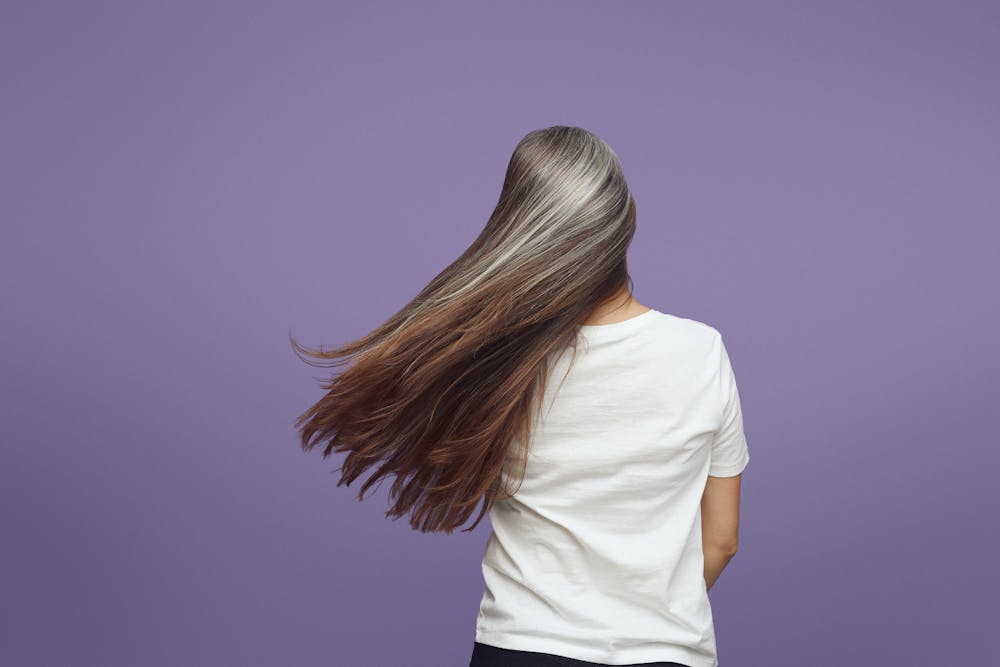

Gray hair is supposed to mean something. That’s the whole point. Not the color itself, which is just pigment cells doing less work than they used to, but what the culture has decided it means: that you’ve crossed some invisible line, that you’re no longer quite the version of yourself that counts, that the next step is a box of color and a conversation you have with yourself every six weeks at the bathroom sink. Most women know this pressure well enough to feel it even before the first strand appears.
The gray hair conversation has changed in recent years, and not just because the beauty industry discovered it could sell “silver toning shampoo” as aspirational. Something else is happening. More women are walking away from the dye chair and keeping their gray, not apologetically, not as an act of protest, but with a kind of easy confidence that other people in the room can’t help noticing. It raises a question worth sitting down with: what does it actually take, psychologically, to make that choice and mean it?
Because keeping your gray hair proudly is not passive. It is not simply giving up. The women who do it, who walk into a work presentation or a family dinner or a first date with silver at their temples and their heads held up, tend to share something in the way they carry themselves. Call it an interior architecture. The science, as it turns out, has a few things to say about what that architecture looks like.
A Settled Sense of Who They Are
Identity is the first piece. People who choose to let their natural color come through have usually stopped outsourcing their self-image to the cultural moment they happen to be living in. That doesn’t mean they’ve stopped caring about their appearance. It means they’ve developed a stable enough sense of self that their worth doesn’t hinge on whether their hair matches some updated standard of what a woman their age should look like.
Self-acceptance, which involves being aware of and able to accept one’s own strengths and weaknesses, is considered a central characteristic of positive psychological functioning and mental health. It’s one of those findings that sounds like a fortune cookie until you watch it play out in a real person. The woman who lets her gray come in isn’t resigning herself to anything. She’s decided, probably through some combination of lived experience and hard-won clarity, that she is not a problem to be solved.
This is harder than it sounds in a culture where every magazine cover and Instagram algorithm treats visible aging as something to be corrected. Women who resist that pressure haven’t done so by accident. They’ve developed a kind of internal compass that doesn’t spin when external opinion turns against them.
Resilience That Comes From the Inside Out
Research from Our Lady of the Lake University found that self-acceptance helps middle-aged and older adults manage adversity and maintain mental well-being, with the capacity to embrace both positive and negative aspects of oneself cultivating a sense of self-worth and reducing vulnerability to external stressors. Which is a formal way of saying: the people who have made peace with who they are do not fall apart every time someone or something tries to tell them they should be different.
Gray hair becomes a small but visible test of that resilience. The world has opinions about it. Other people at family dinners have opinions about it. The occasional well-meaning colleague will have opinions about it. The women who keep their silver anyway have practiced the muscle of not letting external evaluation run the show. They’ve learned to distinguish between feedback that’s useful and noise that’s designed to keep them purchasing something.
Resilience of this kind isn’t cheerfulness. It’s not pretending things are easier than they are. It’s the capacity to encounter pressure and not be redirected by it, to absorb the moment and continue moving in the direction you’d already chosen.
The Ability to Read a Room Without Needing to Win It
There is a particular freedom that arrives when you stop needing everyone to approve of you at every moment. Psychologists call aspects of this “secure attachment” or “non-contingent self-esteem,” but in practice it looks like a woman who can walk into a room, notice what’s happening around her without performing for it, and leave the room still knowing exactly who she is.
Physical traits can influence how people are perceived and evaluated by others, often reflecting underlying qualities considered important for social interaction, and gray hair is one such trait that can potentially alter social perceptions related to aging. The women who keep their gray anyway understand, consciously or not, that other people’s perceptions are data, not verdicts. They know they will be read as older in certain rooms. They’ve decided that doesn’t cost them anything they actually need.
This is not nonchalance. It’s something more deliberate: a choice to engage with the world on your own terms rather than managing the impression you make as a full-time occupation.
Comfort With Complexity

The women who let their hair go gray and own it tend to be comfortable with things that don’t resolve neatly, including themselves. They’ve usually lived through enough contradictions to know that holding two true things at once is not a weakness. They can appreciate that there is real cultural pressure on women to look younger, acknowledge that pressure honestly, and still choose not to comply. Both things are true. Neither cancels the other out.
Research published in Frontiers in Psychology in 2025 found that faces with gray hair were perceived as older and less attractive, with some participants also perceiving gray-haired faces as less trustworthy, though gray hair had no impact on assessments of social status or aggression. The study’s findings are complicated, because the reality is complicated. Gray hair does change how some people perceive you. The women who choose it anyway have processed that complexity rather than denied it, and decided their own comfort with their appearance is worth more than managing everyone else’s snap judgments.
That’s a psychologically sophisticated move. It requires what researchers sometimes describe as “positive rational acceptance,” an approach to coping that involves consciously reframing a challenge rather than avoiding it or trying to fix it away.
Long-Term Thinking Over Short-Term Approval
There is something almost strategic about the gray hair choice when you look at it closely, not strategic in a calculating way, but in the sense that the women making it are playing a longer game than the next compliment or the next look in the mirror. They have learned to measure their choices against what they actually want their life to feel like, not just what it looks like to someone passing by.
This connects to a broader pattern. Women who make value-driven choices about their appearance tend to report higher psychological wellbeing across a range of measures. The research on body image and aging consistently finds that it’s the relationship with your own body, not the body itself, that determines how you feel about it. A woman who has made an active, considered choice about her hair, and made it for herself, tends to carry that decision differently than one who is just between salon appointments.
The subjective aging framework proposes that aging is not just a physiological process but also how individuals perceive, evaluate, and experience their age-related changes, with awareness of these changes and attitudes toward aging consistently associated with life satisfaction, well-being, and mental health. In other words, the story you tell yourself about your own aging is doing a lot more work than the color of your hair. But the two are not unrelated. Choosing gray often means choosing a more honest story, one without the background maintenance of pretending.
A Low-Grade Defiance That Doesn’t Need an Audience
This one is harder to name, but you know it when you see it. It’s not anger, and it’s not a statement. It’s more like a private decision that happens to be visible. Women who keep their gray proudly have usually developed a relationship with convention that’s comfortable rather than combative. They’re not trying to prove anything to anyone. They just stopped letting the default assumption that visible aging needs to be corrected run their decisions.
The American Academy of Dermatology notes that gray hair is a normal part of aging, common for people in their 30s or 40s, though it can happen earlier. The word “normal” in that sentence is doing work that tends to get overlooked. Most of the anxiety around gray hair is not about hair at all. It’s about what gray hair is supposed to mean, about invisibility, about being past a certain cultural expiration date. The women who reject that framing have freed up a remarkable amount of mental real estate.
That low-grade defiance tends to extend in every direction. They’re usually the people in the room who say the thing others were thinking, who decline the invitation they didn’t actually want to attend, who have noticed that other people’s comfort is not their permanent responsibility. The hair is almost incidental. It’s the spirit underneath it that’s doing something interesting.
The Willingness to Be a Little Bit Interesting
There is, honestly, a kind of curiosity that the genuinely gray women tend to have, an interest in what comes next rather than a preoccupation with what they might be losing. Research published in Nature Cell Biology in October 2025, led by University of Tokyo experts, suggests that gray hair may be evidence that the body has protected itself against melanoma, a serious form of skin cancer. Whatever you think of that finding, the metaphor it carries is not lost on people who’ve spent any time thinking about the gray hair question: silver strands not as loss, but as evidence of a body that has done something hard and come through it.
The women who keep their gray tend to be interested in that framing. Not because it makes them feel better about their appearance, exactly, but because it fits a broader orientation they have toward their own history. They tend to view the marks that time leaves on a body, the lines, the changes in texture, the silver, as information rather than damage. Their curiosity about who they are now is stronger than their grief about who they used to be.
What This Is Really About
None of this is an argument that keeping your gray hair is the right choice for everyone, or a morally superior one, or any kind of choice at all. Hair dye exists, it works, and it is the business of exactly no one else what you do with your own hair. The women who color it are not less psychologically sophisticated than the women who don’t.
What the gray hair question does is give us a clear, visible place to look at something that’s harder to see in other contexts: the relationship between a person and the expectations that society has appointed for her. What the research, taken together with the observation of actual women actually living their lives, suggests is that the women who keep their silver tend to have built something real in the place where the approval-seeking used to live. A sense of self that doesn’t need constant maintenance. A long enough view to know that the next decade will be more interesting than it is threatening.
You don’t have to have that figured out. Most of us are somewhere in the middle, halfway between the dye and the decision, checking the mirror and not entirely sure what we’re looking for. That’s not weakness. That’s just where most of the honest conversations about aging actually happen, in the bathroom, under the bad lighting, with the question still open.
AI Disclaimer: This article was created with the assistance of AI tools and reviewed by a human editor.