
A simple challenge that was shared on Facebook became popular because it felt like a quick IQ-test anyone can try. You do not need math skills or logic formulas. You only need your eyes, or so it seems.
The longer you look, the less confident you feel. That moment of doubt is what hooks people. It is also where psychology quietly steps in. What looks easy at first turns into something surprisingly tricky, not because the image is complex, but because the brain is. This is why so many people return to the image more than once. They are not chasing a number; they are chasing certainty.
The Dot Puzzle That Tricked So Many People
The puzzle itself looks harmless. A notepad with a handwritten message asking how many dots you can see. Some dots jump out immediately. Others blend into letters, punctuation, or spacing. Many people count once and feel sure. But then they look again, and suddenly, the number changes.
Some viewers realize they ignored dots inside question marks or letters. Others notice details they skipped the first time. The image never changes, but the answer often does, which tends to create frustration and debate.
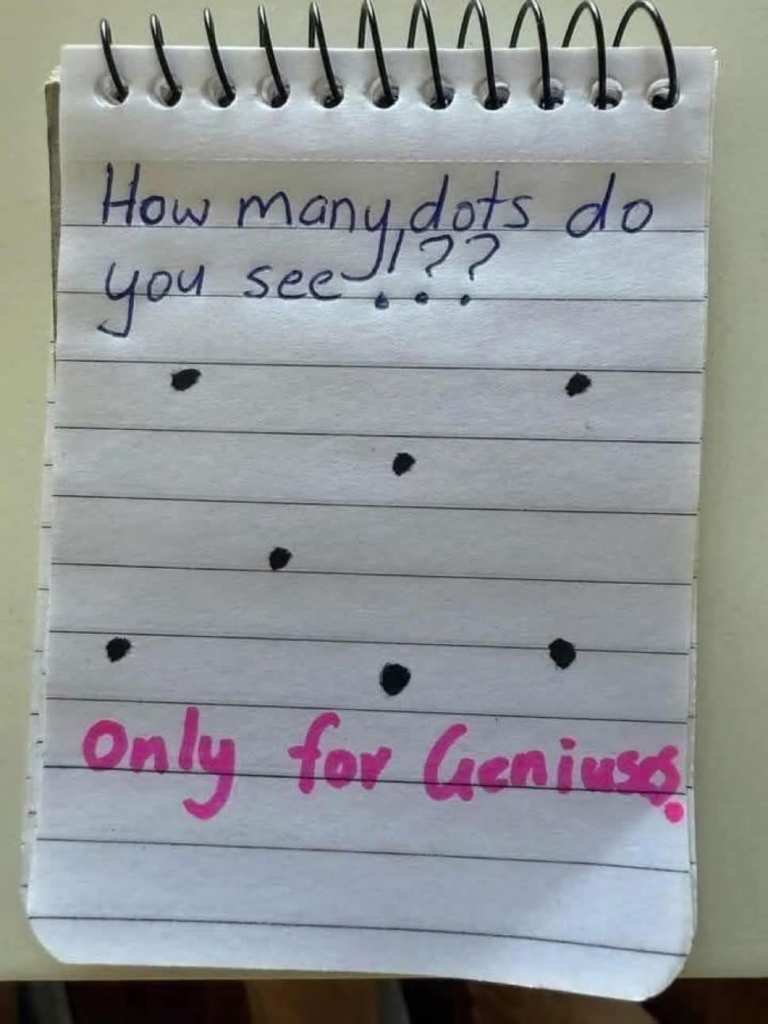
The puzzle spreads online because people want confirmation of the correct answer. They want to know if others counted the same way. The comment sections fill with arguments, jokes, and corrections. Everyone feels slightly unsure, and that shared uncertainty keeps the image circulating longer than expected.
What makes this puzzle clever is not deception, as nothing is hidden on purpose. The illusion works because the brain fills in gaps automatically, even when it should not.
Why Simple Images Confuse the Brain
The human brain loves shortcuts. It looks for patterns and familiar shapes, which saves time in daily life. When you read, you do not examine every letter. You recognize words instantly. That same habit works against you in this puzzle. Instead of counting each dot carefully, the brain assumes it understands the image. It groups elements together and dismisses details that feel decorative or unimportant.
This is why rushing leads to mistakes. The brain trusts its first impression too much. Slowing down helps, but many people resist doing that. They believe effort is unnecessary for something that looks simple. The puzzle exposes how often the brain chooses speed over accuracy, even when accuracy matters. It also reveals how easily confidence forms around incomplete information.
Is This Really a Measure of Intelligence
Calling the challenge a quick IQ test sounds dramatic; however, intelligence is far more complex than a single visual task. True IQ tests measure memory, reasoning, spatial awareness, and problem-solving together. Still, the dot puzzle reveals something useful. It shows how someone approaches a problem. Does the person rush? Do they double-check or question their first answer? Do they get defensive when others correct them?

In that sense, the puzzle reflects thinking style rather than intelligence level. It highlights attention, patience, and willingness to slow down. Those traits matter in real life as they shape decision-making, communication, and learning. Even though this is not a formal intelligence test, it mirrors behaviors that influence performance far beyond puzzles.
How Optical Illusions Actually Work
Optical illusions exist because perception is active. Our eyes collect light, and the brain decides what that light means. That decision depends on experience and biological limits. Psychologists explain that the brain filters information constantly. It cannot process everything at once, so it focuses on what seems important and ignores the rest. Most of the time, this works well, but in visual puzzles, it causes errors.
When dots sit close together, the brain groups them. When dots appear inside letters, the brain treats them as decoration. These choices happen automatically, which you rarely notice. Some illusions also come from neural limits. Certain visual neurons respond better to edges or contrast and fine details sometimes receive less attention. This makes the brain efficient, but not precise.
Attention, Confidence, and Everyday Blind Spots
The dot puzzle mirrors how attention works in daily life more than people realize. Most of the time, we believe we notice what matters. In reality, the brain constantly filters details to save energy. When you skim an email, you might miss a word that changes the meaning. When you drive a familiar route, parts of the trip disappear from memory. Familiar patterns make the brain relax, sometimes too much.

Confidence adds another layer to the problem. Many people feel certain after their first count. They trust their initial guess and defend it online. Then someone points out a missed dot hidden in punctuation or spacing. That moment often feels uncomfortable for people. Psychologists describe this as a confidence gap. It happens when belief and accuracy drift apart. Optical illusions expose this gap in a clear and harmless way. The brain assumes it is right because it usually is.
From an evolutionary perspective, this makes sense. The brain evolved to act quickly. Speed once mattered more than precision, and today, that instinct remains. Counting dots is not a survival task, so the brain treats it casually.
Why People Love and Share These Puzzles
Despite the frustration they cause, people genuinely enjoy these challenges. A puzzle like this creates a small mental itch that gets people’s curiosity going. It looks easy, but the brain wants closure. Visual puzzles feel safe as there is no real risk or score follows you. No one truly fails. That makes people more willing to engage, even if they feel unsure. It becomes play instead of pressure.
Social media amplifies this effect. Once people post their answers, the puzzle turns social. Comments are filled with different numbers. Some confident. Some hesitant. Others were openly confused. That mix keeps the conversation going. People return to the image not to solve it, but to compare themselves with others.

The label quick IQ-test adds emotional fuel. It quietly pokes at the ego. Even those who know it is not a real intelligence test feel tempted to prove something, if only to themselves. In the end, sharing the puzzle is less about dots and more about participation.
Read More: Top 25 Riddles With Answers to Challenge Your Mind
What Puzzle Lovers Have in Common
Not everyone stops for these challenges. Some scroll past instantly, while others pause without thinking. Research suggests puzzle lovers often enjoy mental engagement. They tolerate uncertainty better than most. They like testing assumptions rather than defending them. For these people, missing a dot is not a failure; it is information.
They enjoy noticing how their thinking shifts with each attempt. The process matters more than the answer. That mindset turns frustration into curiosity. This is why some people replay the puzzle even after learning the correct count.
The Real Lesson Behind the Dots
In the end, the puzzle is not about the correct number, but rather about awareness. It reminds people that perception is constructed and that seeing is not passive. The brain decides what matters and what does not. That decision is made quickly and without permission. Realizing this can feel uncomfortable, but it can also feel freeing. Once you accept perception is imperfect, curiosity replaces certainty.
So how many dots can you count?
This so-called quick IQ-test succeeds because it slows people down, even briefly. In a fast world, that lesson is worth more than a number.