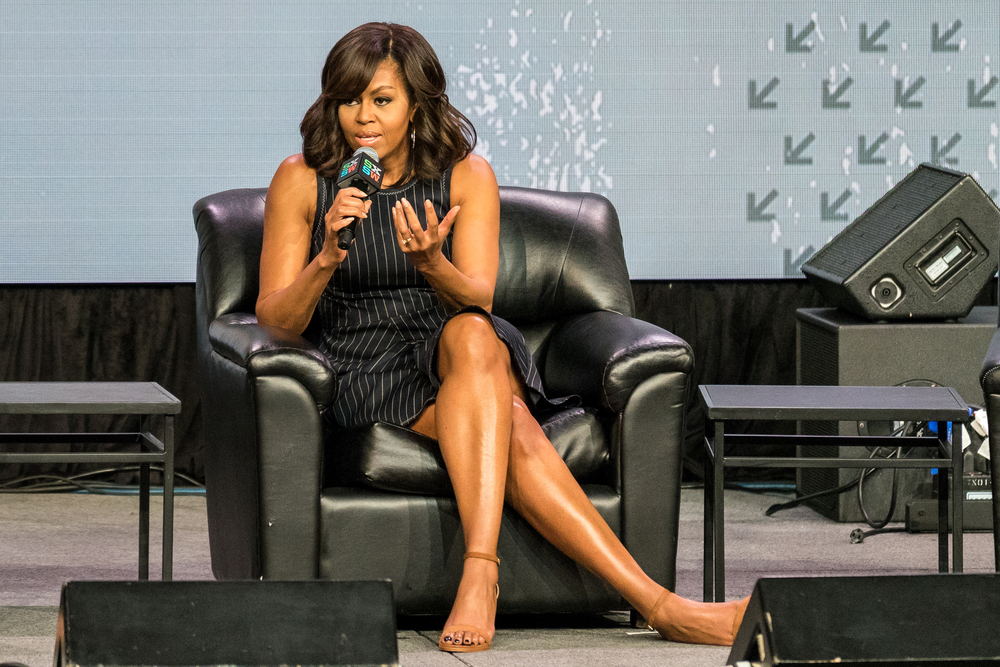

Few things expose the fault lines of American political life faster than someone famous trying to say something generous about the other side. The compliment goes wrong, the framing gets picked apart, and suddenly the concession everyone was waiting for becomes its own controversy. That is roughly what happened this week when Michelle Obama sat down with podcast host Sam Fragoso for an episode of Talk Easy and offered what she clearly intended as an act of political empathy toward the millions of Americans who voted for Donald Trump.
Obama appeared on Sunday’s episode of Talk Easy with Sam Fragoso, where Fragoso asked her how the emotions of Barack Obama’s presidential victory compared to those that followed Trump’s wins. She said she felt “deeply disappointed” when Trump won, but acknowledged that people were eager for something “different” because the system had stopped working in their favor.
The response she gave was notable – not because a prominent Democrat acknowledged working-class frustration (that has been happening since 2016), but because of the specific framing she chose, and what critics on both sides of the aisle heard in that framing. Within hours of the episode going live, the clip was everywhere, and the reaction split almost perfectly along the same lines that have defined American political debate for the better part of a decade.
What She Actually Said
According to Mediaite, Obama said that the election outcome had to do with people’s pain and where they are in their lives, and that people struggling with healthcare as well as the high cost of living were made more susceptible to finding someone to blame. She pointed specifically to voters who had supported her husband twice before switching to Trump, and she pushed back against the habit of reducing those voters to a single unflattering explanation.
Fox News reported that Obama said: “You can’t just pigeonhole them and say you just don’t care, and you’re racist or whatever you’re thinking. This is an act of ‘I don’t know what else to do.’ I just wish we had more leaders that were figuring out how to do more for the middle class, for the working folks, because those are the folks who are drowning in this economy.”
She also drew on her own family history to ground the argument. Obama described how widening income inequality has left working-class families of all backgrounds feeling abandoned, recalling her own father’s struggle with employment as a contrast to the financial instability facing millions of Americans today. The line that would generate the most coverage came toward the end of that section of the conversation: “It’s not me anymore, but I know those folks, and they’re good people, and they don’t have a way out and that makes for bad choices.”
Taken together, the remarks amounted to an argument that economic desperation – not ideology or bigotry – was the primary engine behind Trump’s coalition, at least among the voters who had previously backed Barack Obama. It was a more charitable reading of that coalition than the Democratic mainstream has typically offered, and it came from one of the party’s most visible figures.
The Criticism From the Right
The reaction from conservative commentators was immediate, and it cut in a specific direction. Rather than welcoming the concession that Trump voters are not racists, many on the right objected to the underlying premise: that voting for Trump constitutes a “bad choice” made by people who had no better options.
Sky News Australia contributor Kristin Tate said on The Kenny Report: “Liberals still fundamentally don’t understand Trump voters. When she says people voted for Trump because they didn’t know what else to do, that sounds incredibly dismissive.” Tate continued: “This is why Democrats struggle with working-class voters; they analyze voters like anthropologists instead of just listening to them.”
The critique, broadly, was that even Obama’s generous framing still places Trump voters in the position of being people who stumbled into a decision, rather than people who made a deliberate, reasoned choice. The word “desperate” – which appeared in several headlines describing her comments – was itself part of the problem, in this reading. Critics argued that Trump voters weren’t merely cornered, sad, or searching for a way out, but that they looked at the available options and voted for the candidate they trusted to fight for them. Describing that as a “bad choice” made from helplessness, rather than a considered political judgment, struck many Trump supporters as condescension dressed in sympathy.
This criticism carries real weight. Obama’s framing does carry an implicit hierarchy: the people making “good choices” are, by implication, those who arrived at a different conclusion at the ballot box. Acknowledging that someone’s anger is understandable while characterizing their response to that anger as a mistake is a position, not a neutral observation, even when it is delivered with evident warmth.
The Criticism From the Left
The criticism from the other direction was quieter but present. Some observers noted that Obama’s position contains a tension that Democratic leaders have struggled to resolve: she is effectively arguing that the same economically desperate voters she wants liberals to stop demonizing are also supporting the very administration whose policies she has spoken out against in other forums.
With the 2026 midterm elections approaching, Democrats face a strategic question that Obama’s comments bring into sharp relief. The party cannot simultaneously tell voters it understands their economic pain while also opposing the policies those same voters helped put in place. Obama did not offer a resolution to that contradiction during the podcast, and her comments were not designed to be a policy platform. But the tension is real, and it reflects a problem the Democratic Party has not yet solved: how to speak honestly about why it lost without either validating the choices that led to the loss or insulting the people who made them.
Obama also made separate comments during the interview that generated friction of a different kind. She referenced remarks she made earlier in 2026 describing the country as being in a “janky” phase – speaking in April on her IMO podcast about how America regularly goes through different periods of change and turmoil. She also praised community responses to recent events in Minnesota in terms that some viewers found inconsistent with her expressed sympathy for working-class voters across political lines.
The Broader Context
IBTimes UK noted that Obama described the discontent as cutting across races and regions – people in cities, rural counties, on farms, and in working families of all backgrounds who felt that doing everything right was no longer enough to stay financially stable, and whose anger made them, in her words, “susceptible to find someone to blame other than the people who are rightfully a part of the problem.” That observation places her in a longer conversation within the party about how Democrats communicate with voters they have lost – one that has been running since 2016 without resolution.
That framing – anger as a vulnerability that bad actors can exploit – is itself a contested one. It assumes that the object of the anger is misdirected, which is again a position rather than a neutral description of events. Whether voters chose Trump because they were manipulated by a populist into misidentifying the source of their problems, or because they made a rational calculation that his policies better served their interests, is precisely the question that Democrats and Republicans disagree about. Obama’s comments lean toward the first interpretation, and that is the root of the “out of touch” charge that followed.
She did, notably, stop short of some of the harsher characterizations her party’s base has reached for since 2016. She said that many of the people who voted for her husband twice voted for Donald Trump, and pushed back explicitly against reducing them to a single unflattering type. That is a meaningful distinction to draw, even if critics on both sides found the surrounding language problematic.
What the Reaction Tells Us
The speed and predictability of the backlash may be more revealing than the comments themselves. Obama said something that was simultaneously too sympathetic for some Democrats and too patronizing for most Republicans, which means she ended up in the one place that guarantees maximum controversy: the middle, without quite reaching it.
The “dismissive” and “out of touch” labels applied to her comments point to something real. There is a structural problem with the argument that people voted the way they did because they were in pain and didn’t know what else to do – it removes agency from the voters being defended. People tend not to enjoy being told their choices were bad, even by someone who also says they are good people. The warmth and the condescension arrive in the same sentence, and that combination is difficult to receive as intended.
At the same time, the fury of the reaction reflects something else: any attempt to describe the political moment honestly is going to offend someone. Saying Trump voters acted out of economic desperation insults people who voted with conviction. Saying they voted with conviction implies endorsement of the outcome. Saying nothing gets characterized as elitist silence.
The Conversation Nobody Wants to Have
What Obama stepped into – imperfectly, at the cost of a predictable news cycle – is a conversation that both parties have managed to avoid having directly for nearly a decade. The working-class voters who crossed over in 2016, and again in 2024, did not come with a uniform explanation attached. Some were motivated by economics, some by cultural anxiety, some by a genuine belief in Trump’s policy agenda, and some by a profound frustration with a Democratic Party that felt increasingly remote from their daily lives. All of those motivations can coexist in the same person, and none of them reduces cleanly to the story either side wants to tell.
Obama’s attempt to extend some interpretive charity toward those voters while still framing their choice as a product of helplessness rather than judgment is not a solution to that problem. But the problem exists whether she talks about it or not. The reaction – fast, furious, and almost entirely predictable – says less about what she actually said than about how little room remains in American public life for anyone to say anything complicated about the people on the other side. That is not a problem any single podcast interview is going to fix. It does, at least, make the next conversation slightly harder to avoid.
AI Disclaimer: This article was created with the assistance of AI tools and reviewed by a human editor.