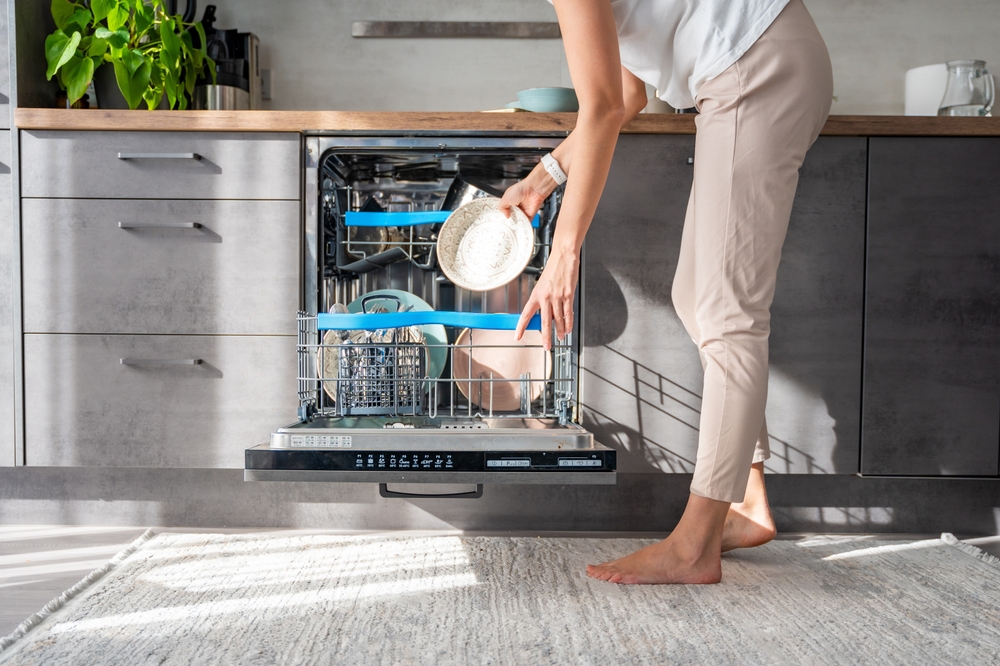

The advice has been around for years: skip the pre-rinse. Appliance technicians say it, dishwasher manufacturers print it in their manuals, and yet the faucet runs every night in millions of kitchens while people rinse plates that are about to go into a machine specifically designed to do that exact job. It is one of those domestic habits that spread without ever being examined – passed down at the kitchen sink rather than learned from anyone who understood how the machine worked.
The problem is that pre-rinsing is not just unnecessary. It is demonstrably counterproductive. Appliance repair technicians have been saying so for years, and the manufacturers of both dishwashers and detergents agree. But because no one loves being told that a habit they have performed thousands of times is working against them, the pre-rinse ritual persists, wasting water, wasting time, and in a specific and almost poetic way, making the dishes less clean than they would have been if you had just walked away.
Here is what’s actually happening inside your dishwasher, why your instinct to rinse first is sabotaging the machine, and what to do instead.
The Tiny Sensor That’s Running the Show
Your dishwasher is not simply filling with water and spraying everything until the timer goes off. It is reading the situation. Most modern dishwashers have a built-in food sensor that detects how much food is on the dishes, which signals to the machine how long the cycle should run and at what water temperature. That sensor is the reason the appliance can clean a full rack of dinner plates caked with pasta and a single rinsed glass in the same load – or at least, that is what it’s designed to do.
The turbidity sensor measures how murky the water is inside the tub during a wash cycle. Turbidity is just a technical word for cloudiness – how many particles are suspended in the water at a given moment. During the washing cycle, water enters the dishwasher and the sensor is activated; it emits light, usually infrared, which is directed into the water, and that light scatters when it encounters particles like leftover food or grime. The murkier the water reads, the more aggressively the machine works.
Think of the turbidity sensor as the difference between a one-size-fits-all wash and a custom clean. Without it, your dishwasher would run the same cycle every time – a single cereal bowl and a casserole dish caked in baked-on food get the same treatment. With the sensor, your dishwasher can adapt to the mess. It is a genuinely clever piece of engineering. The machine calibrates itself based on what you put in it. The only thing that breaks this system is loading it with dishes that are already mostly clean.
What Happens When You Pre-Rinse
Ian Palmer-Smith, an appliance repair expert at Domestic & General, told HuffPost that when you rinse the dishes off first, the dishwasher isn’t going to run as heavy a cycle as it would otherwise – which can cause grime still stuck on dishes to not be cleaned off as well. The sensor reads clean-looking rinse water, concludes the load is light, and adjusts the cycle accordingly. If you then have even one or two items with baked-on residue that survived your pre-rinse, those items may come out of the dishwasher still dirty, because the machine ran a light cycle based on misleading information.
If your dishwasher was made in the last 20 years, it likely has one of these sensors, according to appliance repair expert Lee Gilbert, founder of appliance parts retailer Ransom Spares. The user manual will typically list features, including whether the machine has a food sensor – look for terms like “soil sensor,” “auto-sensing cycle,” or “smart sensor technology.” If your settings menu has an “Auto” or “Sensor Wash” cycle, that is your signal.
The effect is maddeningly circular: you rinse the dishes to help the machine, the machine sees clean dishes and runs a shorter cycle, and the one pan with stuck-on residue comes out as dirty as it went in. You then rewash it by hand, which is exactly the outcome the dishwasher was supposed to prevent. The turbidity sensor is designed to continually assess water clarity, modifying cycle length to guarantee that dishes come out impeccably clean – but only if you give it accurate data to work with.
The Detergent Problem Nobody Talks About
The sensor is only half the story. The detergent you are using was also designed for dirty dishes, and pre-rinsing undermines it in a separate and equally counterproductive way.
Enzymes in dishwasher detergent are specifically designed to attach to and break down food particles. These biological catalysts target specific types of food residue: amylases break down starches from foods like potatoes and pasta, proteases tackle protein residues from meat and dairy, and lipases dissolve fats and oils from butter and cooking grease. These are not generalist cleaners. They are targeted compounds that latch onto specific molecules and dismantle them.
According to Cascade, the enzymes actually work better if you don’t pre-wash your dishes, because without food to attack, their cleaning power is underutilized. Strip the dishes clean before loading them and the enzymes have nothing to target. They do not simply wait for the next cycle – they rinse away with the water, having accomplished nothing. Appliance repair experts frequently find that customers who pre-rinse excessively experience more issues with cloudy glassware and white film on dishes, because the powerful detergents continue working even without food particles and sometimes begin attacking the dishware itself.
So the pre-rinse does not just fool the sensor. It also destabilizes the chemistry. You spend time at the sink, run the water, and in exchange receive dishes that are potentially cloudier than they would have been if you had done nothing at all.
The Water Math Is Not in Your Favor
Beyond the mechanical and chemical arguments, there is a straightforward resource calculation that makes pre-rinsing very hard to defend. Letting your faucet run for five minutes while washing dishes can waste 10 gallons of water and uses enough energy to power a 60-watt light bulb for 18 hours, according to the U.S. Environmental Protection Agency. Most people rinse more than five minutes’ worth of dishes in an average household load. Multiply that by seven nights a week and the numbers become genuinely startling.
Today’s dishwashers consume less water and energy than older models, often using less than 3 gallons of water per wash cycle. Running the tap to pre-rinse can easily consume more water than the machine uses for the entire wash. The pre-rinse, in other words, often uses more water than the dishwasher itself. The appliance you bought to save time and resources is being lapped by the habit you have before you even turn it on.
What You Actually Should Do
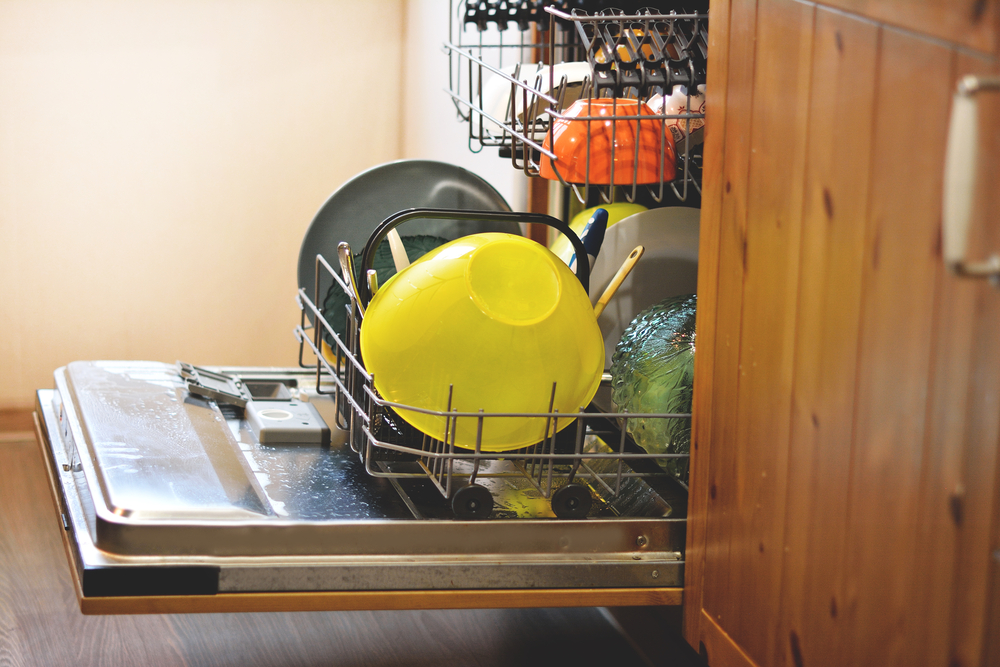
The correct move is not complicated, but it does require overriding a habit that probably feels deeply ingrained. Major manufacturers including Whirlpool, GE, and Jennair all specify in their owner’s manuals to remove food particles, bones, toothpicks, and excessive grease, and to scrape off hard soils – but the instruction is consistently to scrape, not to rinse. The distinction matters. A spatula or paper towel over the trash takes five seconds and does not run water. That is the move.
For dishes that have been sitting for several hours and have dried food on them, the right step is to leave them in the machine longer, not to pre-rinse them. Some dishwashers have a soak setting for exactly this reason. If yours does not, loading the machine with dried-on food and running a normal cycle will generally still produce cleaner results than pre-rinsing, because the sensor and the enzymes are both working as designed.
Loading the dishwasher correctly matters more than most people realize once you take pre-rinsing out of the equation. Blocking the spray arms or the detergent dispenser with tall items reduces cleaning performance significantly regardless of how dirty or clean the dishes are going in. Pots and pans belong on the bottom rack with their soiled surfaces angled toward the spray arm. Glasses and bowls go on the top rack. Nothing should be nested so tightly that water cannot reach the interior surface.
The filter also needs attention, and most people have never cleaned theirs. Cleaning the dishwasher filter monthly makes a significant difference to cleaning performance – appliance experts recommend cleaning it about once a month, which includes emptying out the food trap and giving it a wipe-down, because it only takes a few minutes but is key to keeping the dishwasher working properly long term.
Hot Water and Detergent Quality
Two other variables come up repeatedly among appliance technicians as reasons dishes do not come out clean, and both are easy to address. The first is water temperature. Dishwashers draw from your home’s hot water line, and if that line runs cold at first – as it does in most houses where the kitchen sink is far from the water heater – the machine can start its cycle with water that is not hot enough to activate the detergent enzymes properly. Running the kitchen faucet until the water turns hot before starting the dishwasher solves this. You are not rinsing dishes; you are priming the water line.
The second variable is detergent quality. Not all formulations are equal. Some dishwasher detergents contain enzymes, specifically amylase and protease, that digest proteins and starches by breaking them down into smaller pieces, similar to how stomach enzymes begin digestion. After the detergent starts that breakdown process, the dishwasher rinses away the remaining debris, and the dishes emerge clean. Budget detergents that rely on bleach and alkaline builders rather than enzymes do not benefit from dirty dishes in the same way – but they also do not perform as well on stubborn food soils. If your dishes consistently come out with residue, switching to an enzyme-based detergent before blaming the machine is worth trying.
A Habit That Has Had a Good Run
There is something genuinely difficult about unlearning a domestic habit, especially one that came from someone you watched do it for years. The pre-rinse was not irrational – it made sense with older machines and older detergents, when the chemistry was simpler and the engineering less sophisticated. The behavior had logic once. It just kept going long after the technology outpaced it.
The good news is that stopping is a genuine subtraction from your evening routine, not an addition. You are not replacing the pre-rinse with something else. You scrape the plate, put it in, close the door. The machine does the rest, and it does it better without your help than with it. Every habit that gets to retire as a net gain is worth acknowledging, even if the thing being retired is as unglamorous as standing at the kitchen sink with a running faucet before loading the dishwasher.
The dishes will be cleaner. The water bill will be lower. And whatever those five minutes were costing you every night can go somewhere else entirely.
AI Disclaimer: This article was created with the assistance of AI tools and reviewed by a human editor.