

Joyce Hanna was 40 years old when she read a book about aerobics and decided to go around the block. She didn’t know she was starting something. Fifty years later, at 90, she is still at it: six days a week, Peloton bike on alternating days, free weights on the others, all of it building on itself for half a century. Her greatest fitness achievement, she has said, isn’t the marathon she ran in three hours and twenty minutes at 45. It’s that she is still exercising and still enjoying it.
A senior workout routine doesn’t have to be dramatic in any individual session. It has to be consistent across years, and ideally decades. The four moves that form the core of Hanna’s routine aren’t exotic. They’re the same categories exercise scientists keep arriving at independently: cycling-based cardio with intervals, strength training with free weights and machines, stretching, and the daily accumulation of effort across years.
Parade.com first reported Hanna’s story and workout specifics. The precision of her routine (three days cycling, three days weights, stretching woven into both) maps cleanly onto what current exercise science recommends for adults her age. The CDC recommends aerobic activity, muscle strengthening, and balance work each week for adults 65 and older. Hanna has been doing the precise thing, without interruption, for five decades.
1. HIIT Cycling on a Stationary Bike

Hanna rides a Peloton bike for at least 30 minutes three times per week. Each session includes HIIT intervals (alternating between short bursts of intense effort and brief rest periods) followed by five minutes of stretching. The stationary bike delivers cardiovascular work without putting the joints under the kind of compressive load that running accumulates. You get the metabolic benefits without the road rash.
HIIT asks the heart and lungs to work at elevated intensity for short periods, then recover. Heart and lung functioning decline with age, and improving cardiovascular fitness can lower the risk of heart disease, hypertension, diabetes, and stroke. Cycling three times a week keeps those systems in conversation with real effort. The five minutes of stretching that follow each ride maintain the flexibility that allows her to get on the bike in the first place.
Hanna doesn’t cycle every day. She alternates, which gives her cardiovascular system a challenge and her musculoskeletal system a day of relative rest. At 90, recovery isn’t optional. It’s structural. A senior workout routine that doesn’t build in recovery isn’t sustainable.
2. Strength Training With Free Weights and Machines

Hanna focuses on strength training three times per week for 30 to 60 minutes each session. Free weights at 90. Machines at 90. Three times a week, for up to an hour.
Resistance training has been shown to lower blood pressure for people 60 and over, according to a 2025 meta-analysis published in Archives of Gerontology and Geriatrics covering 51 randomized controlled trials. A 2024 study in the International Journal of Epidemiology found that any amount of weight training lowered all-cause, cardiovascular, and cancer mortality for people with an average age of 70. Any amount. The evidence doesn’t require a specific program or a certain number of sets. It just requires doing it.
Muscle loss with age, known as sarcopenia, accelerates if you stop challenging your muscles. Bone density follows a similar pattern. Neither is inevitable, but both require active maintenance. Hanna’s three weekly sessions address both. Free weights also require balance and coordination that machines don’t. The body has to stabilize itself, which trains systems well beyond the muscle being loaded. For an older adult, that integration is where much of the functional benefit lives. The body that can pick up a dumbbell can usually also catch itself on an uneven sidewalk.
3. Stretching (Built Into Every Session, Not Bolted On)
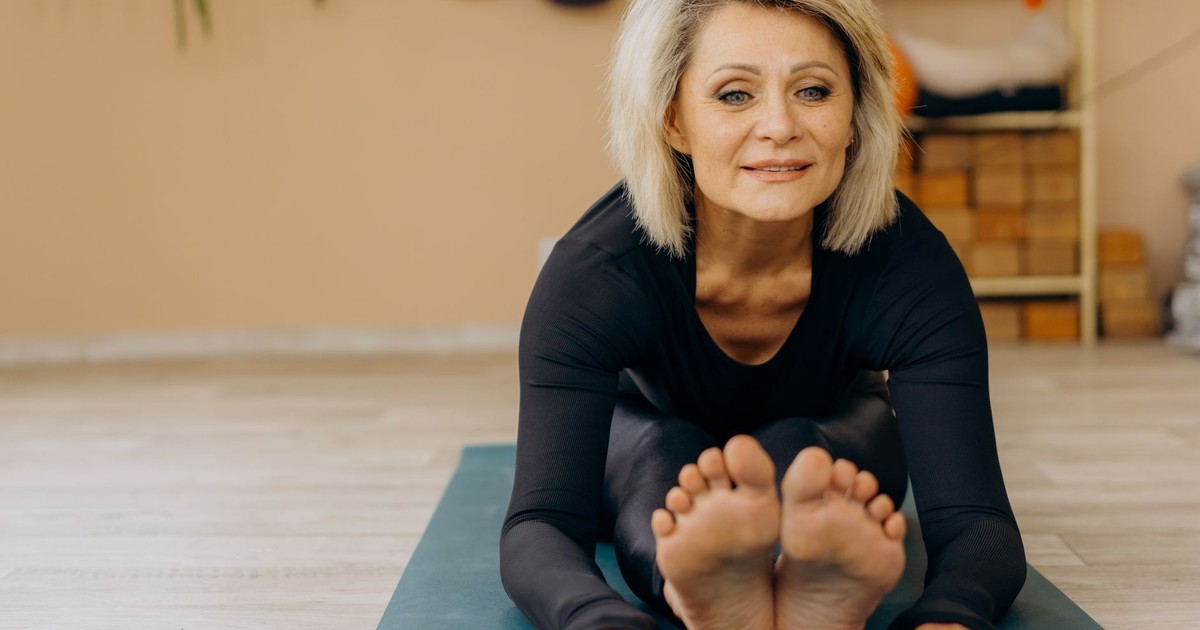
Hanna doesn’t treat stretching as an optional five-minute extension she’ll do if she has time. It’s embedded directly into her cycling sessions, and it’s a logical part of a strength routine that’s now spanned 50 years.
A well-rounded senior workout plan includes strengthening, flexibility, and balance activities: abdominal contractions, wall push-ups, daily stretches, and single-leg balance holds among them. Flexibility isn’t just about touching your toes. It’s about whether you can reach something in a high cabinet without your shoulder seizing, whether you can get in and out of a car without a production, whether your stride stays long enough to clear a curb. At 90, those capacities determine independence.
Without consistent stretching, a gradual shortening and stiffening becomes self-reinforcing. Tight muscles pull on joints. Altered movement patterns create compensation. Compensation creates injury. Injury creates a rest period. And a rest period, at 90, has a different cost than it does at 40. Hanna’s insistence on stretching as a fixed part of every cycling session is evidence of someone who has understood this for decades.
4. Six-Day-Per-Week Consistency (The Move That Makes the Other Three Work)

Hanna aims for six workouts per week at 30 to 60 minutes each. This is the fourth move, and it is the one that operates as the foundation for everything else. It’s not a specific exercise. It is the practice of not stopping.
For adults 65 and older, the CDC recommends aerobic, muscle-strengthening, and balance activities each week, with the baseline set at at least 150 minutes at moderate intensity (which could be as straightforward as 30 minutes a day, five days a week). Hanna does more than that, but the principle is the same: frequency is not the enemy of longevity. Inactivity is.
Six days a week sounds like an extreme commitment when you’re 40 and trying to wedge a workout between school pickup and a 7 p.m. deadline. At 90, with a lifetime of habit behind her, it sounds like what Monday looks like. She didn’t decide at 88 to get serious about fitness. She decided at 40, kept the appointment with herself for five decades, and now the discipline has become part of her identity rather than something she has to summon anew each morning. The research on longevity habits consistently returns to this same finding: it’s not the intensity of any given effort. It’s the weight of years of effort, compounded daily.
Hanna notes that her routine reduces stress, provides energy for daily demands, and improves her sleep quality. Those are the returns on 50 years of consistent investment.
What Joyce Hanna Actually Teaches Us

To fellow seniors, Hanna’s advice is: “Keep moving and get on a schedule that you can live with.” That’s not the advice of someone who ran on unusual talent. That’s the advice of someone who figured out the only actual secret, which is that there isn’t one.
The four moves she follows (cycling intervals, strength work with real weights, consistent stretching, and six days a week of deliberate effort) are not a performance of extreme fitness. They are a maintenance program built over half a century, with each component earning its place because it does something the body needs. None of them require youth. None of them require a specific machine, a gym membership, or a starting fitness level that most people don’t have. They require a decision and enough patience to let the habit form.
Disclaimer: This information is not intended to be a substitute for professional medical advice, diagnosis, or treatment and is for information only. Always seek the advice of your physician or another qualified health provider with any questions about your medical condition and/or current medication. Do not disregard professional medical advice or delay seeking advice or treatment because of something you have read here.
AI Disclaimer: This article was created with the assistance of AI tools and reviewed by a human editor.