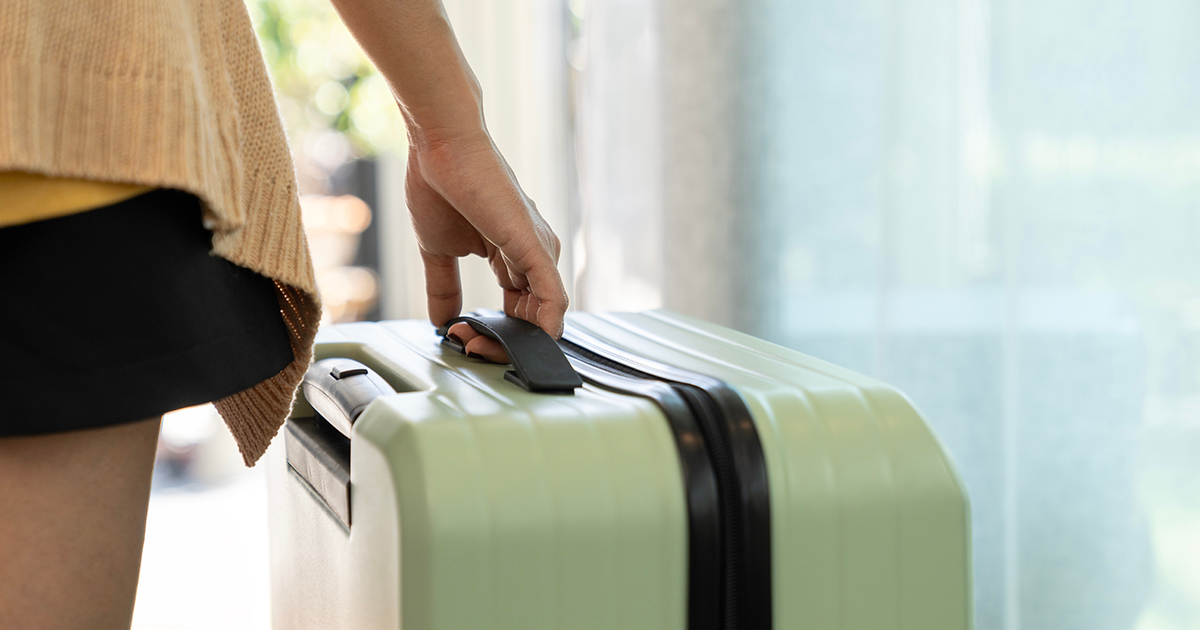

Packing light has never stopped anyone from packing a little folklore alongside the sunscreen. Before most modern travelers even think about carry-on restrictions, people around the world are already consulting older, stranger systems of preparation – ones that have nothing to do with travel insurance and everything to do with what their grandmothers told them about spirits, thresholds, and the specific bad energy that can follow you through a border crossing.
Travel superstitions are easy to dismiss until you’re standing in an airport at six in the morning, deeply aware that your flight is on a Friday and you forgot to do the thing. That’s the particular power of inherited ritual: it doesn’t ask you to believe in it intellectually, only to feel the faint unease of skipping it. People in Serbia and Mexico and Norway arrived at remarkably similar forms of pre-departure protection completely independently.
What follows are eight of the most enduring travel superstitions from around the world, where they came from, and why the logic behind most of them holds up better than you’d expect.
1. Packing Garlic (The Balkans, Mediterranean, and Beyond)

The carry-on item nobody wants to sit next to has been considered essential travel protection across a wide swath of the world for thousands of years. In Bosnia and Herzegovina, Greece, and Italy, slipping a clove of raw garlic into your luggage is a practice with genuine historical depth, rooted in the belief that garlic guards against the “evil eye” – the harm that comes from being envied or ill-wished by someone you encounter along the way. Border crossings, in particular, have long been considered high-risk zones, spiritually speaking: places where you are scrutinized by strangers, often stressed and visibly anxious, and therefore especially vulnerable.
According to ancient Greek sources recorded by Theophrastus, garlic was placed by the ancient Greeks on stone piles at crossroads as an offering to Hecate, goddess of magic and the night. The reasoning was that garlic placed at crossroads protected travelers from evil spirits and disoriented demons. The crossroads has always been a liminal space – neither here nor there, a place of transition – and travelers moving through unfamiliar territory were understood to be in a similar kind of in-between state, exposed and needing protection.
The tradition of carrying a garlic clove appears across Latin American households as well, particularly in parts of Mexico. According to the USC Digital Folklore Archives, families carry a garlic clove in their pocket specifically to prevent mal ojo – the evil eye. The garlic absorbs whatever bad energy or ill wishes are sent your way during the journey; by the time you return home, it has dried and shriveled. The drier it is, the more it has absorbed.
2. Sitting on Your Suitcase Before You Leave (Russia and the Slavic World)

Few travel rituals are as immediately recognizable – or as genuinely eerie to witness for the first time – as this one. Known in Russian as “sidet’ na chemodanakh,” or “sitting on suitcases,” it is an ancient custom familiar to anyone who grew up in Russia, a former Soviet country, or a diaspora household that maintained the tradition.
The informal rules are precise: dressed to leave, luggage packed and at the door, everyone – both the traveler and those seeing them off – sits in complete silence for a few moments before standing up to go. There’s no small talk. There’s no checking of phones. You sit, you think, and then you leave. The origin of the custom lies in pre-Christian Russia, where it was believed that your fortunes were influenced by house spirits. If you crossed the threshold to begin a journey and then returned to retrieve something you had forgotten, the spirits would be offended and spoil your trip. Taking a moment to sit and think, therefore, helped you call to mind any forgotten item before you crossed that line.
Another interpretation held that the pause would trick bad domestic spirits into believing you weren’t actually leaving, so only the good ones would accompany you on your journey. In practice, the ritual also functions as a genuinely useful moment of mental stillness before the chaos of travel kicks in.
3. “Tvi Tvi” – The Friendly Curse (Norway)

The concept of wishing someone luck by cursing them sounds like something you’d have to explain at length, and yet Norway has been doing exactly this for centuries without anyone finding it confusing. “Tvi, tvi” – an onomatopoeia that mimics the sound of spitting – was used to put a friendly curse on someone you liked. The logic was simple: if somebody had already cursed you, evil spirits had no reason to bother you. It was typically used as a warm send-off, specifically for someone about to begin a journey.
The spitting aspect is not just verbal. The full ritual involves spitting three times over your shoulder, which in Scandinavian folk tradition signals to malevolent forces that you have already had your share of bad luck and have nothing left worth targeting. It operates on the same psychological framework as the English theater phrase “break a leg” – you linguistically preempt disaster by pretending it has already arrived.
4. Throwing Water Behind a Departing Traveler (Serbia, the Balkans, and the Middle East)

If you’ve ever felt the impulse to dramatically splash water after someone leaving your home, it turns out there are cultures where this is both appropriate and actively encouraged. Across Serbia, the broader Balkans, and parts of the Middle East, tossing water behind someone as they leave is considered a blessing. Water represents ease and flow, so splashing it on the ground behind a departing traveler is meant to ensure their journey goes as smoothly as running water moves.
Serbians consider this a cause for celebration rather than alarm. According to the custom, spilling water behind a person going on a trip – or even to a job interview – will bring them luck and ensure everything ends happily. The water must always be thrown behind the traveler, not in front of them or over them. It follows them out into the world, a liquid escort for the road ahead.
The symbolism connects to much broader cultural attitudes toward water as a life force, an element associated with purification, continuity, and the removal of obstacles. Across many traditions, water is what things flow through – rivers carry you somewhere, rain nourishes, water cleanses. Sending it after someone you love is, in a way, sending them ease. You can also read about unlucky plants through a similar symbolic lens: objects in the home and objects carried on a journey have always been understood as carriers of fortune or misfortune, and people have organized their spaces accordingly for millennia.
5. Never Depart on a Friday (Europe and Maritime Tradition)

Friday has had a public relations problem for centuries. Friday’s reputation as an unlucky day transcends cultures, and it extended particularly to sailors and travelers, who regarded it as a day of bad omens due to its association with the crucifixion of Jesus Christ. This is one of the few travel superstitions that left a paper trail: in the 19th century, Admiral William Henry Smyth described Friday in his nautical lexicon The Sailor’s Word-Book as the “Dies Infaustus” – meaning “unlucky day” – a day on which experienced seamen were strongly disinclined to set sail.
The fear of Friday departures was not limited to sailors. Maritime tradition spread it to broader European travel culture, and it eventually evolved into specific anxieties around Friday flights, Friday road trips, and Friday embarkations of any kind. The superstition became so entrenched in seafaring communities that it gave rise to the legend of HMS Friday – a ship supposedly built on a Friday, captained by a man named Friday, launched on a Friday, and never heard from again. Naval historians have found no evidence it existed, which has done precisely nothing to diminish the story’s appeal.
Thursday, named after Thor, the god of storms, was also considered ill-fated for setting sail. Most superstitious sailors believed that Sunday was the only genuinely auspicious day to begin a voyage.
6. Unlucky Numbers on the Road (Italy and East Asia)

Most travelers are aware that some hotels skip the 13th floor. Fewer know that this number anxiety extends to specific travel dates and aircraft rows in ways that vary dramatically by country – and that two of the most deeply held numerical superstitions have nothing to do with 13 at all.
Many Italians believe the number 17 to be an anagram for VIXI – a Latin phrase meaning “I have lived,” understood as a symbolic indication of death. As a result, they avoid traveling on the 17th day of the month and regard that date with roughly the same dread that many Americans associate with Friday the 13th. It is a curiously rational basis for a superstition: not a vague feeling that the number is bad, but a specific interpretive chain from Roman numerals to a death announcement.
In East Asia, the number four carries similar weight, though for phonetic rather than visual reasons. In Mandarin, Cantonese, Japanese, and Korean, the word for “four” sounds close to or identical to the word for “death.” On some Air China flights, there is simply no row 4. Hotels in mainland China, Hong Kong, Japan, and South Korea regularly omit not just the 4th floor but any floor containing the digit – so no 14th, 24th, or 34th floor either. For travelers moving between cultural contexts, the number four goes from neutral to ominous the moment the plane touches down.
7. Never Go Back for Something You Forgot (Multiple Cultures)

This one operates on a more universal level of unease. Across Russia, the Slavic world, Turkey, and parts of Latin America, returning home after you have already crossed the threshold to begin a trip is considered seriously bad luck. If you forgot your phone charger and your departure was five minutes ago, many traditions hold that you are better off buying a new one at the airport.
The logic connects directly to the house-spirit beliefs that gave rise to the “sitting on suitcases” tradition. In pre-Christian Russia, crossing the threshold to start a journey and then returning for something you forgot was thought to offend the house spirits, who would then spoil your trip as punishment. The ritual of sitting quietly before leaving was partly designed to prevent exactly this situation by helping you mentally account for everything before you crossed that line.
In Turkish folk tradition, the same prohibition exists, and if you absolutely must return, you are supposed to sit down inside the house, look in a mirror, or make a specific gesture before leaving again – essentially resetting the ritual so the spirits understand that this return does not count as a real departure. The variations are different, but the underlying belief is consistent: the moment you step across the threshold with intention, you have entered a new and vulnerable phase of the journey. Going back disrupts something that was already set in motion.
8. Don’t Sweep the House While Someone Is Traveling (Caribbean, Latin America, Eastern Europe)

This superstition plays out after the traveler has already left, which gives it a slightly different character from the others on this list. It falls to the people who stayed behind. In several cultures, sweeping immediately after a traveler has left home is considered bad luck. Traditions in parts of the Caribbean, Latin America, and Eastern Europe suggest that sweeping too soon after departure could symbolically remove the traveler’s luck or even affect their safe return.
The logic here is about residue, in the most non-gross sense of the word. A person’s presence in a home leaves something behind – their energy, their footsteps, whatever invisible trace distinguishes a room they’ve been in from one they haven’t. Sweeping that away before they’ve had a chance to get wherever they’re going is understood as sweeping away their connection to home, the thing that ensures they can find their way back.
The practical side of this is quietly reassuring: it is a tradition that gives grieving families something not to do. When someone you love has just left for a long trip, or even a short one, the impulse to busy yourself with chores is strong. Several cultures looked at that impulse and said, specifically regarding the broom: not yet. Wait until they’re safe.
What All of This Is Really About
The thread connecting garlic cloves in luggage to Norwegian spitting curses to Serbian water rituals is not irrationality. It is the very reasonable human recognition that travel – even in the age of GPS, real-time flight tracking, and airline apps that tell you your bag made the connection – involves handing control over to systems and situations and people you cannot manage from the inside. The ritual gives you something to do with your hands when there is genuinely nothing useful left to do.
What’s more striking is how these travel superstitions almost all cluster around the same two moments: the departure and the threshold. Virtually every tradition on this list is concerned with the crossing, the goodbye, the exact instant when familiar ground ends and the unknown begins. That is the same moment people have been anxious about since before the word “travel” existed, when every journey was long and uncertain and the probability of returning was not something you could look up on your phone. We have inherited these rituals from people for whom the stakes were real and the fear was reasonable. Using them now is not about believing in house spirits. It is about honoring the seriousness of what it means to leave, even when the flight is two hours and the destination has good Wi-Fi.
Some of these traditions have outlasted the civilizations that invented them. The garlic is still in the bag. The water still hits the pavement. The house is still not being swept. None of that is foolishness – it is, in the most human way possible, people trying to hold on to the people they love for one more second before the door closes. You don’t have to believe in house spirits to understand why someone would want to.
Disclaimer: This information is not intended to be a substitute for professional medical advice, diagnosis, or treatment and is for information only. Always seek the advice of your physician or another qualified health provider with any questions about your medical condition and/or current medication. Do not disregard professional medical advice or delay seeking advice or treatment because of something you have read here.
AI Disclaimer: This article was created with the assistance of AI tools and reviewed by a human editor.