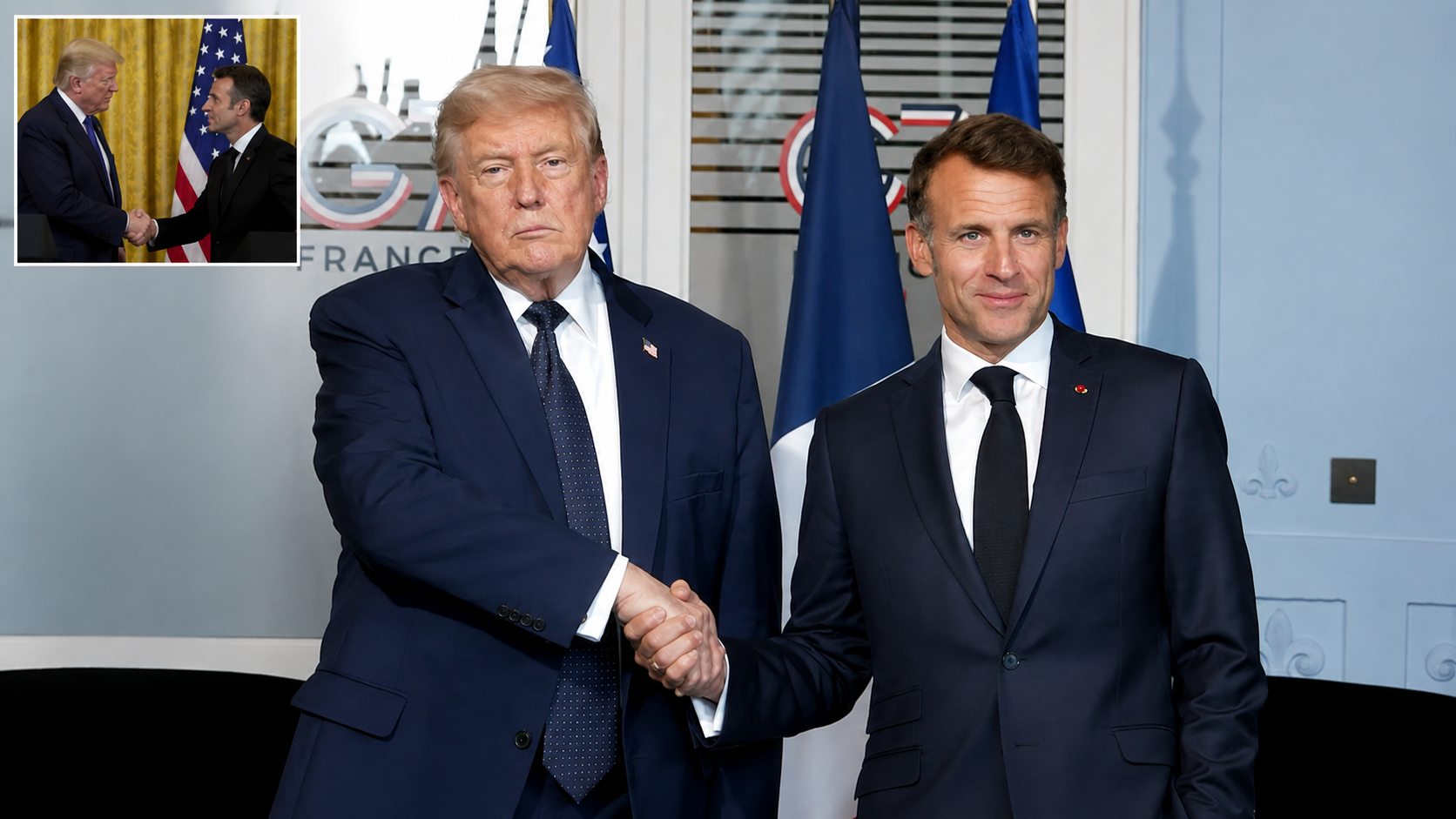

Every world leader learns fast that cameras catch everything, including the two seconds before the handshake begins. At the G7 summit in Évian-les-Bains, France, on June 15, 2026, Donald Trump closed his eyes just before reaching for Emmanuel Macron’s hand. That half-second detail, barely a blink in the footage, is what body language experts couldn’t stop talking about.
The exchange was strange not because it was combative or tense, but because it was almost nothing at all. Given everything these two men have made of a handshake over nearly a decade, that flatness read louder than any grip could. The two men who once turned a bilateral greeting into a knuckle-whitening contest of will had, without explanation, stopped playing the game – at least on one side of the clasp.
The footage spread quickly. Part of why it registered so hard is context: this wasn’t two strangers meeting awkwardly at a conference. This was Trump and Macron, whose handshakes have operated for years as a kind of diplomatic theater, each one scrutinized like a chess move executed in public.
What Actually Happened at Évian-les-Bains
Trump arrived at the Hotel Royal Evian for the G7, where he was first welcomed by U.S. Ambassador to France Charles Kushner before heading toward Macron for a bilateral meeting. What the cameras captured at that meeting was not the power move Trump is known for deploying.
According to HuffPost’s analysis, a great handshake usually has firm elbow pumps and sustained eye contact, but this one had neither. Trump’s wrist hung limply straight down while Macron reached upward to meet him. In the video, Trump also closed his eyes before taking Macron’s hand – and to the experts watching, that absence of eye contact indicated disinterest in the proceedings.
The closed eyes before the grip struck clinical psychologist and behavioral expert Denise Dudley as particularly telling. “God give me strength, I’m about to do this thing that I don’t want to do,” she said, putting words to what she read in Trump’s expression.
The Anatomy of a ‘Dead Fish’
Dudley explained that Trump “is literally hanging his hand downward,” which is what’s known as a “dead fish” handshake, where the other person is left to do all the work. In practical terms: Macron gripped upward while Trump’s wrist angled downward, leaving the French president to maintain an exchange that Trump barely participated in.
A dead fish handshake, in Dudley’s interpretation, signals a refusal to extend full energy and a pointed unwillingness to acknowledge the other person as an equal. It is not an accident of posture. It is a choice, whether conscious or not, to withdraw – to offer the shape of a handshake without its substance. “I’m not going to give you my full energy. I’m not going to acknowledge you as an equal,” she said.
Behavioral scientist Abbie Maroño agreed, calling it “a limp handshake for sure” and adding that “it felt so passive that it was disrespectful.” The lack of energy was especially notable to body language expert Traci Brown, given Trump’s usual style. “It’s off-brand for him,” Brown said. “His brand is power and force, and so this is the exact opposite of that.”
That contrast is almost impossible to ignore. Trump’s dominant handshake style has been so consistent, so deliberate, so publicly performed, that abandoning it in this specific meeting with this specific leader requires some kind of explanation – even if the explanation is one nobody’s comfortable spelling out.
A History of Hands
The same day as the limp grip with Macron, Trump held French First Lady Brigitte Macron’s hand for about 13 seconds, continuing to shake it as he spoke to the couple. The contrast between those two exchanges – one warm and sustained, the other passive and brief – did not go unobserved, and it was the juxtaposition, more than either handshake alone, that drove the story.
Trump and Macron have a documented history of physically intense greetings. In 2017, the pair shook hands for nearly 30 seconds at a NATO summit in Brussels, with Macron later telling a French outlet, “My handshake with him, it wasn’t innocent.” He clamped down and refused to be pulled. The knuckles whitened, the cameras stayed on them, and neither man broke first. In a 2025 meeting in Egypt, the pair locked into what observers called a tug-of-war grip lasting around 26 seconds, with Trump clamping down on Macron’s hand and the French leader pulling back sharply.
That Macron has consistently met Trump’s physical dominance with his own resistance made the 2026 G7 exchange even more conspicuous. This time, Macron reached upward and found nothing to push against.
Words Saying One Thing, Hands Another
Trump, at the same summit, referred to Macron as “a very special friend.” Behavioral scientist Maroño put it plainly: “This is a classic situation of words saying one thing and the body saying the other. And whenever the words and the body say different things, I always kind of lean towards what a body’s saying.”
When verbal and nonverbal signals split, most communication researchers will tell you the body is the more honest messenger. People manage their words carefully. They manage their posture and grip pressure considerably less so, especially in a moment that lasts less than three seconds and is being captured on camera from twelve different angles.
The handshake occurred one day after Trump’s late-night UFC fight celebration of his 80th birthday. Fatigue was floated as a possible contributing factor – Trump had spent the night on Air Force One before arriving in France. But body language analysts generally treated that explanation as incomplete. A closed-eyes pre-grip and a deliberately downward wrist are patterned behaviors, not the drooping of a tired man.
Trump’s public behavior has been a recurring subject of analysis, partly because his nonverbal style is so consistent in most contexts that any deviation becomes immediately legible as information.
The Diplomatic Context Behind the Grip
A handshake does not exist in a vacuum, and this one had a great deal of context swirling around it. According to ABC News, the G7 summit in France was the first time the leaders had met in person since the start of the U.S.-Iran war, which had reached its fifteenth week and continued to impact the global economy. The war had caught U.S. allies off guard, and some were unwilling to heed Trump’s requests for assistance, creating tensions between Trump and several G7 leaders.
France and the U.S. had been navigating a particularly layered set of disagreements. The U.S.-led war in Iran stood as one of the biggest points of contention between Trump and Macron. Last year, Macron had slammed Trump’s 20 percent tariffs on the European Union as “brutal and unfounded,” and the two leaders’ approaches to the war in Ukraine also differed significantly, with Macron joining forces with British Prime Minister Keir Starmer to form a “coalition of the willing” aimed at supporting Ukraine.
Trump publicly criticized Macron and other allies for not doing more to assist the U.S. in Iran. Speaking at a private event in April, he accused Brigitte Macron of treating her husband “extremely badly” – a comment that preceded the summit handshake by fewer than eight weeks and added its own layer of texture to the already complicated greeting.
The Weight Behind Three Seconds
The detail that’s hardest to dismiss about the Trump Macron handshake is the one that doesn’t read as performed: Trump closing his eyes. Nobody closes their eyes before a handshake as a power move. The yank-and-grab has a hundred practitioners. The dead fish is usually the province of the unconfident. That Trump, of all people, offered one to Macron of all people, at this summit of all summits, is the thing the cameras couldn’t stop showing.
Despite the tense backdrop, Trump was scheduled to have a private dinner with Macron at the Palace of Versailles at the end of the final day of the summit, and Trump acknowledged the invitation warmly, saying, “The French President, who happens to be a very nice man, invited me to dinner at Versailles.” So within the same seventy-two hours: a dead fish handshake with the president, a 13-second grip with the president’s wife, and dinner at one of the most famous palaces in the world. The Trump-Macron relationship has always resisted a single, clean narrative.
Some patterns go back further than any single summit. The 2017 Trump Macron handshake was a war of equals, and the 2025 Egypt follow-up was more of the same. The 2026 version looked more like a truce nobody announced – which, given everything else happening in that room that week, might be exactly what it was.
AI Disclaimer: This article was created with the assistance of AI tools and reviewed by a human editor.