

Both volumes of Lars von Trier’s Nymphomaniac are streaming on Netflix in the U.S., and its return to an easy, familiar platform has revived a warning that has followed the film since 2013: ‘Watch this one by yourself.‘ That advice has been around since its theatrical release. The warning itself is not new, but the fact that the message has not moved in over a decade suggests the experience has not either, which makes sense because it’s one of the most shocking movies ever made. So why does this movie come with a warning like that?
The movie’s name actually answers that on its own. The term nymphomania is used to classify someone who has an uncontrollable compulsion toward sex, and that is exactly what the film follows across 2 volumes and 8 chapters. It opens with a woman named Joe, found beaten in an alley. A man named Seligman brings her home, and she begins telling him the story of her life from her earliest sexual memories through decades of escalating need.
Von Trier committed to showing all of it, and the actors committed to performing it. Charlotte Gainsbourg, Stellan Skarsgård, Shia LaBeouf, Uma Thurman, Willem Dafoe, and Jamie Bell all signed on knowing exactly what the film would ask of them. Gainsbourg had already worked with von Trier on Antichrist and returned knowing this would push her further. Thurman had an Oscar nomination and decades of leading roles behind her, Dafoe had been working steadily since the mid-80s, and LaBeouf was at the height of his Transformers fame. None of them needed this film, and all of them chose it anyway.
That many recognizable actors do not sign on to a film this explicit unless the material justifies it, and their presence signals something the title alone does not. This is not exploitation. It is a serious film that happens to demand serious discomfort from its audience.
The critical response backed that up, but only partially. Volume I holds a 77% on Rotten Tomatoes while Volume II sits at 59%,. That split means the people who review films for a living could not agree on whether it held together from one half to the next. That kind of division usually fades once the noise around a release settles, but with Nymphomaniac, it never has. More than a decade later, new viewers on a different platform are having the same arguments.
If the reactions were a product of 2013’s cultural climate, they would have changed by now. But they haven’t. Which points to the film itself rather than the moment it landed in. Von Trier made something that keeps doing what it was designed to do, no matter when someone finds it, and everything that follows here pulls on a different part of that reaction, starting with the most obvious one.
What Makes This Film So Hard to Watch With Company
The scenes are usually the first thing people warn each other about, and the warning is earned. But it also forces a question that has followed the film just as long. Why do these scenes need to exist at all? Why do they need to look the way they do?
Von Trier was telling the story of a woman whose entire life is shaped by a compulsion she cannot control. He decided early on that the audience should not be able to look away from what that compulsion actually looks like. Softening the scenes or cutting around them would have given the viewer a way out. But the whole point of the film is that Joe never gets one.
The discomfort the audience feels isn’t incidental. It’s the mechanism. Von Trier built the film so that watching it puts you closer to Joe’s experience than any non-explicit version ever could. And critics noticed. Multiple reviews observed that the scenes are never arousing. They are funny, absurd, uncomfortable, sometimes terrifying, but they never let the viewer settle into a passive response, which is the one thing addiction never allows either.
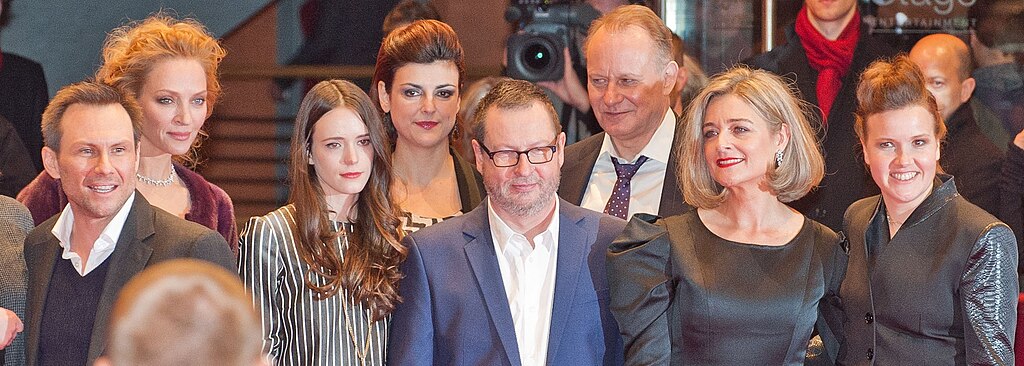
To make that work, von Trier needed a method that could put recognizable actors into scenes explicit enough to feel real without requiring them to perform those acts. Producer Louise Vesth described the technique to The Hollywood Reporter at Cannes. The actors performed from the waist up while body doubles, who were actually having sex, performed separately. The two layers were then merged digitally in post-production. So the audience can’t locate where one performer ends or another begins.
Von Trier had tested this technique in 2009 with the opening of Antichrist, using body doubles for Dafoe and Gainsbourg. But only for a single sequence. Nymphomaniac stretched it across the entire film, and the result is so convincing that audiences watching it for the first time had no way of knowing body doubles were involved at all. The detail only came out later when the production team explained the compositing process. Which means that for the full 4 hours, the viewer is watching Charlotte Gainsbourg, Shia LaBeouf, and Jamie Bell in what looks entirely real.
The MPAA gave the film an NC-17 rating in early 2014. Which is the highest rating a film can receive in the U.S. No one under 17 is allowed to watch it. Most major theater chains won’t screen a film with that rating. Most retailers won’t stock it, and an NC-17 shrinks a film’s audience before it even opens. Rather than cut it down to earn an R, the distributor surrendered the rating and released the film unrated altogether.
The version most Netflix viewers will encounter is the 4-hour theatrical cut released in two parts. That version was edited down to four hours by von Trier’s editors with input from the film’s stakeholders. With von Trier’s permission but without his direct involvement. He saw the 5-and-a-half-hour version as the complete film and reportedly approved the shorter cut without watching it, because he did not want to be the one to compromise it.
90 minutes were removed. Most of what came out was dialogue between Joe and Seligman rather than the explicit scenes. Which tells you something about what von Trier considered essential. The director’s cut, which Zentropa premiered at Venice later that year, is also on Netflix. Even the shorter version exceeded what the MPAA would allow. Which gives anyone weighing whether to press play a practical sense of what they’re walking into.
Most people know the feeling of watching a film with their parents when a sex scene comes on, and suddenly no one knows where to look. Multiply that by 4 hours, and you start to understand why people say to watch this one alone. But the real reason goes beyond embarrassment. The pressure of performing a reaction or managing someone else’s discomfort works against the kind of attention the film is asking for, and that attention is the point.
What Critics Say the Film Is Really About
The surface reading is addiction, and the film commits to it fully. Joe calls herself a nymphomaniac, the structure follows escalating compulsive behavior from early experimentation through loss of control. Every chapter adds weight to a cycle she cannot break. But critics who sat with both volumes tended to land somewhere else.
What Joe is actually chasing is not sex but connection. Every encounter she describes to Seligman moves her further from other people rather than closer to them. Sex becomes the thing she reaches for because the thing she actually needs keeps slipping out of range. That distance between the act and the need behind it is where von Trier plants the real story. The compulsion is real, but the loneliness underneath it is what he keeps circling back to.
The film’s entire shape reinforces this. Joe tells her story, and Seligman keeps interrupting with analogies. Comparing her sexual history to fly fishing, to Bach compositions, to mathematical sequences, to theology. He is trying to make her experience legible by mapping it onto frameworks he already understands. The film keeps showing the audience how badly that fails. Joe is describing what it felt like to live inside a compulsion she could not stop. And Seligman keeps flattening it into metaphors he can hold at a distance. Von Trier stages that tension across both volumes so the viewer can feel how small someone’s experience becomes when another person tries to intellectualize it, which is exactly what the audience is also doing by watching.
That tension also carries a gender problem that critics have never stopped pulling apart. The entire plot rests on a woman confessing her sexual history to a man who then tries to absolve her of it. Eric Sasson, writing for The New Republic, asked why female sexuality still needs male permission to exist on screen without shame. The framing is not neutral. Joe speaks, Seligman interprets. And the power to define her experience sits with the listener rather than the person who lived it.
Other critics argued that von Trier built this dynamic on purpose. That he wanted the audience to notice it and push back rather than accept it as the film’s position. Both readings hold without canceling each other out. Which is part of why the film still generates the same arguments it did when it first screened over a decade ago.
Von Trier also threads his own history into the film in ways that are hard to miss. Seligman pauses Joe’s story at one point to insist that opposing Israel’s government as a political state is not the same as hating Jewish people. A distinction that mirrors the fallout from von Trier’s own remarks at Cannes in 2011. Where rambling comments about understanding Hitler got him declared persona non grata by the festival.
Joe’s refusal to apologize for who she is echoes von Trier’s refusal to soften his work for audiences who want something easier to sit with. Several critics read Joe as von Trier’s stand-in. The character closest to his own position. Which makes the film as much a self-portrait as it is a story about one woman.
The title promises one thing, and the film delivers another. Anyone pressing play expecting four hours of shock for its own sake will find that, but the shock is in service of questions the film has no interest in answering for you.
The Performances That Carry It
The film asks its audience to sit through things most films would cut around. None of that works unless the actors commit completely. Every performance in Nymphomaniac carries the weight of scenes that could easily tip into exploitation if the person on screen flinched. And no one flinches. In one of the most talked-about sequences in the entire film, Uma Thurman appears in a single chapter of Volume I as Mrs. H, the wife of a man Joe has been sleeping with, who shows up at Joe’s apartment with her children after the affair tears her family apart.
There is no sex in the scene. Thurman delivers a 7-page monologue that von Trier shot in near real time. Moving from composure to fury to grief without cutting away. What she does with it turns the chapter into the first moment where Joe’s compulsion becomes visible, not through Joe herself but through the damage it leaves on someone else. Critics compared her to Elizabeth Taylor in Who’s Afraid of Virginia Woolf. A film built almost entirely on two couples tearing each other apart through conversation in a single room. The comparison fits because Thurman does something similar in a fraction of the running time.
She later said the scene gave her more to work with than some roles give across an entire movie. When von Trier called with the part, Thurman’s baby was 3 weeks old, and she had not worked in nearly three years, but the material was strong enough on the page that she prepared it like a one-act play and flew to the set anyway.
Jamie Bell’s chapter in Volume II takes the film somewhere harder. He plays a man Joe visits for sessions rooted in physical domination and pain. His commitment to the role without softening any of it is part of why most viewers say this is where the film becomes difficult to watch. Bell first became known as a teenager playing the lead in Billy Elliot. A film about a young boy from a northern English mining town who wants to dance ballet. Nothing in that career prepared audiences for what von Trier asks of him here. The tonal shift between the two volumes drove a bigger wedge among critics for Volume II, and Bell’s chapter is where the divide kicks in.
The actors carrying the most screen time are the ones audiences have never seen before. Stacy Martin plays young Joe across most of Volume I and was completely unknown when von Trier cast her. Mia Goth, who has since become one of the most recognizable faces in horror through films like Pearl and MaXXXine, made her screen debut here, too. Building the most exposed roles around unfamiliar faces meant viewers could watch them without the distraction of celebrity. While the bigger names like Thurman, Dafoe, and Christian Slater arrive in concentrated doses around them. One chapter each, showing up at full intensity because the structure gives every recognizable face a limited window.
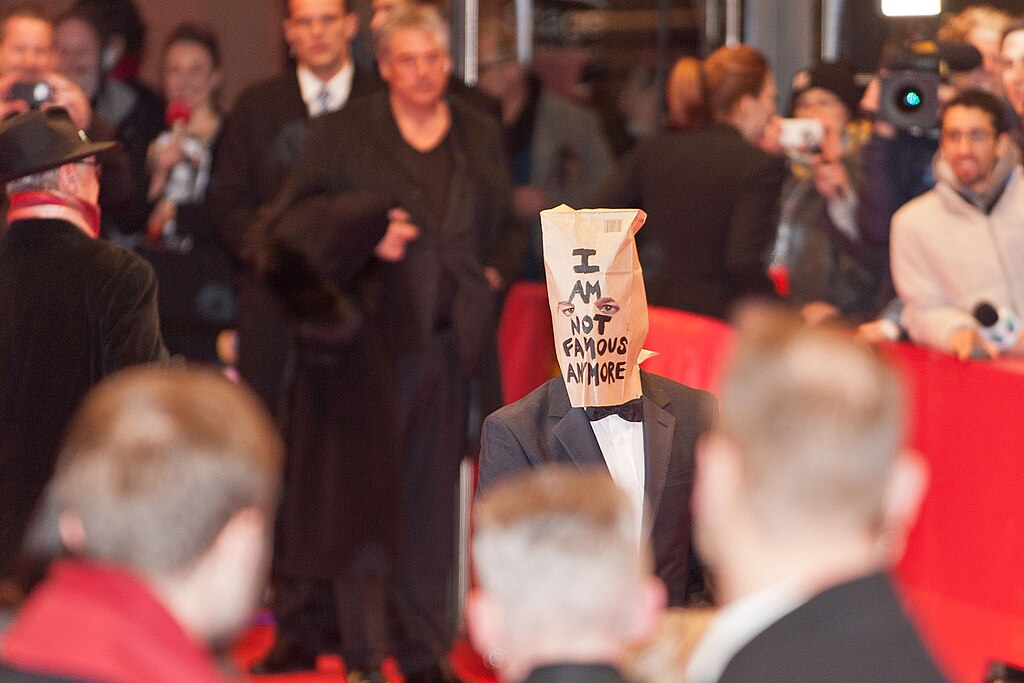
Shia LaBeouf got his role by sending von Trier a tape of himself having sex with his girlfriend. A detail that has been widely reported. It also tells you that the line between performance and reality was blurred before cameras ever started rolling. LaBeouf later told the press he found the experience terrifying. And that von Trier was dangerous in a way he wanted to be near. Almost every cast member who gave interviews about the film described the process in similar terms. Drawn to something they knew would be uncomfortable and choosing it anyway. Which is not far from what the audience does when they press play.
The other thing nobody expects from the film is how funny it is. Von Trier takes Seligman’s analogies and literalizes them on screen. So when Joe compares a lover to a cat, the film cuts to a fat tabby against a blue background, and when she corrects herself and says the man was more like a jaguar or a leopard, von Trier swaps in a leopard basking in the sun.
He called this technique “Digressionism,” a term he coined to describe a storytelling style that deliberately wanders away from its own plot. He cited Marcel Proust as an influence. Proust was a French novelist known for writing thousands of pages in which memory, association, and digression are the entire point rather than interruptions to it. The comparison is exactly the kind of reference that makes von Trier both infuriating and impossible to dismiss.
The humor never cancels out the discomfort. But it keeps the viewer from settling into any single register long enough to go numb. That tonal control across four hours is harder to pull off than the explicit content. It is the thing that actually holds the film together.
Where It Sits in Von Trier’s Work
Nymphomaniac is the final film in what von Trier and critics call the Depression Trilogy. Following Antichrist in 2009 and Melancholia in 2011. A film about a woman planning her wedding while a rogue planet drifts toward Earth. All three movies star Charlotte Gainsbourg and von Trier, made over a period where he was publicly struggling with severe enough depression to shut down production for months at a time. He has spoken in interviews about being unable to get out of bed. About needing medication to function on set, and about channeling that experience directly into the work rather than waiting until he felt better to make it.
That context sits underneath all 3 films. Antichrist follows a couple unraveling after the death of their child. Melancholia follows a woman so consumed by depression that she is the only calm person when the world actually ends. Nymphomaniac follows a woman who cannot stop reaching for something that keeps making her lonelier. Each film circles the same emptiness from a different angle. But Nymphomaniac is the only one where von Trier lets the central character sit down and try to explain herself, chapter by chapter, as if the act of telling the story might finally make it make sense.
When the uncut director’s cut screened at the Venice Film Festival in September 2014, three audience members fainted during a restored sequence and had to be carried out of the cinema. That detail has become part of the film’s reputation. It also gives some sense of what the theatrical cut left on the table. As mentioned earlier, the studio cut 90 minutes, removing mostly dialogue rather than the content that put people on the floor in Venice.
Von Trier considered the director’s cut his finished film, and he let someone else shape the theatrical cut because he refused to compromise it himself. For anyone deciding where to start, the theatrical cut of Volume I runs about 2 hours and works on its own as a way to test whether von Trier’s method works for you before committing to the full project. If it does, the director’s cut is where he intended the film to live.
More than a decade after its premiere, the film is doing the same thing to a new audience that it did to the first one. The same arguments, the same discomfort, the same split between people who think von Trier earned every frame and people who think he used shock to avoid making something cleaner. That split has not moved. The conversation around gender, power, and consent has changed considerably since 2013. But the film absorbs all of it and keeps generating the same friction.
If you have made it this far into an article about Nymphomaniac, you are probably the kind of viewer the film was made for. Watch it alone, start with Volume I, and see if you want to keep going. Von Trier built something that will not meet you halfway, and what it all means is a question he left for the audience to answer for themselves.
Read More: Controversial Horror Film Sparks Outrage, Leading To Its Ban In Six Countries