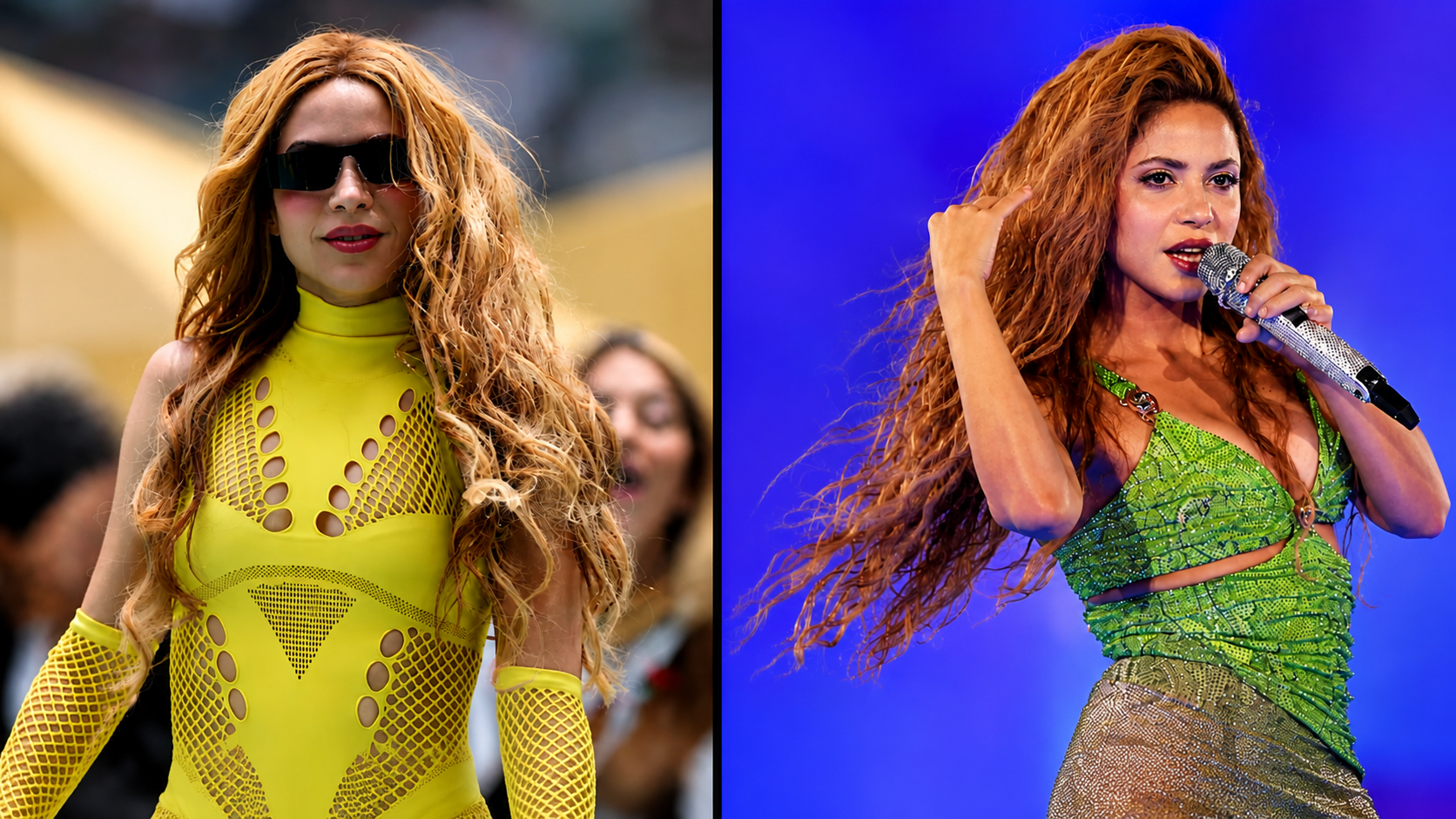

The internet has developed a remarkable ability to find a conspiracy in any high-definition footage of a woman, and Shakira’s Shakira World Cup performance at the 2026 FIFA opening ceremony on June 11 was not going to escape that particular tradition. She had barely left the pitch before social media was awash with a theory so confidently stated and so thoroughly unsubstantiated that it deserves its own trophy: that the woman who performed in front of 80,000 people at Mexico City’s Estadio Azteca was not, in fact, Shakira.
The theory spread with the speed and conviction that only the internet can produce. Screenshots were circulated. Jawlines were circled. Slow-motion clips were analyzed like they were the Zapruder film. Someone’s cousin who once saw Shakira in person weighed in. The verdict from a substantial corner of X and TikTok: the hips, notoriously, told a different story.
The actual performance was, by any reasonable measure, a spectacle. The Colombian superstar headlined the opening ceremony alongside Nigerian artist Burna Boy, and the pair performed “Dai Dai,” the official song of the 2026 FIFA World Cup, in front of more than 80,000 spectators ahead of the tournament’s opening match. Shakira came out first at the Estadio Ciudad de México wearing a bright yellow mesh bodysuit and matching gloves, delivering sharp dance moves as she sang her newest World Cup song. Burna Boy joined her halfway through the track, and the pair performed atop an enormous turquoise-and-yellow flag that covered the field, reading “We are ready.”
She’s Done This Before, and Then Some
To understand why the conspiracy theory landed with such force, it helps to understand the weight of expectation Shakira carries to a World Cup stage. She is not a performer who happens to have World Cup experience. She is, at this point, basically a fixture of the tournament itself.
Nicknamed the Queen of the World Cup, Shakira has been a frequent presence at the tournament dating back 20 years. In 2006, she and Wyclef Jean performed “Hips Don’t Lie” and “Bamboo” at the World Cup’s closing ceremony in Germany. In 2010, she contributed the official FIFA World Cup song “Waka Waka (This Time for Africa)” and performed it at both the opening and closing ceremonies in South Africa. Four years later, she returned to the 2014 World Cup to perform “La La La (Brazil 2014)” with Carlinhos Brown at the closing ceremony in Brazil.
The 2026 performance carried its own poetic parallel to 2010, because Shakira performed “Waka Waka” back then ahead of a match between South Africa and Mexico, the same two nations that faced off in Mexico City this time around. The Mexico City performance marked the fourth time the “Hips Don’t Lie” singer has contributed songs to the World Cup, and the 2026 event marked only her second official World Cup opening ceremony appearance, her first having been in South Africa in 2010.
That history is what turned a “she looked a bit different” observation into full-blown conspiratorial fervor. When the standard is iconic, anything less than iconic becomes evidence of fraud.
What Actually Sparked the Theory

Shakira ran onto the grass in a bright yellow top, white shorts, platform sneakers, and a huge pair of dark sunglasses that never left her face. Visually, this was not the barefoot Waka Waka Shakira of 2010. The look was sportier, more street, and crucially, half her face was covered. Her hair also skewed slightly lighter and redder than some fans expected from recent appearances.
On X and TikTok, users dissected screenshots side by side with older photos, circled jawlines and legs, and slowed down the choreography frame by frame. Upon first glance, fans noted that Shakira didn’t really look like herself, pointing out apparent differences in her face and body, including her height. The sunglasses, which never came off, became a focal point, with some claiming they were hiding Botox swelling.
For many online commenters, though, it all came down to the hips. The alleged body double didn’t seem to move as fluidly or energetically as Shakira is known to do. It all started when some viewers thought Shakira seemed to stumble in the routine, and that her movements seemed different from usual. From there, the speculation escalated in the way online speculation tends to: each new claim treated as confirmation of the last, the theory growing thicker with every repost.
One X user wrote: “She looked like a completely different person compared to a few weeks ago in Rio de Janeiro. IS THAT A BODY DOUBLE?” Another posted: “I’m crying, how is it that they’ve put Shakira’s stunt double at the inauguration?” Someone else quipped: “They slipped us the Temu Shakira!”
The “Shakibecca” Angle
The conspiracy theory was vivid enough on its own, but the internet, reliably, found a way to make it more specific. Some conspiracy threads attempted to connect the performance to Rebeca Maiellano, a Venezuelan Shakira impersonator known as “Shakibecca,” who has indeed worked in Mexico around the time of the tournament. The logic here is of a particular internet vintage: woman who looks like Shakira exists, therefore woman who looks like Shakira was secretly deployed to perform in front of 80,000 people and hundreds of high-definition cameras while FIFA, the artist’s entire team, and the global press corps said nothing.
A larger trend sits behind this specific claim: a persistent theory that a number of celebrities are not actually real at all, but have been replaced by body doubles, or even clones or robots in more elaborate versions. The Shakira theory fits neatly into that genre, down to the specific logic that physical differences visible on a compressed social media clip are more reliable than, say, the official record.
The Evidence Against It Is Pretty Straightforward
Official FIFA broadcasts and high-resolution stills all credited Shakira, not a mysterious stand-in. Outlets reviewing rehearsal footage on her own channels described consistent staging, costuming, and movement from practice to live show.
Then there’s the forehead. Shakira has a small scar on her forehead that is visible in numerous photographs taken over the years, including images distributed by the Associated Press from an event held in New York in May 2026, and the same mark is clearly visible in images from the World Cup opening ceremony. Many fans pointed this out directly, with one X user noting: “Days and days rehearsing just to send in a body double. She’s Shakira and she looks spectacular, and like anyone, she gets nervous and flubbed a step.”
One fan posted a video of Shakira rehearsing at the Estadio Azteca a day before the ceremony, writing: “Yeah, it was her. Yesterday she was rehearsing. She just looks a little different with that hair color.” The video was taken from Shakira’s own Instagram account and showed her in a black crop top and leggings. In the caption, she wrote: “It’s been a non-stop rehearsal week for us. We are ready!! Can’t wait to see you all tomorrow at the FIFA World Cup Opening Ceremony.”
Neither Shakira’s team nor FIFA has dignified the rumor with a statement, and there is zero credible sourcing backing the idea of a double, only speculation bouncing between platforms. Euronews, which reviewed the footage directly, concluded that the scenario requiring a body double would demand that the alleged stand-in had “spent months studying Shakira’s every move, learning her choreographies, copying her hairstyle and reproducing even the tiniest facial scar in order to fool millions of viewers and dozens of high-definition cameras.”
The Performance Itself: What Critics Actually Said
Away from the body double rabbit hole, the ceremony received its own mixed-but-more-grounded reception. The ceremony was criticized for lacking depth, with its cultural elements described as undercooked, though several Latin artists performed, including J Balvin, Danny Ocean, Belinda, and veteran Mexican rock group Maná, adding regional flavor to the event.
Shakira, to her credit, knows her way around a World Cup stage. Sixteen years after “Waka Waka” became one of football’s defining tournament songs, she returned to the center of the opening ceremony, but it was not another Waka Waka moment. Critics noted the song was polished but made more for the studio than the stadium, and the extended Afrobeats middle section drained energy from the performance.
The more generous verdict acknowledged what anyone who has seen Shakira perform across two decades already knows: she is, in any context, a formidable live performer. She executed the choreography of “Dai Dai” with her dancers before being joined by Burna Boy, and the duo ended the song with “Dale, allez, let’s go!” She is also set to co-headline the halftime show of the FIFA World Cup 2026 final on July 19 at MetLife Stadium in New Jersey, alongside Madonna and BTS. A body double with a schedule like that would deserve her own headline slot.
What We’re Really Watching
There is a specific kind of scrutiny that follows certain women onto every stage they ever stand on, one that treats aging, a different haircut, or a slightly off night as evidence of something sinister rather than evidence of being human. Shakira is 49, not 30. She has performed at more World Cups than her ex-boyfriend, Gerard Piqué, ever played in. She headlined an opening ceremony in front of 80,000 people with weeks of rehearsal documented on her own social media.
The body double theory does not really hold up to even a single moment of sober consideration, which is precisely why it spread so fast. The internet does not run on sober consideration. It runs on the brief, addictive dopamine hit of being the person who noticed something that everyone else missed. “Is that even her?” is a more thrilling sentence to post than “she seemed a bit tired.”
As Euronews noted in their review, it is of course always possible that the alleged double spent months learning Shakira’s every move, copied her hairstyle, and reproduced even her smallest facial scar to fool millions of viewers and dozens of high-definition cameras. Or, alternatively, that it was Shakira. They were inclined to go with the second option. After all, those hips don’t lie.
The Thing Underneath the Joke
The conspiracy theory is funny. It is also, if you pull it apart slightly, a little familiar. Women who have spent decades building something extraordinary tend to reach a point where the internet decides they have peaked and starts looking for evidence of decline. The comparison is always to their own past, to a version of themselves that was younger and which the internet has decided is the correct version. The woman on stage at 49 gets measured against the woman on stage at 33, and any gap becomes suspicious.
While a few fans attributed Shakira’s perceived change in energy to age, even more declared that’s never stopped her before. Also, she’s only 49. That sentence carries more weight than its tone suggests. “Also, she’s only 49” is its own small essay. The standard against which she was being judged was not what a 49-year-old performer looks like. It was what Shakira looked like at a World Cup when she was 33. No one can pass that test, because that test is designed to be failed.
The hips, for what it’s worth, do not lie. But the screenshots, the zoom-ins, the circled jawlines, and the confident X posts comparing a compressed phone-camera screenshot to a 15-year-old Getty image? Those, reliably, do.
AI Disclaimer: This article was created with the assistance of AI tools and reviewed by a human editor.